
Best Tree Fertilizer Spikes: 4 Formulas Compared

Jobe’s 16-4-4 Tree Spikes is the best tree fertilizer spike pick for most deciduous trees and shrubs because its 16-4-4 formula is made for all deciduous varieties.
Fertilizer spikes are solid, premeasured nutrients placed in soil near roots; match the product label to the tree type and application timing.
We earn a commission if you buy through links on this page. As an Amazon Associate I earn from qualifying purchases. Products are compared on manufacturer specifications, not hands-on testing.
- Best overall: Jobe’s 16-4-4 Tree Spikes – Made for all deciduous trees and shrubs and supplies 16-4-4 nutrients.
- Best for general feeding: SimplyGro 8-8-8 Tree & Shrub Spikes – An 8-8-8 formula is intended for trees and shrubs across several types.
| Product | Best for | NPK ratio | Intended plants | Pack size | Shop |
|---|---|---|---|---|---|
| Jobe’s 16-4-4 Tree Spikes | Deciduous trees | 16-4-4 | Deciduous trees and shrubs | 15 spikes | Check Price on Amazon |
| Jobe’s 15-3-3 Tree & Shrub Spikes | Twice-yearly feeding | 15-3-3 | Trees and shrubs | 9 spikes | Check Price on Amazon |
| SimplyGro 8-8-8 Tree & Shrub Spikes | Balanced nutrition | 8-8-8 | Trees and shrubs | 24 spikes | Check Price on Amazon |
| Winchester Gardens 15-10-9 Spikes | Larger gardens | 15-10-9 | Trees and shrubs | 70 spikes | Check Price on Amazon |
Tree Fertilizer Spikes Compared
Compare formulas, intended tree types and pack sizes before choosing a feeding plan.
Jobe’s 16-4-4 Tree Spikes

Jobe’s 16-4-4 Tree Spikes is the broad deciduous-tree option, with a 16-4-4 formula and 15 spikes per package. The maker says the spikes feed all season and deliver nutrients below the soil surface near active roots. Premeasured solid spikes avoid mixing or measuring, which can make placement simpler than liquid feeding. This formula suits deciduous trees and shrubs; it is not the targeted fruit-and-citrus choice in this group. Confirm the tree type and placement instructions on the package before applying, since species and size can affect how much fertilizer a tree needs.
Bottom line: Choose this for general feeding of deciduous trees and shrubs.
Jobe’s 15-3-3 Tree & Shrub Spikes

Jobe’s 15-3-3 Tree & Shrub Spikes distinguishes itself with a defined application schedule: apply twice a year, in early spring and late fall. Its 15-3-3 formula comes in a nine-spike pack, with premeasured doses intended to reduce measuring and overfeeding. The maker says nutrients reach active roots below the surface. It suits buyers who want a seasonal routine for trees and shrubs, especially the oak, maple, dogwood and boxwood types. The nine-count pack is smaller than the 15-, 24- and 70-spike options, so it may not cover as many plants.
Bottom line: Pick this if a spring-and-fall feeding schedule suits your routine.
SimplyGro 8-8-8 Tree & Shrub Spikes
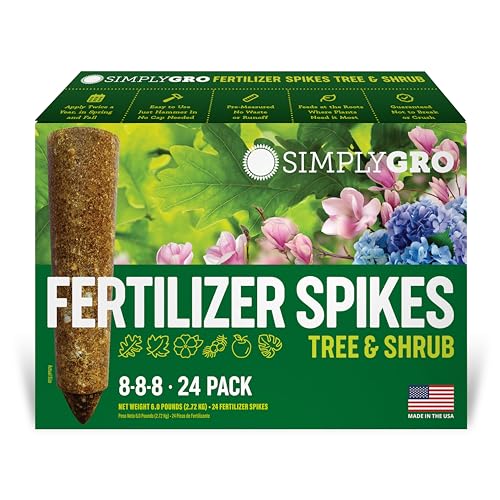
SimplyGro 8-8-8 Tree & Shrub Spikes uses equal 8-8-8 nitrogen, phosphorus and potassium proportions and comes with 24 spikes. Its formula is intended for deciduous, coniferous, decorative, flowering and fruiting trees and shrubs, giving it a broader stated range than products targeted specifically to deciduous or citrus trees. Each spike is 5 inches long, and the maker says it can feed continuously for up to three months. The schedule recommends spring and fall application, so this is not a once-and-done annual option.
Bottom line: Choose this for a balanced formula across varied tree and shrub types.
Winchester Gardens 15-10-9 Spikes

Winchester Gardens 15-10-9 Spikes stands out for its 70-spike case, the largest pack in this group, and a 15-10-9 nutrient ratio. Its premeasured dosage is designed for no-mess feeding without runoff, according to the maker. The case format can suit a landscape with many trees or shrubs, rather than a single small planting. The specifications do not identify specific tree species or a timing schedule, so verify the package’s directions for your trees before use. Its child- and pet-friendly feature claim is not a substitute for keeping fertilizer secured and following label precautions.
Bottom line: Pick this case when you need a larger supply for multiple trees or shrubs.
How to Choose Tree Fertilizer Spikes
Choose by plant type and soil need first, then compare the N-P-K ratio. The three numbers represent nitrogen, phosphate and potash percentages by weight; a 10-15-15 formula is not interchangeable with 16-4-4 because the nutrient proportions differ. A soil test is a sound way to identify nutrient deficiencies before adding fertilizer, since established trees often need no fertilizer when growth and foliage are normal. Do not assume a higher first number means a better choice. Match the product label to the species, soil conditions and season, and avoid placing fertilizer against the trunk.
When to Apply Tree Fertilizer Spikes
Early spring is a common time to fertilize trees when soil is workable and growth is beginning, but timing depends on species, climate and the specific product schedule. For example, some formulas call for a second fall application, while others supply different timing directions. Apply spikes into moist soil rather than frozen or waterlogged ground, and water afterward if the label directs it. Avoid late-season nitrogen feeding in cold climates when new growth may not harden before winter. With less than 12 inches of annual shoot growth on a young tree, first check soil moisture, light and planting depth; fertilizer cannot correct those underlying problems.
How to Place Fertilizer Spikes Safely
Place spikes in the root zone rather than at the trunk: tree feeder roots are concentrated in the upper 12 to 18 inches of soil and extend outward toward or beyond the canopy edge. Evenly spaced points around the drip line distribute nutrients more broadly than a cluster beside the trunk. Use the package directions for spacing, number of spikes and depth because dosage varies with trunk size and formula. Keep fertilizer away from storm drains and surface water, and store unused spikes in their original closed packaging out of reach of children and pets. Wear gloves if the label recommends them, and wash hands after handling.
Tree Fertilizer Spike Formulas at a Glance
Formula and intended use are the clearest distinctions among these spike types; the table summarizes the specified nutrient ratio and target plants.
| Formula type | Common use | Choice rule |
|---|---|---|
| General tree and shrub | Routine feeding across listed tree or shrub types | Match listed species and N-P-K to soil needs |
| Fruit and citrus | Fruit, citrus and some palm use | Choose when the target tree is on the label |
| Balanced N-P-K | Equal nitrogen, phosphate and potash proportions | Use only when a balanced ratio fits the soil need |
Product labels govern how much to apply and where to place it. Do not use extra spikes to compensate for slow growth; excess fertilizer can injure roots and wash nutrients into nearby waterways.
Frequently Asked Questions
How far from a tree trunk should spikes go?
Place spikes in the root zone, not beside the trunk; feeder roots commonly extend to the canopy edge and beyond. Follow the package spacing and dose directions, which may account for trunk size.
Should I fertilize a tree every year?
Not necessarily; established trees with normal growth and foliage may not need annual fertilizer. A soil test and the product’s schedule can help determine whether feeding is warranted.
Can fertilizer spikes damage tree roots?
Yes, concentrated fertilizer can injure roots if too many spikes are placed too close together. Keep to the product’s dose and spacing directions and avoid placing spikes against the trunk.
Are fertilizer spikes safe around pets?
Keep spikes and unused fertilizer secured away from pets, even when a product is described as pet-friendly. Follow its handling directions and prevent pets from chewing or swallowing fertilizer.
Can I use tree spikes in dry soil?
Moist, workable soil is generally easier to penetrate than hard, dry ground. Water the area if needed and follow the label’s directions for watering after placement.