
Best TRQ Oxygen Sensors: 5 Vehicle-Fit Kits Compared

For most GM truck and SUV owners whose vehicles match the applications, TRQ GM V8 4-Piece O2 Sensor Set is the most complete choice because it includes two upstream and two downstream sensors. TRQ oxygen sensor kits are vehicle-specific replacement sets; choose a different kit if your vehicle is an Acura or Honda, older GM, Chrysler, or Nissan application.
Before ordering, match the year, make, model, engine, and reference number to your vehicle; similar model names can use different sensors.
We earn a commission if you buy through links on this page. As an Amazon Associate I earn from qualifying purchases. Products are compared on manufacturer specifications, not hands-on testing.
- Best overall: TRQ GM V8 4-Piece O2 Sensor Set – Includes two upstream and two downstream sensors for the GM V8 applications.
- Best for Acura and Honda: TRQ Acura/Honda 2-Piece Upstream Set – Includes a pair of upstream sensors for the Acura and Honda models.
- Best for Nissan V8s: TRQ Older GM 4-Piece O2 Sensor Set – Includes four heated, four-wire sensors for listed 5.6L Nissan and Infiniti applications.
| Product | Best for | Kit contents | Sensor positions | Vehicle fit | Shop |
|---|---|---|---|---|---|
| TRQ GM V8 4-Piece O2 Sensor Set | GM V8 applications | 4 sensors | 2 upstream, 2 downstream | Listed 2008–2013 GM V8 SUVs and trucks | Check Price on Amazon |
| TRQ Acura/Honda 2-Piece Upstream Set | Acura and Honda | 2 sensors | Upstream | Listed 2008–2020 Acura and 2008–2019 Honda | Check Price on Amazon |
| TRQ Older GM 4-Piece O2 Sensor Set | Older GM vehicles | 4 sensors | 2 upstream, 2 downstream | Listed 1996–2002 GM models | Check Price on Amazon |
| TRQ Chrysler/Dodge/Jeep/Ram 4-Piece Set | Chrysler-family vehicles | 4 sensors | 2 upstream, 2 downstream | Listed 2011–2023 Chrysler-family models | Check Price on Amazon |
| TRQ Nissan/Infiniti 5.6L 4-Wire Set | Nissan 5.6L V8s | 4 sensors | 2 upstream, 2 downstream | Listed 2007–2012 Nissan/Infiniti 5.6L V8s | Check Price on Amazon |
TRQ Oxygen Sensor Kits
Compare sensor count and position, then confirm that the vehicle application matches your exact engine and model year.
TRQ GM V8 4-Piece O2 Sensor Set

This set covers both sensor positions with two upstream and two downstream oxygen sensors. The applications include Chevrolet Silverado and GMC Sierra V8 models, plus several Chevrolet, GMC, and Cadillac SUVs; the exact year range varies by model. That makes the set relevant when a repair calls for all four sensors rather than only an upstream pair. The limitation is fit: the broad application range does not establish compatibility with every engine or trim. Match your exact vehicle and reference number before choosing it.
Bottom line: Choose this when your listed GM application needs all four sensor positions.
TRQ Acura/Honda 2-Piece Upstream Set

This pair is the only upstream-only kit among these options, making it the targeted choice when the repair calls for two upstream sensors on an Acura or Honda. Its application range includes Acura models from 2009–2020 and Honda models from 2008–2019, with vehicle-specific fit differences. Unlike the four-piece sets, it does not cover downstream positions. Check that the repair requires upstream sensors and verify the exact model year and engine; a matching make alone is not enough to establish fit.
Bottom line: Pick this for an Acura or Honda that needs two upstream sensors.
TRQ Older GM 4-Piece O2 Sensor Set

This four-sensor set targets older GM vehicles, including listed 1996–2002 Chevrolet and GMC trucks and SUVs, as well as Cadillac Escalade applications. It includes two upstream and two downstream sensors, so it differs from the newer GM V8 set by its model-year range rather than sensor count. The broad fit wording covers multiple platforms, so confirm the exact vehicle, engine, and reference number before ordering. This set is not a substitute for the newer GM kit simply because both include four sensors.
Bottom line: Choose this for a 1996–2002 GM application needing all four sensors.
TRQ Chrysler/Dodge/Jeep/Ram 4-Piece Set
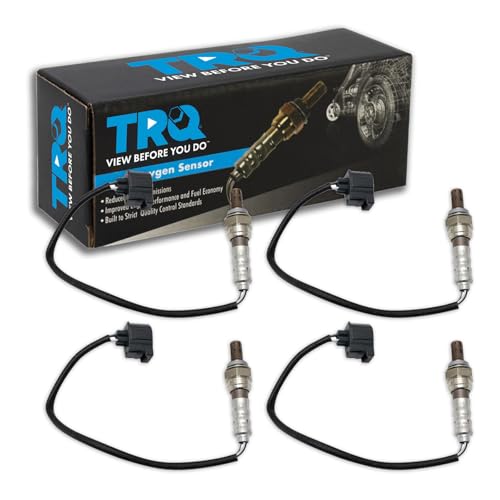
This kit groups four sensors for listed Chrysler, Dodge, Jeep, and Ram applications, with two upstream and two downstream units. Its broad model coverage includes years that differ by vehicle, from the 2011 Chrysler 200 and Dodge Avenger to listed Ram applications through 2020 and Jeep Grand Cherokee applications through 2021. That makes exact year-and-model matching especially important. The kit’s four-sensor count suits repairs requiring both positions, but it is not the right selection when only one position or a different engine-specific part is needed.
Bottom line: Pick this when a Chrysler-family vehicle needs upstream and downstream replacements.
TRQ Nissan/Infiniti 5.6L 4-Wire Set

This set is distinguished by its 5.6L V8 application and four-wire heated sensor design, with two upstream and two downstream sensors. The vehicles include Nissan Titan, Pathfinder, and Armada models and Infiniti QX56 models within their respective year ranges. A four-wire connector and engine size are useful fit checks, but they do not replace checking the exact vehicle application and sensor reference. This kit is narrower than the other four-sensor options, so it should not be selected for a different Nissan engine based on make alone.
Bottom line: Choose this for a 5.6L Nissan or Infiniti application needing four sensors.
How to choose TRQ oxygen sensors
Choose by the vehicle application and the sensor position the repair requires, not by brand alone. Oxygen sensors are commonly identified as upstream, before the catalytic converter, or downstream, after it; vehicles can have more than one of each. A four-piece set is useful only when the repair calls for all four positions. Use your vehicle identification number and engine details to narrow the application, then compare the sensor reference numbers against the part being replaced. A broad year range can cover different models but does not mean every engine or trim within those years uses the same sensor. If the repair diagnosis identifies only one position, do not assume a full set is necessary.
Upstream and downstream sensor positions
Upstream sensors monitor exhaust before the catalytic converter, while downstream sensors monitor exhaust after it. On many vehicles, upstream sensor readings inform fuel-control adjustments; downstream readings help monitor catalytic-converter performance. The number and location of sensors vary by engine and exhaust layout, so a four-sensor kit is not universal even among vehicles with the same nameplate. Use the diagnostic trouble code and service information to identify the bank and sensor position; codes such as sensor circuit or heater faults do not by themselves prove that the sensor is the only cause. Avoid swapping upstream and downstream parts based solely on appearance, since connector and calibration differences can matter.
Check vehicle fit before selecting a set
Model year, engine size, and position are the key fit checks for these kits. The applications include broad year spans and multiple vehicle models, but those ranges are not interchangeable: an older GM set and a newer GM V8 set cover different vehicles. Reference numbers provide another cross-check, especially when a vehicle had multiple engine options or production changes. Use this quick rule: if the exact year, model, engine, or required position does not match the kit’s application, pause and verify the correct part number before ordering. A matching make or connector style alone is not sufficient to confirm fit.
| Repair need | Kit type to consider | Fit check |
|---|---|---|
| Both sensor positions | Four-piece set | Match year, engine, and application |
| Two upstream positions | Upstream pair | Confirm the vehicle uses the paired application |
| One sensor only | Position-specific replacement | Match bank, position, and reference number |
Common oxygen sensor replacement mistakes
Replacing a sensor without confirming its position is a common source of an incorrect repair. A vehicle may have multiple banks and sensors, and a diagnostic code points to a circuit or reading rather than automatically identifying a failed component. Check the wiring, connector, and exhaust condition as part of diagnosis; damaged wiring or an exhaust leak can affect sensor readings. Oxygen sensors can be hot after driving, so let the exhaust cool before working near them and support a raised vehicle with properly rated stands rather than relying on a jack. Use the correct tool and avoid twisting the sensor wiring during installation.
Frequently Asked Questions
How many oxygen sensors does a vehicle use?
Many vehicles have at least one upstream and one downstream sensor, while V-style engines commonly have sensors on both banks. The exact count depends on engine and exhaust layout, so confirm the position map for the specific vehicle before choosing a set.
What is the difference between upstream and downstream oxygen sensors?
An upstream sensor sits before the catalytic converter and commonly helps the engine control fuel mixture; a downstream sensor sits after it and helps monitor converter operation. Their locations and functions make them non-interchangeable by position, even when the connectors look similar.
Can I replace only one oxygen sensor?
Yes, when diagnosis identifies one failed sensor and the replacement matches its bank and position. A trouble code alone may indicate a circuit issue, so check the sensor wiring and related exhaust condition before replacing parts.
Why does an oxygen sensor have four wires?
Many four-wire oxygen sensors use two wires for the heater circuit and two for the sensor signal and ground. Wire color and connector arrangement can vary, so use the vehicle-specific wiring diagram rather than matching colors by assumption.
Should I replace upstream and downstream sensors together?
Not automatically; replace the positions that diagnosis and the repair requirement support. A four-sensor set is suitable when all four positions are being serviced, but a two-sensor upstream kit addresses a different repair scope.