
Best Truck Bed Ice Chest: 5 Coolers Compared

The Igloo BMX 52 Qt is the best truck bed ice chest for most people because its 52-quart capacity and 15.6-pound weight balance useful storage with easier lifting. Choose a different cooler if you need wheels, less capacity or a larger 65-quart interior.
A truck bed ice chest is a portable insulated cooler, but bed dimensions and tie-down points determine whether it fits securely. Measure the intended space and account for clearance before choosing.
We earn a commission if you buy through links on this page. As an Amazon Associate I earn from qualifying purchases. Products are compared on manufacturer specifications, not hands-on testing.
- Best overall: Igloo BMX 52 Qt – Its 52-quart size and 15.6-pound weight combine substantial storage with a lighter carry weight.
- Best for rolling: Igloo Trailmate 52 Qt Roller – Its 6.25-inch wheels and telescoping handle make it easier to move before loading.
- Best for more capacity: YETI Tundra 65 – The 65-quart size offers more room than the 52-quart models.
- Best for compact loads: RTIC Ultra-Light 32 QT – The 32-quart capacity and 14.7-pound weight suit smaller loads.
| Product | Best for | Capacity | Dimensions (L × W × H) | Weight | Shop |
|---|---|---|---|---|---|
| Igloo BMX 52 Qt | Everyday truck loads | 52 qt | 26.19 × 16.42 × 16.1 in | 15.6 lb | Check Price on Amazon |
| VEVOR Ultra-Light 52 QT | Lightweight storage | 52 qt | 16.9 × 25.5 × 17.72 in | 20.5 lb | Check Price on Amazon |
| Igloo Trailmate 52 Qt Roller | Rolling transport | 52 qt | 25.62 × 20.26 × 16.7 in | 19.5 lb | Check Price on Amazon |
| YETI Tundra 65 | Larger food loads | 65 qt | 17.3 × 30.8 × 16.0 in | — | Check Price on Amazon |
| RTIC Ultra-Light 32 QT | Compact cooler loads | 32 qt | 15.12 × 23.15 × 14.41 in | 14.7 lb | Check Price on Amazon |
Truck Bed Ice Chests Compared
Compare capacity, dimensions and carry features against your truck bed space and the load you plan to haul.
Igloo BMX 52 Qt
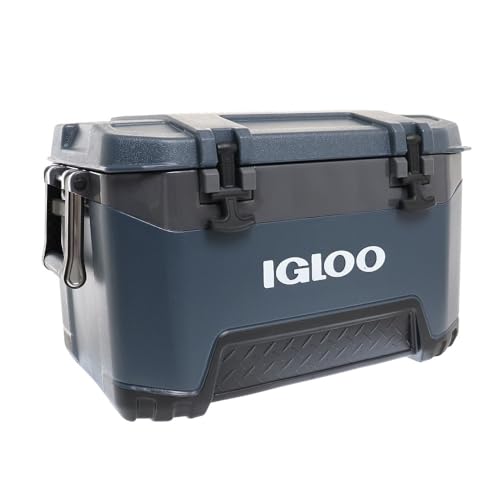
The Igloo BMX 52 Qt combines 52-quart storage with a 15.6-pound weight, making it the most balanced choice here for regular truck-bed use. Its blow-molded construction has extra-thick foam-insulated walls and lid, while rubberized T-latches secure the closure. It holds up to 83 cans, and the triple-point grab handle has stainless-steel reinforcement and a rubber grip. The threaded drain plug can connect to a water hose for draining. This cooler has no wheels, so it is less convenient to move across a campsite than the rolling option.
Bottom line: Choose this for a large everyday load that still needs manageable lifting.
VEVOR Ultra-Light 52 QT

The VEVOR Ultra-Light 52 QT stands out for its six-day cooling capability and 2.5 inches of closed-cell foam insulation. It weighs 20.5 pounds and uses a hard polypropylene body with a commercial-grade silicone seal. The 52-quart interior is sized for about 45 to 50 standard 12-ounce cans, useful when you want room for drinks and food in one cooler. A quick-flip latch is designed for easy opening. The 20.5-pound empty weight is higher than the BMX’s, so this is less appealing if you expect to lift it in and out frequently.
Bottom line: Choose this if the cooling duration and insulated seal matter more than carry weight.
Igloo Trailmate 52 Qt Roller

The Igloo Trailmate 52 Qt is the only cooler here with wheels, pairing 6.25-inch soft-ride wheels with a marine-grade telescoping handle. That makes it easier to pull across ground once unloaded from the truck. Its 52-quart capacity holds up to 80 cans, and 1.5-inch foam-insulated walls and lid support extended ice retention. The 19.5-pound cooler has Sure-Lock latches. Wheels and a handle add useful mobility, but they do not replace securement in a moving truck bed; use suitable tie-downs to prevent shifting.
Bottom line: Choose this if you need to roll a full cooler away from the truck.
YETI Tundra 65

The YETI Tundra 65 is the largest-capacity option in this group at 65 quarts, for buyers who prioritize space over a smaller footprint. It has rotomolded construction, up to 3 inches of PermaFrost insulation and a FatWall design. The product maker says the cooler is certified bear-resistant, and its T-Rex lid latches use heavy-duty rubber. At 30.8 inches long, it takes more bed length than the 52-quart choices.
Bottom line: Choose this when extra capacity matters and your bed has room for its longer body.
RTIC Ultra-Light 32 QT

The RTIC Ultra-Light 32 QT is the smallest-capacity option, at 32 quarts, and its 14.7-pound weight makes it easier to carry than the larger coolers. It has up to 2.5 inches of closed-cell foam insulation and is designed for one-person carrying. Its compact size suits a short trip or a truck bed that needs to preserve cargo room for other gear. The tradeoff is clear: 32 quarts provides substantially less space than the 52- and 65-quart options, so it is not the fit for group-sized food and drink loads.
Bottom line: Choose this for a compact load that leaves more room for other cargo.
How to Choose a Truck Bed Ice Chest
Start with capacity, then check the cooler’s footprint against usable bed space. A quart is 57.75 cubic inches, so 52 quarts represents about 3,003 cubic inches of nominal volume; interior shape and insulation reduce practical packing space. A common planning estimate is roughly one-third ice to two-thirds contents by volume, adjusted for trip length and how often the lid opens. For a solo day trip, 32 quarts can be easier to manage; for group food and drinks, 52 or 65 quarts offers more room. Compare exterior length, width and height with bed clearance, wheel wells and any tonneau cover before deciding.
Truck Bed Cooler Fit and Securement
Measure the narrowest usable bed width and the length available between the cab and tailgate, not just the bed’s advertised dimensions. A cooler must also clear wheel wells, bed rails and a closed tonneau cover; allow space for lids to open and handles to move. In a moving vehicle, a heavy cooler can shift during braking or a turn, so use cargo tie-downs or a restraint suited to the cooler and truck’s anchor points. Do not rely on a lid latch as cargo restraint. Keep the cooler low and stable, and never obstruct visibility or access to safety equipment. Wheeled models still need securing while the truck is in motion.
| Need | Capacity direction | Fit check |
|---|---|---|
| Small load or more cargo room | 32 qt | Compare exterior width and height |
| General food and drink load | 52 qt | Measure clearance and lid access |
| Extra storage volume | 65 qt | Confirm bed length and lift plan |
Cooler Insulation and Ice Retention
Hard coolers commonly use foam insulation in the walls and lid; thicker insulation and a well-sealed lid can reduce heat transfer, but performance also depends on conditions. Pre-chilling the cooler and contents, limiting lid openings and keeping it shaded help conserve ice. Ambient heat, direct sun, warm food and repeated access can shorten cooling time. Ice-to-content ratio matters: for multi-day use, allocate a substantial part of the interior to ice rather than filling every gap with warm items. Treat manufacturer duration claims as best-case guidance, not a guarantee for a hot truck bed or frequent access.
Loading and Caring for a Truck Bed Cooler
Pack cold food below 40°F and keep raw meat sealed separately so leaking juices cannot contaminate ready-to-eat food. A cooler is not a refrigerator, so use a thermometer when food safety matters; discard perishable food that has been above 40°F for more than two hours, or one hour when temperatures exceed 90°F. Drain meltwater as needed and clean the interior after each trip with mild soap and water, then dry it before storage to limit odors and mildew. Avoid overloading the lid or standing on it unless the maker explicitly supports that use. Check drain plugs and latches before loading to prevent leaks and unexpected openings.
Frequently Asked Questions
How much ice should go in a truck cooler?
A common starting point is about one-third ice and two-thirds food and drinks by volume. Use more ice for longer trips, hot weather or frequent lid opening, and pre-chill both the cooler and its contents.
Can a cooler stay in a hot truck bed?
Direct sun and hot air can melt ice faster, so shade the cooler or cover it without blocking ventilation around any vehicle equipment. Keep perishable food at or below 40°F and use a thermometer during extended trips.
How do I stop a cooler moving in a truck bed?
Secure it to suitable cargo anchors with tie-downs that prevent forward, sideways and rearward movement. A cooler lid latch is not a vehicle restraint, and wheels should be locked or restrained if the model provides that feature.
What size cooler fits a pickup truck bed?
Measure the bed’s usable length, narrowest width and height clearance, including wheel wells and tonneau cover space. Compare those measurements with the cooler’s exterior dimensions and leave room to open its lid.
How long can food stay safe in an ice chest?
Keep perishable food at or below 40°F and check with a food thermometer rather than relying only on remaining ice. Discard perishables held above 40°F for over two hours, or one hour when outdoor temperatures are above 90°F.