
Best TV Antenna for Rural Wooded Areas: 4 Picks

For a rural wooded area, the Antennas Direct ClearStream 4V Antennas Direct ClearStream 4V is the strongest match because its four-loop, multi-directional design includes Hi-VHF elements and reflectors. Trees can weaken over-the-air signals, so the best choice still depends on tower direction, distance, and where you can mount the antenna.
Choose a directional outdoor antenna if you can aim it toward broadcast towers; consider an attic or indoor option only when its placement has a workable signal path.
We earn a commission if you buy through links on this page. As an Amazon Associate I earn from qualifying purchases. Products are compared on manufacturer specifications, not hands-on testing.
- Best overall: Antennas Direct ClearStream 4V – Four loops, reflectors, and Hi-VHF elements provide a substantial antenna design for rural and wooded settings.
- Best for weather-resistant mounting: GE Outdoor HD Antenna 29884 – It is rated for attic or outdoor mounting and receives VHF and UHF signals up to 70+ miles, according to GE.
- Best for longer cable reach: 2026 Digital TV Antenna, 40-ft Cable – Its 40-foot coaxial cable allows more flexibility in placing the antenna away from the TV.
| Product | Best for | Reception design | Cable length | Mounting | Shop |
|---|---|---|---|---|---|
| Antennas Direct ClearStream 4V | Multi-directional reception | Four loops, reflectors, Hi-VHF elements | — | Indoor, attic, or outdoor | Check Price on Amazon |
| GE Outdoor HD Antenna 29884 | Roof or attic setup | VHF and UHF; 70+ miles | — | Attic or outdoor; J mount | Check Price on Amazon |
| 2026 Digital TV Antenna, 40-ft Cable | Long cable routing | Amplifier with long/short modes | 40 ft | Indoor or outdoor | Check Price on Amazon |
| TV Antenna for Smart HDTV, 35-ft Cable | Indoor-outdoor flexibility | Amplified; 360° claim | 35 ft | Indoor or outdoor | Check Price on Amazon |
| Indoor TV Antenna, 16.5-ft Cable | Simple indoor placement | Amplifier | 16.5 ft | Indoor or outdoor | Check Price on Amazon |
TV Antennas for Rural Wooded Areas
Compare the antenna design and installation options first, then choose a mounting spot with the clearest path toward local broadcast towers.
Antennas Direct ClearStream 4V
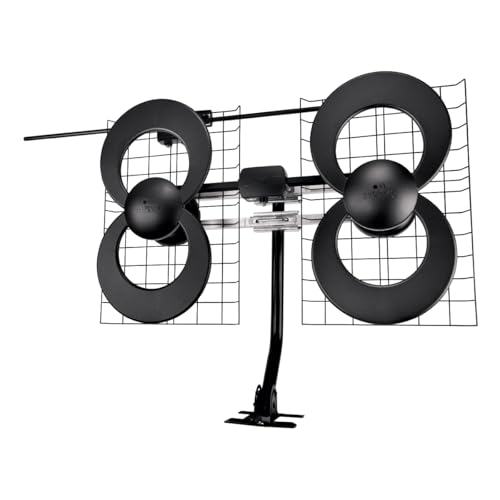
The four-loop design with reflectors and Hi-VHF elements makes this the most substantial match here for a rural location where stations may be spread across the dial. Its 27.8-by-17.4-inch body can be installed indoors, in an attic, or outdoors, giving you options for finding a higher or clearer position. The antenna supports UHF and VHF signals and is compatible with NEXTGEN TV, 4K, and 8K broadcasts. Trees and building materials still affect reception, and the antenna cannot overcome a blocked or very weak signal.
Bottom line: Pick this if you want a multi-directional antenna with both Hi-VHF elements and reflectors.
GE Outdoor HD Antenna 29884

The GE model is the clear choice when outdoor-rated installation and a J mount matter. GE says it receives VHF and UHF broadcasts from up to 70+ miles, and the weather-resistant design can go on a roof or in an attic. It works with TVs and converter boxes that use a standard coax connection and supports ATSC 3.0 broadcasts where available. Unlike the ClearStream 4V, the specifications do not describe a multi-directional loop design, so check tower bearings and plan to orient it toward the stations you want.
Bottom line: Choose this for an outdoor-rated VHF/UHF antenna with a J mount included.
2026 Digital TV Antenna, 40-ft Cable

The included 40-foot coaxial cable is the useful distinction for this amplified indoor/outdoor antenna: it can give you more freedom to position the antenna away from the television. Its maker says the signal booster switches between long- and short-range modes and describes the antenna as waterproof and durable. The claimed 6,000-mile range is not a practical way to predict reception; broadcast range depends on tower distance, terrain, and obstructions such as trees. The fields do not give a VHF/UHF design or installation mount, which matters if you need a specific tower-facing setup.
Bottom line: Consider it when a longer coax run is your main installation need.
TV Antenna for Smart HDTV, 35-ft Cable

The 35-foot coaxial cable and indoor/outdoor positioning are the main practical features of this amplified antenna. Its maker claims 360-degree reception and a 6,000-plus-mile range, but those figures should not replace checking real local tower locations: wooded terrain and trees can obstruct broadcasts regardless of the claimed range. That makes it a less certain fit for someone who needs a directional rooftop solution for distant stations.
Bottom line: Choose it only if flexible placement and the 35-foot cable suit your setup.
Indoor TV Antenna, 16.5-ft Cable

The 16.5-foot cable and wall, table, or window placement options make this the most indoor-oriented choice. Its maker says the antenna includes an amplifier and supports 4K and 1080p formats; the specifications also mention outdoor fastening options. That flexibility may help with experimenting near windows, but the fields do not describe a VHF/UHF element design or provide a tower-range figure. For a wooded rural site, prioritize an outdoor or attic position with a clearer path if indoor placement cannot receive the stations you need.
Bottom line: Pick it for a nearby-window indoor setup rather than heavily obstructed terrain.
How to choose a TV antenna for wooded terrain
Start with tower direction and obstructions, not a claimed maximum range: broadcast signals travel line of sight, and dense trees, hills, and house materials can weaken them. VHF and UHF are the two main broadcast bands; an antenna needs elements suited to the stations you want, so check local channel assignments before choosing. Directional antennas focus toward one area and can be aimed at distant towers, while multi-directional designs are useful when towers lie in different directions. If you can place an outdoor antenna above nearby rooflines and aim it at the tower cluster, favor that over an indoor antenna behind walls or foliage.
A practical decision rule is to use an outdoor or attic position when trees obstruct the window-level signal path; use an indoor antenna only when it receives reliable stations from a clear window location.
Mounting and signal placement
Higher placement and a clearer path generally help more than a larger advertised mile figure. An attic avoids direct weather exposure, but roof sheathing, metal roofing, foil insulation, and wiring can attenuate or disrupt reception. Outdoor mounting usually gives a less obstructed path, but the mast and antenna need secure installation, weather-rated hardware, and careful separation from overhead power lines. Keep coax runs as short as practical; long cable runs and splitters add signal loss, especially for weak stations. For multi-directional reception, rotate the antenna in small increments and rescan the TV after each position rather than assuming a 360-degree claim means equal reception in every direction.
Directional and multi-directional antennas compared
Directional designs concentrate reception toward one tower area, while multi-directional designs can receive from a broader set of bearings. Choose based on where the stations you want are located, not a label such as long range. Broadcast reception can differ by channel because VHF and UHF behave differently around obstacles and the antenna’s elements are not identical across bands. The table gives a simple placement decision; a local station map helps identify which direction to favor.
| Situation | Better starting choice | Reason |
|---|---|---|
| Towers clustered in one direction | Directional antenna | Aim toward the cluster |
| Towers in multiple directions | Multi-directional antenna | Broader receiving pattern |
| Obstructed window-level path | Attic or outdoor antenna | More placement height and clearance |
Common rural antenna setup mistakes
Expecting an amplifier to create signal is a common mistake: an amplifier can boost a signal already received, but it cannot restore broadcasts blocked by terrain or dense trees. A very strong amplifier can also overload nearby stations, so use one only where a long cable run or weak incoming signal warrants it. Another mistake is selecting by exaggerated mileage claims; real reception depends on tower distance, terrain, frequency band, and placement. Rescan the television after moving the antenna, since digital channel reception can change with orientation. If a station remains unavailable, try a higher location or a different aiming direction before adding splitters or more amplification.
Frequently Asked Questions
Do trees block over-the-air TV signals?
Dense foliage can weaken broadcast signals, especially when the antenna sits behind or below the trees. A higher outdoor or attic position with a clearer path toward the towers can improve the chance of reception.
Is an amplified TV antenna better in a rural area?
An amplifier helps compensate for cable loss or a weak signal that the antenna already receives; it does not create a signal blocked by a hill or dense trees. Long coax runs and splitters are common reasons to consider amplification.
Should I mount a TV antenna higher outside?
Higher placement often improves line of sight over nearby obstacles, but secure mounting and clearance from overhead power lines are essential. Try an attic location first if it offers a clear path and avoids exposed-weather installation.
How do I aim a directional TV antenna?
Use a local broadcast-tower map to identify the bearing of stations you want, then point the antenna toward that cluster. Rotate it in small increments and rescan the TV after each adjustment because digital channels can appear or disappear with small changes.
Do TV antennas receive both VHF and UHF channels?
Many antennas are designed for VHF and UHF, but their element designs can favor one band. Check the broadcast band for the stations you want before choosing, particularly when local channels use different frequencies.