
Best Ultrasonic Fruit and Vegetable Washer Compared

KUNPHY 2.5L 40 kHz Washer suits most shoppers because its 2.5-liter capacity, 40 kHz frequency, and three timed cycles are clearly specified. Choose another model if you want a removable drain basket or a larger-capacity claim, but compare the actual usable basin size first.
Ultrasonic produce washers use high-frequency vibrations in water; they are an optional cleaning step, not a replacement for rinsing produce under clean running water.
We earn a commission if you buy through links on this page. As an Amazon Associate I earn from qualifying purchases. Products are compared on manufacturer specifications, not hands-on testing.
- Best overall: KUNPHY 2.5L 40 kHz Washer – Its 2.5-liter capacity, 40 kHz frequency, and 5-, 10-, and 15-minute cycles are specified.
- Best for lift-out draining: Ultrasonic Washer with Drain Basket – The product features describe a two-tier drain basket that lifts out of the basin.
- Best for one-button operation: Ultrasonic Ion-Purification Washer – The maker describes one-button starting and electrolytic ultrasonic cleaning.
| Product | Best for | Frequency | Shop |
|---|---|---|---|
| KUNPHY 2.5L 40 kHz Washer | Timed wash cycles | 40 kHz | Check Price on Amazon |
| Ultrasonic Washer with Drain Basket | Lift-out draining | 100 Hz | Check Price on Amazon |
| Ultrasonic Ion-Purification Washer | One-button starting | — | Check Price on Amazon |
Ultrasonic Fruit and Vegetable Washers
Compare the capacity, cleaning approach, and cycle controls before choosing a countertop produce washer.
KUNPHY 2.5L 40 kHz Washer
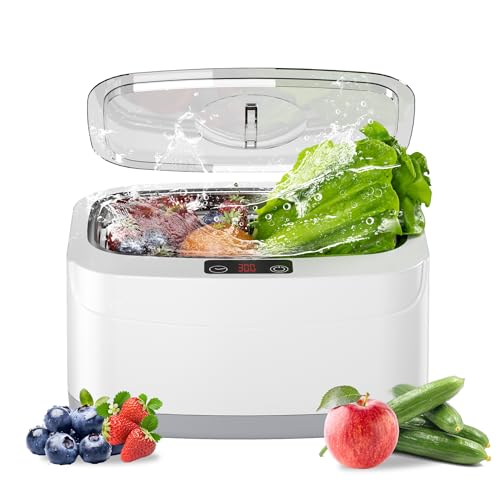
KUNPHY 2.5L 40 kHz Washer stands out for pairing a 2.5-liter capacity with a 40 kHz ultrasonic frequency and three timed cycles. The 5-, 10-, and 15-minute options let you choose a shorter or longer run, while the LED screen shows remaining time. The maker says the washer is designed for produce including berries and lettuce. This is a fit for households that want cycle choices and a frequency; shoppers who need a lift-out basket should compare its basin design before deciding.
Bottom line: Choose this if a ultrasonic frequency and three timed cycles are your priorities.
Ultrasonic Washer with Drain Basket

Ultrasonic Washer with Drain Basket differs from the other options by describing a two-tier drain basket that lifts out of the water basin. Its size is 9.06 by 5.12 inches, and the maker describes 100 Hz micro-vibrations for cleaning produce as well as seafood and meat. The removable basket may suit someone who wants to lift washed items from the water rather than scoop them out.
Bottom line: Pick this if a lift-out drain basket matters more than having a specified cycle duration.
Ultrasonic Ion-Purification Washer

Ultrasonic Ion-Purification Washer is distinguished by its electrolytic ultrasonic approach and one-button start, rather than a specified frequency or timer menu. The maker describes a 360-degree cleaning design for fruits, vegetables, seafood, and meat; those are maker claims, not a substitute for ordinary food-safety handling. Its footprint is 9.1 by 9.1 inches and 5.1 inches high, which gives a useful countertop sizing reference. Shoppers who want to compare capacity or set an exact cycle length should verify those points before selecting this model.
Bottom line: Choose this if a one-button control and electrolytic ultrasonic approach suit your routine.
How to Choose an Ultrasonic Produce Washer
Start with the batch size and the controls you will actually use: a larger tank can reduce the number of loads, while a timer lets you set a run without estimating it. Ultrasonic cleaners work by creating pressure waves in liquid; at sufficiently intense conditions, tiny bubbles form and collapse, a process called cavitation. Household produce appliances vary in design and output, so a frequency or cleaning claim alone does not establish how much residue a unit removes. Use the frequency, capacity, and cycle information as comparison points, not proof of pesticide removal. If capacity matters, choose a unit whose basin can hold your usual load with room for water to circulate rather than packing produce tightly.
What to Know About Ultrasonic Cleaning
Ultrasonic cleaning sends sound waves through water, and cavitation can loosen material from submerged surfaces; surface geometry, water conditions, and load arrangement affect cleaning. A quoted frequency is one part of the system, not a complete measure of cleaning performance. No cycle length or technology label makes an appliance a food-safety treatment. Rinse fruits and vegetables under clean running water before eating or cutting, and rub produce gently with your hands. Scrub firm produce such as melons with a clean produce brush. Do not wash produce with soap, detergent, or commercial dishwashing liquid, which can leave residues. Keep raw meat and seafood separate from ready-to-eat produce to avoid cross-contamination.
How to Size the Washer for Your Counter
Measure both the counter space and the basin footprint before choosing a countertop washer; allow extra room to fill, empty, and dry the bowl. An outside dimension does not tell you the usable water volume, and a capacity in liters is more useful for batch planning than the appliance’s overall dimensions. As a practical rule, if your counter has less than 1 inch of free space around the washer, choose a smaller footprint or relocate other items before use so filling and draining are not awkward. Keep the appliance on a stable, dry surface and follow its electrical safety instructions around water. Let the basin and removable parts dry fully between uses.
Washer Features and Best-Fit Uses
Choose by the feature that solves a real task: timed cycles help set a repeatable run, while a lift-out basket can make draining a batch simpler. The table compares only features available for these exact-fit options; a dash means the input does not provide that value.
| Need | Feature to compare | Option |
|---|---|---|
| Choose a set duration | Three timed options | KUNPHY 2.5L 40 kHz Washer |
| Lift produce out to drain | Lift-out two-tier basket | Ultrasonic Washer with Drain Basket |
| Start with one control | One-button start | Ultrasonic Ion-Purification Washer |
These are convenience distinctions, not evidence that one appliance removes more contaminants. Regardless of the washer selected, handle produce as food: keep it away from raw animal products, wash hands and prep surfaces, and refrigerate cut produce promptly.
Frequently Asked Questions
Does an ultrasonic washer remove pesticide residues?
An ultrasonic label or frequency does not prove that a washer removes pesticide residues. Rinse produce under clean running water and rub it gently; do not treat the appliance as a substitute for that step.
Should I use soap in a produce washer?
No; wash produce with clean water rather than soap, detergent, or commercial dishwashing liquid. Those products are not intended for washing fruits and vegetables and can leave residues.
How long should produce run in an ultrasonic washer?
Use a cycle supported by the appliance controls and its directions; the options for KUNPHY 2.5L 40 kHz Washer are 5, 10, and 15 minutes. A longer run should not be assumed to remove more residue or make food safer.
Can I wash meat with vegetables in one batch?
Keep raw meat and seafood separate from ready-to-eat produce to reduce cross-contamination. Wash the produce separately, and clean food-contact surfaces and hands after handling raw animal products.
Do I need to rinse produce after ultrasonic cleaning?
Yes; rinse fruits and vegetables under clean running water before eating or cutting them. Rub produce gently, and use a clean brush for firm items such as melons.