
Best Ultrasonic Vegetable Cleaner: 5 Models Compared

The KUNPHY 2.5-liter ultrasonic cleaner suits most people because it combines a 40-kHz cleaning method with three timed cycles. Choose a cordless capsule instead if portability or soaking the unit matters more than a basin-style cleaner.
We earn a commission if you buy through links on this page. As an Amazon Associate I earn from qualifying purchases. Products are compared on manufacturer specifications, not hands-on testing.
- Best overall: KUNPHY 2.5L Ultrasonic Cleaner – The 2.5-liter basin cleaner specifies 40 kHz and offers 5-, 10-, and 15-minute cycles.
- Best for cordless use: BUBCLEAN Wireless OH-Ion Capsule – The wireless capsule is described as IPX7 waterproof and runs a 10-minute automatic cycle.
- Best for compact storage: Portable OH-Ion Produce Washer – This portable wireless cleaner measures 6.38 by 3.86 by 3.54 inches.
| Product | Best for | Cleaning method | Capacity or size | Cycle | Shop |
|---|---|---|---|---|---|
| KUNPHY 2.5L Ultrasonic Cleaner | Basin-style cleaning | 40-kHz ultrasonic | 2.5 L | 5, 10, 15 min | Check Price on Amazon |
| BUBCLEAN Wireless OH-Ion Capsule | Cordless use | OH-ion electrolysis | Capsule | 10 min | Check Price on Amazon |
| Portable OH-Ion Produce Washer | Small storage | OH-ion purification; ultrasonic in title | 6.38 × 3.86 × 3.54 in | 10 min | Check Price on Amazon |
| Fabenix USB Wireless OH-Ion Cleaner | Wireless versatility | OH-ion purification | 7 × 4 × 4 in | — | Check Price on Amazon |
| LCOIEDU Cordless OH-Ion Cleaner | Vortex circulation | Titanium electrolysis; vortex | 5.51 × 5.51 × 3.54 in | — | Check Price on Amazon |
Ultrasonic Vegetable Cleaners Compared
Compare the cleaning method and operating format first; not every produce washer here is ultrasonic.
KUNPHY 2.5L Ultrasonic Cleaner
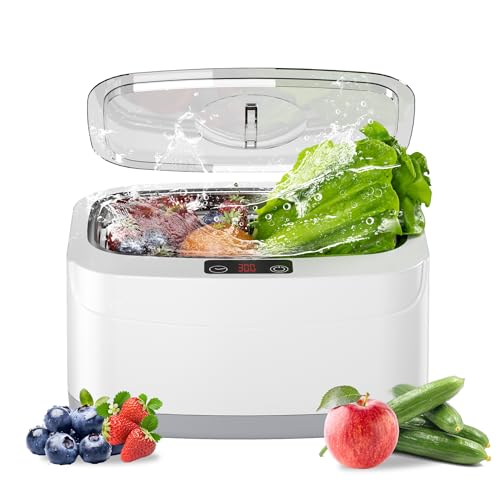
Unlike the cordless capsules, this is a 2.5-liter basin-style cleaner; the maker says it uses 40-kHz ultrasonic waves. Its three cycle choices are 5, 10, and 15 minutes, with an LED screen showing the remaining time. That format suits households that want to clean a batch in a dedicated vessel and select a cycle length. The tradeoff is its 8-by-5-by-5-inch footprint, so it takes more counter or storage space than a small capsule. The specifications do not establish a cleaning result, so treat the cycle options as convenience rather than proof of contaminant removal.
Bottom line: Choose this if you want a basin-style machine with a specified ultrasonic frequency and selectable cycles.
BUBCLEAN Wireless OH-Ion Capsule

The BUBCLEAN is a cordless capsule rather than a 40-kHz basin cleaner. Its maker describes OH-ion electrolysis using tap water without chemical additives, a 10-minute automatic cycle, and an IPX7 waterproof body that can be fully soaked. The compact capsule format is suited to a sink, basin, or travel kit when portability matters. Its main limitation for someone specifically seeking ultrasonic cleaning is that the described method is electrolysis, not an ultrasonic frequency. Its claimed ingredient range includes produce, meat, and seafood, but raw meat should not be washed with produce because splashes can spread bacteria.
Bottom line: Pick this for a portable capsule format, not for ultrasonic operation.
Portable OH-Ion Produce Washer
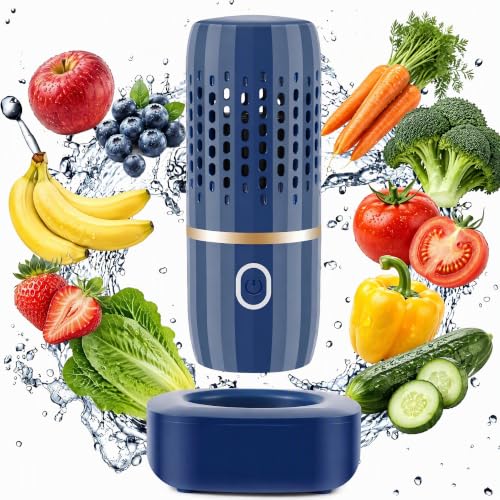
This portable blue washer is presented as a wireless OH-ion purifier, while its name also mentions ultrasonic technology; no ultrasonic frequency is provided. It measures 6.38 by 3.86 by 3.54 inches and weighs 0.8 pound, making its physical dimensions useful if storage space is tight. The maker describes a one-touch 10-minute cycle and use with several ingredient types. Those broad purification claims do not establish a measurable cleaning result. Buyers who specifically need a frequency-confirmed ultrasonic unit should compare that requirement with the KUNPHY’s 40 kHz.
Bottom line: Choose it when compact dimensions matter more than a clearly specified ultrasonic frequency.
Fabenix USB Wireless OH-Ion Cleaner

The Fabenix uses a wireless capsule form and describes OH-ion purification, rather than identifying an ultrasonic frequency. It measures 7 by 4 by 4 inches and weighs about 0.88 pound. Its range includes fruits, vegetables, meat, fish, shrimp, grains, and tableware, so it is aimed at buyers who want one device for different kitchen tasks. Its ion-based method also makes it a different type of product from a frequency-specified ultrasonic basin cleaner.
Bottom line: Consider it for a wireless multi-use format when a specified cycle time is not essential.
LCOIEDU Cordless OH-Ion Cleaner

The LCOIEDU distinguishes itself with a described vortex-circulation design alongside titanium electrolysis; it is a cordless cleaner, not a unit with a ultrasonic frequency. Its dimensions are 5.51 by 5.51 by 3.54 inches, and the maker describes it for produce, meat, seafood, rice, and grains. Choose it for its circulation approach and compact dimensions, not as a confirmed 40-kHz alternative.
Bottom line: Choose this if the cordless form and vortex design fit your routine.
How to Choose an Ultrasonic Vegetable Cleaner
Start by distinguishing an ultrasonic unit from other electric produce washers: ultrasonic cleaning uses high-frequency sound in water, while several cordless capsules here describe electrolysis or OH-ion purification. The KUNPHY is the only one that gives a frequency, 40 kHz, and a 2.5-liter capacity. A frequency identifies the operating method, but it does not by itself prove that pesticide residues or microbes are removed. Match the vessel to your workflow: a basin can handle a batch, while a capsule is designed to be placed in a separate sink or basin. If ultrasonic operation is a firm requirement, choose a model with a ultrasonic frequency rather than relying on broad wording such as “purification.”
How to Wash Produce Safely
Rinse fruits and vegetables under clean, running tap water before eating, cutting, or cooking; FDA guidance does not recommend soap, detergent, or commercial produce wash. A cleaner’s cycle should not replace a running-water rinse, especially for leafy produce where dirt can remain between leaves. Scrub firm produce such as melons or cucumbers with a clean produce brush, and remove outer leaves from lettuce or cabbage. Drying with a clean towel can further reduce surface moisture. Do not use a produce washer for raw meat: USDA guidance warns that washing poultry can spread bacteria through splashes, and the same cross-contamination concern makes shared produce-cleaning vessels a poor choice for raw animal foods.
Ultrasonic and Ion-Based Cleaners Compared
Ultrasonic cleaners use sound-driven vibration in liquid; ion-based products instead describe electrolysis or OH-ion production. These methods are not interchangeable, so check the mechanism before choosing a cleaner marketed broadly as a purifier. In this set, one machine specifies 40 kHz and 2.5 liters, while the cordless models emphasize water-based electrolysis, portability, or circulation. Neither a frequency nor a purification claim alone tells you how much residue is removed from a particular crop. Use the comparison as a method-and-format guide, and continue standard produce preparation.
| Type | What to look for | Practical choice |
|---|---|---|
| Ultrasonic basin | Frequency and vessel capacity | Batch cleaning in a dedicated basin |
| OH-ion capsule | Electrolysis wording, cycle, waterproof design | Portable use in a separate basin |
Common Mistakes With Produce Washers
The biggest mistake is treating a device’s advertised purification function as a substitute for safe food handling. Rinse produce under running water, keep raw meat away from produce and ready-to-eat foods, and wash hands and food-contact surfaces after handling raw animal products. Another common error is mixing cleaning methods: soap or household detergent is not recommended for produce, and residues can remain on food. Avoid overfilling a vessel, since crowded produce may not contact circulating water evenly. For leafy greens, separate leaves and rinse them rather than assuming one cycle reaches every fold. When a cleaner’s capacity is given, keep each batch within that volume instead of packing produce tightly.
Frequently Asked Questions
Does an ultrasonic vegetable cleaner remove pesticides?
A ultrasonic frequency does not prove pesticide removal. Rinse produce under running tap water, and peel or discard outer leaves when appropriate; no cleaning method should be assumed to remove every residue.
Should I use soap with a produce cleaner?
No; FDA guidance recommends clean running water rather than soap, detergent, or commercial produce wash. Wash hands and clean utensils separately so food-contact surfaces do not recontaminate rinsed produce.
Can I wash raw chicken in a vegetable cleaner?
No; washing raw chicken can spread bacteria through splashes onto sinks and nearby food. Keep raw poultry and its cleaning equipment separate from produce and ready-to-eat foods.
How should I clean leafy vegetables?
Separate leaves and rinse them under clean running water to dislodge dirt between folds. Remove outer leaves from lettuce or cabbage and dry the cleaned leaves with a clean towel.