
Best Vinyl Floor Install Kit: 5 Kits Compared by Fit

The Saker 65-piece kit suits most installers because it adds a contour gauge and tape measure to the usual tapping block, pull bar, spacers, and mallet. Choose a simpler kit if you already have measuring and shaping tools.
A vinyl floor install kit groups tools for fitting plank flooring; the right set depends on the room’s edges, obstacles, and the floor maker’s installation requirements.
We earn a commission if you buy through links on this page. As an Amazon Associate I earn from qualifying purchases. Products are compared on manufacturer specifications, not hands-on testing.
- Best overall: Saker 65-Piece Flooring Kit – Adds a contour gauge, tape measure, and 60 spacers to the core flooring tools.
- Best for nail removal: 44-Piece Kit with Claw Nail Puller – Includes a claw nail puller alongside its flooring tools.
- Best for gap options: 49-Pack Vinyl Flooring Kit – Its triangular spacers make 1/4-inch and 1/3-inch gaps.
| Product | Best for | Kit size | Spacers | Extra tools | Shop |
|---|---|---|---|---|---|
| Saker 65-Piece Flooring Kit | Complex room layouts | 65 pieces | 60 spacers | Contour gauge, tape measure | Check Price on Amazon |
| LOZAGU 43-Piece Flooring Kit | Basic plank fitting | 43 pieces | 40 spacers | — | Check Price on Amazon |
| REXBETI 43-Piece Flooring Kit | Handle tapping block | 43 pieces | 40 spacers | — | Check Price on Amazon |
| 44-Piece Kit with Claw Nail Puller | Nail removal | 44 pieces | 40 spacers | Claw nail puller, case | Check Price on Amazon |
| 49-Pack Vinyl Flooring Kit | Specific gap sizes | 49 pieces | — | 1/4- and 1/3-inch spacers | Check Price on Amazon |
Vinyl floor install kits
Compare the included tools and choose a kit that covers the measuring, edge-fitting, and spacing work in your room.
Saker 65-Piece Flooring Kit

The 10-inch contour gauge and tape measure set this 65-piece kit apart for rooms with irregular edges or shaped obstacles. It also includes a tapping block with handle, pull bar, rubber mallet, and two types of spacers, giving the set a broader mix of fitting tools than the simpler kits. It suits installers who need to trace shapes as well as close plank joints. The limitation is that the maker does not give the dimensions of the tapping block or gauge; buyers who need a particular size should confirm those measurements before ordering.
Bottom line: Choose this set if your room has shaped cuts and you want measuring tools in the kit.
LOZAGU 43-Piece Flooring Kit

The LOZAGU kit focuses on the core flooring tools: a rubber mallet, pull bar, tapping block with handle, and 40 spacers. Its mallet is 10.2 inches long, with a 1-3/16-inch head and a rubber grip; those dimensions help distinguish it from the other basic kits here. The steel pull bar has a matte coating and soft pads. This set suits straightforward plank installation when you already have measuring or shaping tools. The feature information cuts off before giving the pull bar’s length, so confirm that measurement if reach is important to your job.
Bottom line: Pick this set for the basic fitting tools and a compact mallet.
REXBETI 43-Piece Flooring Kit
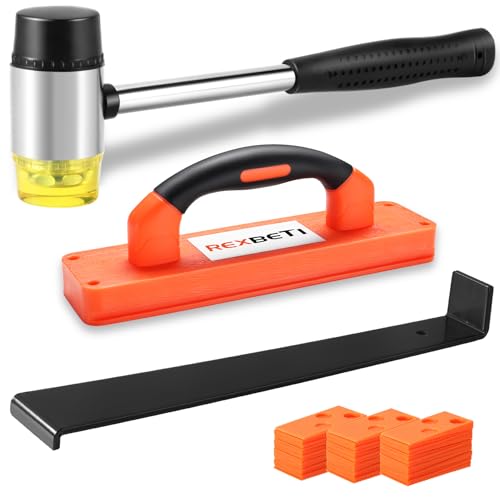
The REXBETI set specifies a 10.5-inch steel pull bar and a polypropylene tapping block with a handle, details useful if you want to compare tool shape and reach. It also has a double-faced mallet with a 1-3/8-inch head and 40 spacers. The maker says the mallet’s rubber grip helps absorb vibration. This kit suits plank work where a handled block is useful for controlled tapping. Its core assortment has no contour gauge or tape measure, so choose another set if you need those tools included rather than supplied separately.
Bottom line: Choose it if the 10.5-inch pull bar and handled block suit your fitting work.
44-Piece Kit with Claw Nail Puller

The claw nail puller and storage case distinguish this 44-piece set from kits centered only on plank fitting. It also includes an 8-ounce double-faced rubber mallet, reinforced steel pull bar with soft pads, tapping block, and 40 spacers. The maker says the mallet is non-marring, but use controlled strikes and check that the block contacts the plank edge as intended for the flooring system. The nail puller may be useful when removing old trim or nails during preparation. This set does not describe measuring or contour tools, so it is less suited to layouts that need those extras.
Bottom line: Pick it when removing trim nails is part of your floor preparation.
49-Pack Vinyl Flooring Kit

The triangular spacers are the distinctive feature here: the product says they create either a 1/4-inch or 1/3-inch wall gap. It also includes a tapping block, pull bar, and double-headed mallet with rubber and plastic striking faces. That combination suits installers who want two stated spacer gap options and a choice of striking surface. Match the gap to your flooring maker’s requirements before starting.
Bottom line: Choose it if one of its two stated spacer gaps matches your flooring instructions.
How to choose a vinyl floor install kit
Choose a kit by the work your room requires, not by piece count alone. A basic set usually centers on a tapping block, pull bar, mallet, and spacers; added tools such as a contour gauge help trace irregular edges, while a tape measure supports layout. Count the tools you will actually use, since spacer totals can make a set sound larger without adding a different function. Floating click-lock planks need joints brought together without striking the locking edge directly; use the tool arrangement recommended for the floor system. If your room has pipes, door jambs, or other shaped obstructions, favor a kit with a contour gauge or plan to supply one separately. Check the flooring instructions for required gap size before choosing spacers.
Use this need-to-tool guide to narrow the kit type:
| Room or task | Useful tool |
|---|---|
| Straight plank runs | Tapping block, pull bar, spacers |
| Irregular edges | Contour gauge and measuring tool |
| Removing trim nails | Claw nail puller |
| Matching a specified wall gap | Spacers sized to the required gap |
Vinyl plank expansion gaps and spacer fit
Floating vinyl plank floors commonly need a perimeter expansion gap, often around 1/4 inch, but the flooring maker’s required clearance controls. The gap allows the floor to move with temperature changes; tight spots at walls, pipes, or fixed cabinets can cause buckling or joint stress. Spacers hold the edge back during installation, but remove them when the floor is complete if the system requires it. Avoid assuming that every spacer fits every room: a 1/3-inch gap differs meaningfully from 1/4 inch, especially in a narrow room. Check the floor carton or installation guide for its gap and whether the same clearance applies around doorways and vertical objects before laying the first row.
Using a tapping block and pull bar safely
A tapping block transfers mallet force to the plank edge, while a pull bar draws the last row or a tight wall-side plank into position. Keep the block aligned with the flooring system’s intended contact area; hitting a locking tongue or groove directly can damage the joint. Use light, controlled mallet strikes rather than trying to force a misaligned plank into place. A pull bar provides leverage near a wall, but stop if the plank edge begins to deform. Vinyl plank cutting also requires care: cut away from your body with a sharp utility knife, keep the other hand clear of the blade path, and use a stable surface. Dry-fit awkward pieces before cutting to reduce wasted material.
Preparing the room before installing vinyl plank
Subfloor preparation matters as much as the tapping tools: the surface should be clean, dry, and within the flatness limits set by the flooring maker. Dust or grit trapped under a floating floor can interfere with fit, and abrupt high or low spots can stress joints. Let planks acclimate only when the floor instructions call for it; products differ in temperature and acclimation requirements. Remove trim carefully if it must be reused, then plan how the flooring gap will be concealed without pinning down a floating floor. Before installation, locate door jambs and pipes, measure their positions, and check that cut edges leave the prescribed clearance. Never force flooring beneath fixed objects unless the floor system permits it.
Frequently Asked Questions
How wide should a vinyl plank expansion gap be?
Many floating vinyl plank floors use a perimeter gap around 1/4 inch, but the floor maker’s required clearance takes priority. Use spacers that hold that exact gap at walls and fixed vertical obstacles.
Can laminate flooring tools be used for vinyl plank?
A tapping block, pull bar, and spacers can be useful for vinyl plank when they suit its joint design. Avoid striking the locking edge directly, since concentrated blows can damage the profile.
Do I need a contour gauge for vinyl flooring?
A contour gauge is useful when planks must fit around irregular shapes such as pipes or uneven trim. For straight walls and square corners, careful measuring may be enough.
When should I remove the flooring spacers?
Remove spacers after the plank field is installed and before fitting trim, unless the flooring system gives a different procedure. Leaving them trapped can prevent the required perimeter movement.
How flat should a subfloor be for vinyl planks?
The allowable subfloor variation depends on the flooring product, so use its flatness tolerance rather than a universal number. Clean and check the surface before installation because debris and abrupt unevenness can affect plank fit.