
Best Walkie Talkies 100 Mile Range: 5 Models Compared

TIDRADIO TD-G100 LTE PoC, 4-Pack is the closest match for 100-mile communication because its 4G LTE push-to-talk service can connect across cellular coverage, unlike conventional radios whose range depends on terrain and line of sight.
Choose a conventional radio instead if you need off-grid local communication or weather-resistant hardware; those radios do not deliver a dependable 100-mile direct radio link.
We earn a commission if you buy through links on this page. As an Amazon Associate I earn from qualifying purchases. Products are compared on manufacturer specifications, not hands-on testing.
- Best overall: TIDRADIO TD-G100 LTE PoC, 4-Pack – 4G LTE connectivity is designed for long-distance communication where compatible cellular service is available.
- Best for water use: Cobra CXT10953PH-M, 3-Pack – The floating waterproof body withstands immersion to 1 meter for 30 minutes.
- Best for rugged worksites: Retevis RB48 Heavy-Duty FRS, 4-Pack – Its feature set includes MIL-STD-810H durability testing and IP67 waterproofing.
| Product | Best for | Communication type | Claimed range | Water protection | Shop |
|---|---|---|---|---|---|
| TIDRADIO TD-G100 LTE PoC, 4-Pack | Long-distance coverage | 4G LTE PoC | 6,000+ miles | — | Check Price on Amazon |
| Cobra CXT10953PH-M, 3-Pack | Water activities | UHF/FM two-way radio | Up to 40 miles | Waterproof; floats | Check Price on Amazon |
| Retevis RB48 Heavy-Duty FRS, 4-Pack | Rugged worksites | FRS two-way radio | — | IP67; floats | Check Price on Amazon |
| Midd Kacy MK108 GMRS, 2-Pack | Hands-free operation | GMRS two-way radio | Up to 6 miles | IP55; not submersible | Check Price on Amazon |
| Midland GXT1000VP4 GMRS, 2-Pack | Weather alerts | GMRS two-way radio | Up to 36 miles | JIS4 water resistant | Check Price on Amazon |
Walkie Talkies for 100-Mile Range
The practical choice depends on whether long-distance communication through cellular networks or direct radio communication matters most.
TIDRADIO TD-G100 LTE PoC, 4-Pack

Unlike conventional walkie talkies, this 4G LTE push-to-talk set uses cellular networks for long-distance communication. TIDRADIO says it can reach 6,000+ miles, includes two SIM cards for the US, Canada and Mexico, and provides 365 days of free data. The set also includes four radios, app-based group management, 3-watt speakers and 3,000mAh batteries.
Choose it when cellular service is available along the route and broad coverage matters more than a direct radio link. Cellular dead zones are the key limitation: LTE PoC radios cannot connect where their required network service is absent.
Bottom line: Pick this for long-distance push-to-talk where cellular coverage is available.
Cobra CXT10953PH-M, 3-Pack
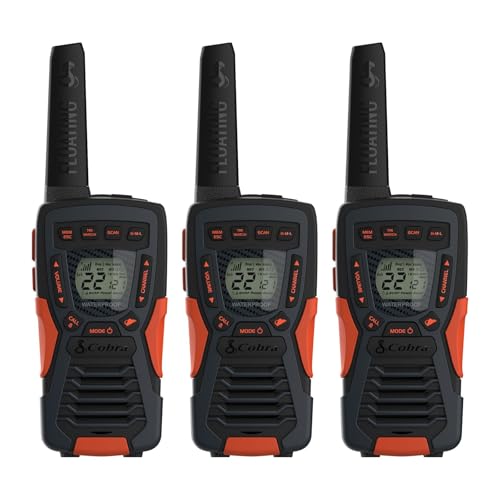
The standout feature here is water recovery: the radio floats and withstands immersion to 1 meter for 30 minutes. Cobra says the set reaches up to 40 miles, and it combines 22 channels with 121 privacy codes for 2,662 combinations. The three-pack also has belt clips and rubberized grips.
This is a better fit for nearby group communication around water than for a 100-mile goal. The 40-mile figure is an ideal-condition ceiling, not a dependable everyday distance; terrain, buildings and obstructions reduce direct-radio range.
Bottom line: Choose this for water-oriented local communication, not a 100-mile link.
Retevis RB48 Heavy-Duty FRS, 4-Pack

Durability distinguishes this four-radio set: Retevis says the RB48 passed 19 tests, including temperature shock, rain, dust, vibration, drops and immersion, and lists MIL-STD-810H testing. It also has IP67 protection, a floating design, NOAA weather capability, vibration alert, SOS and dual PTT controls.
Those features suit harsh work areas where radios may be dropped or exposed to water. This is an FRS radio, not a cellular PoC system, and the maker does not give a range figure to support a 100-mile expectation.
Bottom line: Choose this for a rugged local-radio setup where durability is the priority.
Midd Kacy MK108 GMRS, 2-Pack

Hands-free use is the differentiator: VOX offers nine sensitivity levels, while dual watch monitors A and B channels. The two-radio GMRS set has 60 channels, 121 privacy codes, NOAA alerts, FM radio and rechargeable batteries. The manufacturer gives approximate ranges of 6 miles in open areas, 5 miles in suburbs and 3 miles in cities.
Its IP55 rating resists rain, splashes and dust, but the radio should not be submerged. The range is far short of 100 miles, so this set suits local coordination rather than long-distance communication.
Bottom line: Pick this for short-range coordination when hands-free VOX is useful.
Midland GXT1000VP4 GMRS, 2-Pack

Weather awareness and backup power distinguish this GMRS pair: it scans NOAA weather channels and supports both rechargeable NiMH packs and AA cells. The set includes two radios, headsets, a desktop charger, 50 channels, 142 privacy codes and hands-free voice activation. Midland says the maximum range is up to 36 miles.
That range claim is not a reliable 100-mile direct connection; hills, trees and buildings can sharply limit radio-to-radio reach. Choose this for local outings where weather scanning and AA-cell backup matter more than extreme distance.
Bottom line: Choose this for local GMRS use with weather scanning and AA backup.
How to Get a 100-Mile Walkie-Talkie Connection
A 100-mile connection generally requires network infrastructure, not just a more powerful handheld radio. Direct two-way radios depend on line of sight; the radio horizon between two people standing on level ground is only a few miles, and hills, buildings and trees reduce it further. Cellular push-to-talk radios route voice through 4G LTE networks, extending communication wherever compatible service is available.
For routes that cross rural dead zones, consider a satellite communicator or a repeater-based radio system designed for the area rather than assuming an advertised maximum range is guaranteed. With no cellular coverage and no repeater access, choose conventional radios for nearby coordination and agree on a backup plan before separating.
Range Claims and Radio Types
FRS, GMRS and LTE push-to-talk radios work differently, so their range claims are not interchangeable. FRS and GMRS handhelds transmit directly or through compatible repeaters; LTE PoC radios use a mobile network and usually require an active service plan after any included data period ends. Confirm network compatibility and ongoing data terms before relying on an LTE radio for regular use.
Use this comparison to match the communication method to the route:
| Radio type | How it connects | Key constraint |
|---|---|---|
| FRS or GMRS | Direct radio; some GMRS systems use repeaters | Terrain and line of sight limit reach |
| LTE PoC | Cellular network | Needs compatible coverage and service |
| Satellite communicator | Satellite network | Needs a clear sky view and compatible plan |
For a 100-mile goal, choose LTE PoC when the entire route is within supported mobile coverage; choose a satellite option if it is not.
What Terrain Does to Radio Range
Obstructions matter more than a radio’s channel count when you need reliable direct communication. A clear view across open water or flat land can extend handheld range, while ridges, dense forest and urban buildings block or absorb signals. Elevation can help: moving to a hilltop or upper floor may restore a path that fails at street level.
Test a route at the locations where the group will actually communicate, especially around bends, valleys and buildings. Treat a manufacturer’s maximum as an ideal-condition estimate, not a safe distance for coordinating a group. If separation could create a hazard, carry a second communication method rather than relying on one handheld radio.
Waterproof Ratings and Field Use
IP ratings describe water and dust ingress protection, while floating behavior is a separate design feature. IP67 generally indicates dust-tight protection and temporary immersion under specified lab conditions; IP55 protects against dust ingress and water jets but is not a submersion rating. JIS4 refers to splash resistance, not a guarantee that a radio can be submerged.
Choose protection based on exposure: for a radio likely to fall into water, check both its immersion rating and whether it floats. Keep charging ports closed and dry before charging, and rinse off salt or grit only as the manufacturer permits. NOAA weather reception can provide alerts, but it does not replace a reliable two-way contact plan.
Frequently Asked Questions
Can handheld walkie talkies really reach 100 miles?
A direct handheld-to-handheld link rarely reaches 100 miles because the Earth and terrain block line of sight. LTE push-to-talk can span that distance only where compatible cellular coverage is available.
Do LTE walkie talkies work without cell service?
No, LTE push-to-talk radios need a compatible cellular network to relay communication. A conventional radio or satellite communicator is a better choice for areas without mobile coverage.
How far apart can GMRS radios work?
GMRS handheld range depends on terrain, antenna height and obstructions, and published maximums assume favorable conditions. A GMRS repeater can extend coverage when both radios can reach a properly configured, compatible repeater.
Do I need a license to use GMRS radios?
In the United States, GMRS operation requires an FCC license, though the license covers eligible immediate family members without an exam. FRS radios do not require an individual license, so confirm which service a radio uses before transmitting.
What is the difference between FRS and GMRS radios?
Both are UHF personal radio services, but GMRS allows higher power and repeater use under FCC rules, while FRS radios are limited to lower power and cannot use repeaters. GMRS requires an FCC license in the United States.