
Best Wall Mounted Drying Rack: 4 Models Compared

The Scisum wall mounted drying rack suits most people who need a compact rack with a higher stated load limit: it supports up to 100 pounds and has seven rods. Choose a wider rack instead if you need more hanging span, or verify the mounting requirements before installation.
A wall mounted drying rack folds back against a wall to free floor space, but the wall and fasteners must safely bear the wet laundry load.
We earn a commission if you buy through links on this page. As an Amazon Associate I earn from qualifying purchases. Products are compared on manufacturer specifications, not hands-on testing.
- Best overall: Scisum 28-Inch Wall Rack – Seven horizontal rods and a 100-pound capacity distinguish this 28-inch rack.
- Best for wider loads: 40-Inch Six-Rod Wall Rack – Its 40-inch width gives more span than the other options.
- Best for stated drying area: Zetez 31.5-Inch Five-Rod Rack – Five rods provide about 13.2 linear feet of drying space.
- Best for stainless steel rods: Vikaqi 32-Inch Five-Rod Rack – Its five drying rods are stainless steel, and the rack is 32 inches wide.
| Product | Best for | Width | Rod count | Maximum load | Shop |
|---|---|---|---|---|---|
| Scisum 28-Inch Wall Rack | Higher load claim | 28 in | 7 | 100 lb | Check Price on Amazon |
| 40-Inch Six-Rod Wall Rack | Widest hanging span | 40 in | 6 | 60 lb | Check Price on Amazon |
| Zetez 31.5-Inch Five-Rod Rack | Linear drying space | 31.5 in | 5 | 60 lb | Check Price on Amazon |
| Vikaqi 32-Inch Five-Rod Rack | Stainless steel rods | 32 in | 5 | 60 lb | Check Price on Amazon |
Wall Mounted Drying Racks Compared
Compare the widths, rod materials, and load claims against your available wall space and installation surface.
Scisum 28-Inch Wall Rack
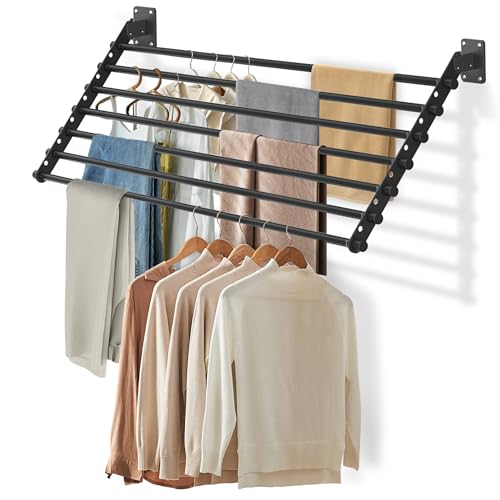
The Scisum stands apart with seven horizontal rods and a capacity of up to 100 pounds, while the other models have five or six rods and claims up to 60 pounds. Its 28-inch width suits a compact laundry nook, and the fold-flat design helps keep the floor clear between loads. Two hanging angles, 90 degrees and 45 degrees, let you change the rack position. The alloy steel brackets are 3 mm thick. A smaller width means less side-to-side hanging span than the 32- and 40-inch options.
Bottom line: Pick this if a compact width and higher stated load limit matter more than a wider span.
40-Inch Six-Rod Wall Rack

The 40-inch rack offers the widest span among these choices, with six stainless steel rods and a 60-pound capacity. Its broad layout can help when a narrower rack would crowd garments together, provided the installation wall has enough clear width. A wall template is included, and the rack is designed to fold away when not in use. The specifications do not establish a particular wall-fastener method, so verify compatible mounting hardware and support before hanging a wet load.
Bottom line: Choose this when your wall has room for a 40-inch rack and hanging width is the priority.
Zetez 31.5-Inch Five-Rod Rack

The Zetez is the only option with a drying-area measurement: approximately 13.2 linear feet across five rods. The rack measures 31.5 inches wide and combines a carbon steel back panel with rust-resistant aluminum rods. Its 60-pound support limit applies when securely mounted into wooden studs, making the mounting surface a key part of the decision. The garment estimate is 8–12 pieces depending on weight; bulky towels or heavier items can reduce how much fits comfortably.
Bottom line: Choose this if a linear drying area and wooden-stud mounting suit your laundry setup.
Vikaqi 32-Inch Five-Rod Rack

The Vikaqi provides a middle-width option at 32 inches, with five stainless steel rods and a capacity of up to 60 pounds. Its mounting holes align with wall studs, and a wall template is included to help position the rack. The folding mechanism retracts the rack against the wall when idle. Compared with the seven-rod Scisum, this model has fewer rods and a lower stated load limit; its advantage is a narrower footprint than the 40-inch rack without giving up stainless steel rod construction.
Bottom line: Pick this for a 32-inch wall area and a five-rod stainless steel layout.
How to choose a wall mounted drying rack
Start with the wall width, then compare rod count and the load claim. These four racks span 28 to 40 inches and have five to seven rods; the published maximum loads range from 60 to 100 pounds. A wider rack spreads clothes over more horizontal space, while additional rods add hanging lines within a compact width. Linear drying footage is useful when supplied, but width alone does not tell you the usable line length. For a wall space under 30 inches, the 28-inch model is the only fit among these choices; leave clearance for the rack to open and for garments to hang freely.
Mounting is as important as the rack’s capacity. Wet fabric weighs more than dry fabric, and a weak anchor or unsuitable wall can fail before the rack reaches its rated limit.
Wall width, rods, and drying space
Rod count and width shape how laundry can be spread out: five rods appear on the 31.5- and 32-inch models, six on the 40-inch model, and seven on the 28-inch model. More rods do not automatically mean more total drying footage, so use a linear-foot figure when comparing that specific measure. The Zetez gives an approximate 13.2 feet; the other options do not provide a comparable figure here.
This table helps match the rack’s dimensions and claimed load to a simple space constraint. Measure the wall section and ensure the opening path is clear before choosing.
| Need | Choose by spec |
|---|---|
| Wall area under 30 in wide | 28-in rack |
| Maximum width among choices | 40-in rack |
| More rods in a compact width | Seven-rod, 28-in rack |
| Stated linear drying area | 13.2-ft Zetez rack |
Mounting and safe load limits
A rack’s capacity claim depends on secure installation, not just its frame. The Zetez specifies mounting into wooden studs for its 60-pound support claim, and the Vikaqi’s mounting holes align with wall studs. The other claims do not establish a specific fastener method, so confirm the correct anchors for your wall and rack before mounting. Do not treat a maximum load as a target for everyday use: distribute garments across rods and avoid loading one end heavily.
Keep the rack away from doors and walkways, and make sure the fold-out arms lock or stay in their intended position before adding laundry. If the wall material or stud location is uncertain, resolve that before installation rather than relying on a drywall anchor to carry a heavy wet load.
Air-drying and rack care
Air-drying works best when garments have room for airflow. Leave gaps between items and avoid overlapping layers; crowded fabric dries more slowly, especially in humid rooms with little ventilation. A rack that folds away can reclaim floor space, but allow clothes to finish drying before folding it closed.
Material affects routine upkeep: stainless steel rods are used on two options, while the Zetez pairs aluminum rods with a carbon steel back panel and the Scisum uses alloy steel brackets. Wipe moisture from metal parts and check the pivots and mounting points periodically for looseness or corrosion. Follow garment care labels for drying temperature and placement, particularly for delicate fabrics.
Frequently Asked Questions
How much weight can a wall mounted drying rack hold?
The four options here claim maximum loads of 60 or 100 pounds. The Zetez ties its 60-pound claim to secure installation into wooden studs; the wall, anchors, and load distribution affect safe use.
How wide should a wall mounted drying rack be?
Measure the usable wall span and reserve space for the rack to open; these models range from 28 to 40 inches wide. If the available span is under 30 inches, only the 28-inch option fits within the widths.
Are more rods better for drying clothes?
More rods provide more hanging lines, but they do not guarantee more total drying footage. For example, the 28-inch rack has seven rods, while the Zetez has five rods and a 13.2 linear feet of drying area.
Can I mount a drying rack on drywall?
A loaded drying rack should be secured to framing or with hardware specifically rated for the wall and load; drywall alone is not a dependable support surface for heavy wet laundry. One model specifies wooden-stud mounting for its 60-pound support claim.
How much space should I leave between clothes on a drying rack?
Leave visible gaps so air can move around each garment, and avoid layering wet items. In a humid room or with poor airflow, increase the spacing because drying takes longer.