
Best Waterproof Bag for Snorkeling: 4 Picks Compared

For most snorkelers carrying a phone and small valuables, Booe Waterproof Belt Bag is the strongest fit because its maker says it is IP67 submersible to 1 meter for 30 minutes. Choose a larger dry bag instead if you need room for towels or clothing, rather than a compact waist pack.
We earn a commission if you buy through links on this page. As an Amazon Associate I earn from qualifying purchases. Products are compared on manufacturer specifications, not hands-on testing.
- Best overall: Booe Waterproof Belt Bag – The maker specifies IP67 submersion to 1 meter for 30 minutes and a touchscreen-friendly phone pocket.
- Best for deeper submersion claims: AiRunTech Waterproof Fanny Pack – Its maker claims triple zip-lock protection to 32 feet underwater.
- Best for more gear: Earth Pak 20L Roll-Top Dry Bag – Its 20-liter capacity and roll-top closure suit carrying more than phone-sized essentials.
- Best for a compact dry bag: HEETA 5L Dry Bag – The 5-liter bag has adjustable shoulder straps and a side handle.
| Product | Best for | Capacity | Carry style | Water-use claim | Shop |
|---|---|---|---|---|---|
| Booe Waterproof Belt Bag | Phone and essentials | — | Waist or crossbody | 1 m for 30 min (IP67) | Check Price on Amazon |
| AiRunTech Waterproof Fanny Pack | Small valuables | — | Waist pack | 10 m (maker claim) | Check Price on Amazon |
| Earth Pak 20L Roll-Top Dry Bag | Extra gear | 20 L | Shoulder strap | Keeps gear dry on water (maker claim) | Check Price on Amazon |
| HEETA 5L Dry Bag | Light dry storage | 5 L | Shoulder straps or hand carry | Accidental submersion only | Check Price on Amazon |
Waterproof Bags for Snorkeling
Match the bag’s size and stated water protection to what you plan to carry and how it will be exposed.
Booe Waterproof Belt Bag

For a phone and a few small valuables, this belt bag has the clearest submersion limit among these compact options: its maker says it is IP67-rated for up to 1 meter for 30 minutes. The airtight TRU Zip closure and clear phone pocket are intended for use around water, and the pack can be worn at the waist or crossbody. Its size makes it a better match for essentials than spare clothes or snorkeling gear. The maker says it fits all phones, but check your phone and case dimensions before relying on the fit.
Bottom line: Choose this for a compact carry option with a specific submersion limit.
AiRunTech Waterproof Fanny Pack
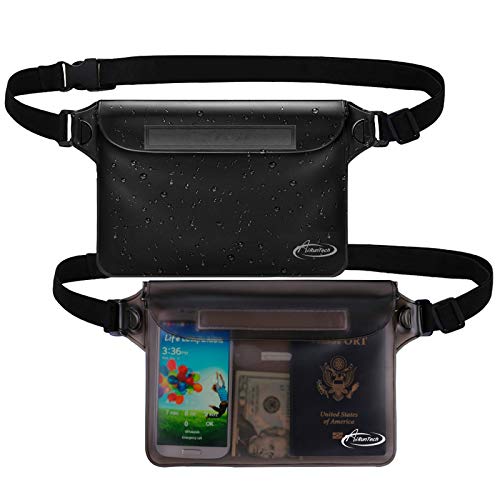
Unlike the other compact pack, this fanny pack separates phone access from valuables: its maker describes a translucent touchscreen-friendly pouch and an opaque pouch for items such as an ID, cash, cards, or passport. The maker claims triple zip-lock protection to 32 feet underwater, a substantially deeper limit than the 1-meter claim on Booe Waterproof Belt Bag. Its 8.5-by-5.8-inch size is suited to personal essentials, not bulky gear. If you plan to keep a phone submerged, treat the depth as the maker’s claim and make sure the closures are fully sealed.
Bottom line: Pick this if you want separate phone and valuables compartments.
Earth Pak 20L Roll-Top Dry Bag

For carrying more than phone-sized essentials, this 20-liter roll-top dry bag offers far more storage than the belt packs. It is made from abrasion-resistant 500D PVC and includes an adjustable 24-to-42-inch shoulder strap, plus an IPX8-certified phone case. The bag is aimed at activities such as kayaking, boating, and paddleboarding, so it is a related choice when snorkeling includes carrying extra gear to the water. Its larger shape is less convenient for keeping valuables close while swimming; the maker’s dry-storage claim does not give a submersion depth for the bag itself.
Bottom line: Choose this when extra storage matters more than a close-fitting phone pouch.
HEETA 5L Dry Bag
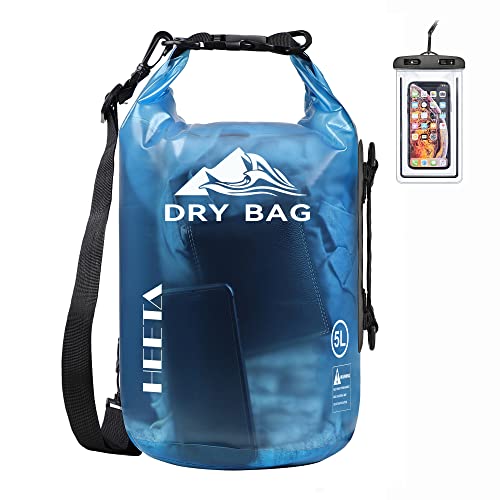
Smaller than the 20-liter roll-top option, this 5-liter bag is a compact choice for light dry storage rather than a phone belt pouch. It has adjustable shoulder straps and a side handle, so it can be carried as a small backpack or by hand. The maker says its seamless construction can handle accidental submersion, but not extended time underwater; that limitation matters if the bag will be submerged while snorkeling. Its PVC body is 0.6 millimeters thick at the bottom and 0.3 millimeters on the sides.
Bottom line: Pick this for a small amount of gear carried to the water, not extended submersion.
How to choose a waterproof snorkeling bag
Choose by exposure first: a phone pouch worn while swimming needs a clear submersion limit, while a dry bag carried between shore and boat may mainly need splash protection. IP67 means dust-tight and protection against immersion in up to 1 meter of water for 30 minutes under the rating test; it does not mean suitable for deeper snorkeling. IPX8 indicates immersion protection under conditions specified by the manufacturer, so the rating alone does not tell you a universal depth. For a bag with no specific depth claim, keep it out of prolonged underwater use.
For phone-only essentials, a waist or crossbody pack stays closer to your body. For clothing or towels, compare capacity: 5 liters is compact, while 20 liters has more room but is bulkier to swim with.
What size bag works for snorkeling
A small phone pouch or belt bag is usually the practical choice when you only need a phone, ID, and cards; larger dry bags make sense for gear carried to the water rather than worn while swimming. The 5-liter and 20-liter options here differ by four times in nominal capacity, so choose based on the actual items you need to keep dry. A roll-top closure also needs space at the top to fold and secure it, which reduces usable room.
Use this simple rule: if the bag must stay on you in the water, choose a compact pack; if it will hold spare clothing or towels, choose a larger dry bag and leave it ashore or with a boat. Keep heavy or sharp objects out of a small pouch that could press against your phone.
Waterproof ratings and snorkeling limits
IP ratings distinguish specific kinds of protection, but they do not make every bag appropriate for every depth. IP67 covers immersion up to 1 meter for 30 minutes in the rating test, while IPX8 conditions are set by the manufacturer and need a depth and duration to judge deeper use. A maker’s depth claim for another closure system is not an IP rating, so compare the actual stated conditions rather than treating numbers as equivalent.
Use this decision rule: if your planned depth exceeds a bag’s limit—or the maker provides no depth—do not take it underwater. Even with a rated bag, close every seal completely and test it with a dry paper towel before putting in electronics or documents.
Keeping phones and valuables dry
Phone touchscreens can behave unpredictably through waterproof plastic, and wet fingers can make taps unreliable; set up navigation or camera functions before entering the water. A touchscreen-friendly pouch does not guarantee every phone or case will fit, so check the phone’s dimensions against the pouch opening and interior before use. Do not assume a clear panel makes a bag suitable for taking underwater photos unless its maker says so.
Waterproof bags are a barrier, not a substitute for careful handling. Rinse salt and sand from closures with fresh water after a snorkeling trip, then let the bag dry fully before storing it. Inspect seals for grit, tears, or deformation; a damaged closure can compromise protection even when the bag’s rating is unchanged.
Frequently Asked Questions
Can I take a phone underwater in a snorkeling bag?
Only use a pouch with an immersion limit that covers your planned depth and duration. An IP67 rating covers up to 1 meter for 30 minutes in the rating test, not deeper snorkeling.
What does IP67 mean for a waterproof bag?
IP67 means dust-tight and tested for immersion in up to 1 meter of water for 30 minutes. It is not a general guarantee for deeper or longer submersion.
How do I check whether my phone fits?
Compare the phone’s dimensions, including its case, with the usable pouch space and opening. Test touchscreen access before entering the water because plastic and wet fingers can affect touch response.
Should a roll-top dry bag be submerged?
Only submerge a dry bag when its maker gives a submersion limit that covers your use. Roll the top closed as directed and leave room for multiple folds; splash protection alone is not a depth rating.
How should I care for a snorkeling bag?
Rinse salt and sand from closures with fresh water after use, then dry the bag fully before storage. Check seals for grit, tears, or distortion before each trip.