
Best Wire Connectors for Automotive: 5 Types Compared

For most automotive repairs that need several connector styles, Kuject 320-Piece Heat-Shrink Terminal Kit is the most versatile choice because its 320-piece kit combines heat-shrink butt, ring, fork and spade terminals. Choose Seamaka 1-6 Pin Waterproof Connector Kit instead when the job calls for sealed multi-pin plugs, or Nilight 120-Piece T-Tap Terminal Kit for tapping an existing wire without cutting it apart.
Automotive wire connectors join, branch or terminate conductors; the right style depends on the circuit and whether the connection needs to unplug, splice or tap into a wire.
We earn a commission if you buy through links on this page. As an Amazon Associate I earn from qualifying purchases. Products are compared on manufacturer specifications, not hands-on testing.
- Best overall: Kuject 320-Piece Heat-Shrink Terminal Kit – A 320-piece assortment includes butt splices plus ring, fork and spade terminals.
- Best for multi-pin plugs: Seamaka 1-6 Pin Waterproof Connector Kit – Includes 1- through 6-pin housings, terminals, seals and a ratcheting crimper.
- Best for wire taps: Nilight 120-Piece T-Tap Terminal Kit – T-tap terminals let you branch from an existing wire and include male quick disconnects.
| Product | Best for | Connector style | Wire range | Pack size | Shop |
|---|---|---|---|---|---|
| Kuject 320-Piece Heat-Shrink Terminal Kit | Mixed terminal repairs | Butt, ring, fork, spade | — | 320 pieces | Check Price on Amazon |
| Seamaka 1-6 Pin Waterproof Connector Kit | Multi-pin harness plugs | 1-6 pin plug housings | 16-22 AWG | 1,008 pieces | Check Price on Amazon |
| Kuject 120-Piece Solder-Seal Splice Kit | Heat-activated splices | Solder-seal butt splices | 10-26 AWG | 120 pieces | Check Price on Amazon |
| Nilight 2-Pin 16 AWG Waterproof Pigtails | Two-wire plug repairs | 2-pin pigtail connector | 16 AWG | 10 connectors | Check Price on Amazon |
| Nilight 120-Piece T-Tap Terminal Kit | Branching existing wires | T-taps and disconnects | 10-22 AWG | 120 pieces | Check Price on Amazon |
Automotive Wire Connectors Compared
Match the connector format to whether the repair splices, branches, terminates or unplugs the wire.
Kuject 320-Piece Heat-Shrink Terminal Kit
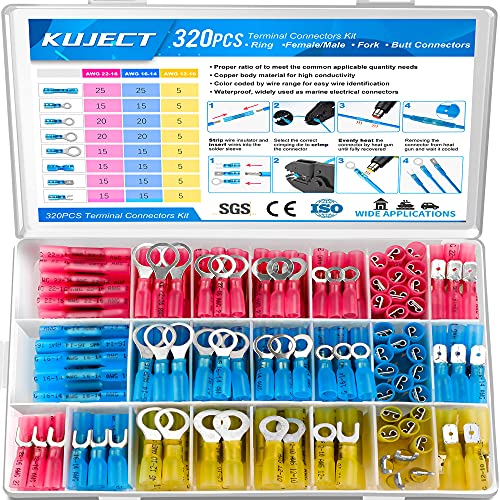
For a mixed repair kit, this set covers more termination styles than a kit limited to one connector type. It includes heat-shrink butt connectors alongside ring, fork and spade terminals, so it can handle wire splices as well as connections to studs or tabs. The maker says its adhesive-lined tubing seals when heated and its copper core supports conductivity; use a compatible crimp tool for the crimp terminals and a heat source suitable for the tubing.
Bottom line: Choose this set when one repair kit needs several terminal styles.
Seamaka 1-6 Pin Waterproof Connector Kit

This kit is the specialized choice for making detachable harness connections: it supplies 1- through 6-pin housings rather than assorted ring and spade terminals. The 1,008-piece assortment includes male and female terminals, rubber cable seals, and a ratchet crimper; the wire fit is 16-22 AWG. The maker describes the plastic housings and brass terminals as suited to waterproof, dustproof connections.
Bottom line: Pick this for building a sealed multi-pin connection in 16-22 AWG wire.
Kuject 120-Piece Solder-Seal Splice Kit

This solder-seal kit differs from crimp-style assortments because the butt splice is designed to join wires with heat rather than a crimping step. The maker says a heat gun activates the solder ring and adhesive sealing rings, and gives a 10-26 AWG range across the color-coded connectors. That makes it useful where a sealed inline splice is wanted and access allows heat-gun use. It does not provide ring, fork or plug terminals, and the joint requires controlled heating, so it is not the pick for a repair that needs varied terminal shapes or no heat source.
Bottom line: Choose these for heat-activated inline splices across the wire range.
Nilight 2-Pin 16 AWG Waterproof Pigtails

For a straightforward two-wire disconnect, these prewired 2-pin connectors avoid assembling a multi-pin housing from loose terminals. Each connector has male and female ends with 10 cm wire leads, a rubber seal, and a rectangular two-position housing; the pack contains 10. The maker gives an operating temperature range of -40°C to +120°C and describes the connectors as waterproof and dustproof. The fixed 16 AWG leads and two-pin format limit flexibility, so these are not appropriate when the harness needs another gauge, pin count or terminal shape.
Bottom line: Use these for a two-wire, 16 AWG connection that needs to unplug.
Nilight 120-Piece T-Tap Terminal Kit

This kit is for adding a branch to an existing wire, not joining two cut wire ends: its self-stripping T-taps connect to a male quick-disconnect terminal. The 120 pieces comprise 60 T-taps and 60 disconnects, in red, blue and yellow for 22-10 AWG wire. The maker says the nylon housings lock closed and the tinned-copper contacts aid conductivity. A tap is useful only when its wire size and terminal arrangement fit the circuit; this kit does not supply sealed plug housings or heat-shrink butt splices.
Bottom line: Pick these when a branch connection to an existing wire is the goal.
How to choose automotive wire connectors
Choose by the electrical job first: splice two wire ends, branch from a live run, terminate at a stud or make a plug that can disconnect. Wire gauge is the next filter; a connector barrel must match the conductor, not just its insulation. Automotive stranded wire is commonly identified by AWG, where a smaller number means thicker wire. For crimp terminals, use the correct crimp profile and a snug pull check after crimping; loose crimps can add resistance and heat. For a splice exposed to moisture, use a sealed connector and keep the seal intact around the insulation. Never choose a connector by color alone unless its gauge range is verified.
| Repair need | Connector type | Key fit check |
|---|---|---|
| Join two cut wires | Butt splice | Wire gauge and splice method |
| Branch from an existing wire | T-tap | Wire size and terminal match |
| Disconnect a harness | Multi-pin plug | Pin count and gauge |
| Attach to a stud or tab | Ring or spade terminal | Terminal shape and mating point |
Wire gauge, terminals and fit
AWG fit determines whether a connector can grip the conductor securely: 16 AWG is thicker than 22 AWG, and a terminal intended for the wrong range may loosen or damage strands. For a 16-22 AWG harness, choose a connector explicitly sized for that span; for 10-26 AWG solder-seal assortments, match the individual color-coded connector to its wire rather than assuming every piece accepts the full range. Ring terminals fit over a stud, while fork terminals can be removed from a loosened screw without taking the screw fully out. Check the terminal barrel and the mating hardware before cutting wire; mismatched pin count or terminal shape means rework.
Sealed, solder-seal and crimp connections
Sealed automotive connectors protect a joint only when the wire seal fits and the housing is fully assembled. Adhesive-lined heat-shrink connectors form a sleeve around an inline splice; solder-seal versions use heat to melt a solder ring as well as shrink the tubing. Crimp butt connectors use compression, so the wire gauge and tool die must match. Heat application requires care: keep a heat gun clear of fuel, solvent, insulation and nearby components, and avoid open flame around vehicle wiring. In engine bays and under vehicles, routing and strain relief matter as much as the connector; a sealed joint still needs support so vibration does not pull on its wires.
Common automotive connector mistakes
The most common mistake is using a tap, splice and plug as if they did the same job. A T-tap branches from an uncut conductor, a butt connector joins two ends, and a multi-pin connector lets a harness disconnect. Another mistake is treating waterproof claims as permission to submerge any connection: enclosure, wire seals, installation and exposure all affect protection. Disconnect the battery before working on vehicle wiring, especially near airbag circuits or high-current feeds; consult the vehicle service procedure for circuits that retain power. Avoid twisting stranded wires into a terminal not designed for them, and do not leave a crimp unsupported where vibration can flex it.
Frequently Asked Questions
Can heat-shrink connectors be used in a car?
Yes, heat-shrink connectors can suit automotive splices when the connector matches the wire gauge and the seal is heated correctly. Keep heat away from fuel vapors, plastics and nearby wiring, and support the finished joint against vibration.
What is the difference between a T-tap and butt connector?
A T-tap branches from an existing wire without cutting it into two ends, while a butt connector joins two wire ends inline. Match the terminal’s gauge range to the conductor before installation.
Are waterproof automotive connectors fully submersible?
A waterproof claim does not by itself establish a safe submersion depth or duration. Keep seals correctly seated and verify the protection rating required for the actual exposure.
Should the car battery be disconnected before wiring repairs?
Disconnect the battery before ordinary wiring work to reduce short-circuit risk, but follow the vehicle procedure around airbag circuits and other systems that retain power. High-current circuits can cause burns or fires if bridged with a tool.