
Bicycle Crank Removal Tool: 5 Options Compared

Pawfly Crank Puller Set suits the widest range of crank systems here because it names square taper, Octalink, ISIS, PowerSpline, and other splined cranks. Choose a different puller if you have a square-taper crank and want a compact standalone tool, or if your crank requires Park Tool’s specific puller.
A crank puller threads into the crank arm and presses against the spindle to remove the arm after its fixing bolt is removed.
We earn a commission if you buy through links on this page. As an Amazon Associate I earn from qualifying purchases. Products are compared on manufacturer specifications, not hands-on testing.
- Best overall: Pawfly Crank Puller Set – Its compatibility covers square taper and several common splined crank systems.
- Best for bottom bracket work: Oumers Crank and Bottom Bracket Tool Set – The set includes a 20-tooth bottom bracket remover and a 16 mm wrench.
- Best for square taper: Park Tool CCP-22 – It fits square-taper spindles and SRAM Power Spline cranks, but not ISIS or Octalink.
| Product | Best for | Crank compatibility | Included extras | Tool size | Shop |
|---|---|---|---|---|---|
| Pawfly Crank Puller Set | Wide compatibility | Square taper, Octalink, ISIS, PowerSpline | 20-tooth socket, wrench, top cap | — | Check Price on Amazon |
| LBOKLING Crank Puller | Compact carry | Square taper, splined cranks | Removable cap | 3.15 × 0.94 × 0.7 in. | Check Price on Amazon |
| Fuaynlk Crank Puller | Compact puller | Square taper, splined cranks | Removable cap | 3.15 × 0.94 × 0.79 in. | Check Price on Amazon |
| Park Tool CCP-22 | Square-taper cranks | Square taper, SRAM Power Spline | — | 4.5 × 1 in. | Check Price on Amazon |
| Oumers Crank and Bottom Bracket Tool Set | BB socket included | Square taper, 20-tooth splined | 20-tooth socket, 16 mm wrench | — | Check Price on Amazon |
Bicycle Crank Removal Tools Compared
Match the puller’s thread and spindle compatibility to your crank before removing an arm.
Pawfly Crank Puller Set
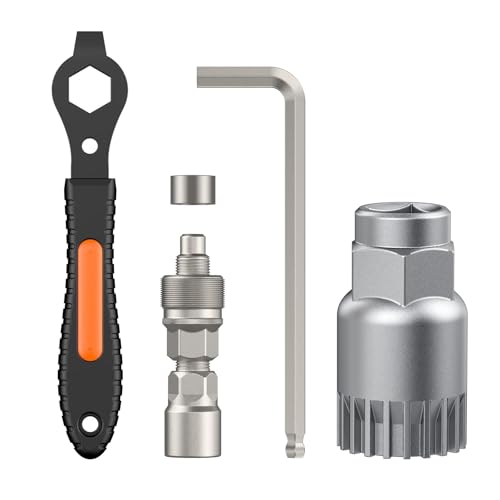
Pawfly Crank Puller Set names more crank systems than the other pullers here, including square taper, Shimano Octalink, ISIS, and SRAM PowerSpline. The set also includes a 20-tooth socket, wrench, and top cap, so it can serve for crank work and some bottom bracket tasks. Its high-carbon steel construction has a three-layer electroplated, sandblasted finish, and the maker specifies an 80 mm threaded shaft. This is the most adaptable choice when you work on different crank standards. Its compatibility still does not guarantee a fit for every splined crank; confirm the crank standard before starting.
Bottom line: Pick this set if you need one puller for several named crank standards and want bottom bracket tools included.
LBOKLING Crank Puller

LBOKLING Crank Puller is a compact standalone puller for square-taper and splined cranks, measuring 3.15 × 0.94 × 0.7 inches. Its removable cap is designed for oversized spindles, and the maker says the extended jacking rod improves operation. Carbon steel with a quenching process is the specified construction. This suits a rider who wants a small crank-removal tool in a home or travel kit rather than a broader set. The compatibility wording does not identify individual splined standards, so verify that the puller matches your crank before applying force.
Bottom line: Choose this compact puller for square-taper or compatible splined cranks when portability matters.
Fuaynlk Crank Puller

Fuaynlk Crank Puller has a similar compact form to LBOKLING Crank Puller, but measures 3.15 × 0.94 × 0.79 inches. The maker says its removable dual-function cap accommodates oversized spindles and its longer jacking rod aids use. It is made from carbon steel with a quenching process. This is a straightforward option for a mechanic who needs a standalone puller for square-taper or compatible splined arms. Unlike Pawfly Crank Puller Set, it does not include a bottom bracket socket or wrench. Its broad splined-crank wording leaves the specific standard to verify against your crank.
Bottom line: Pick this standalone puller if its dimensions suit your kit and your crank standard is compatible.
Park Tool CCP-22

Park Tool CCP-22 is a model-specific choice for cranks using 22 mm × 1 threads and square-taper bottom bracket spindles; it also fits SRAM Power Spline cranks with an 8 mm thread bolt. The steel puller has a rotating tip system. The manufacturer directs users with ISIS Drive or Octalink cranks to its CCP-44 or CWP-7 instead. That limitation makes this a clear fit when your crank matches the named systems, but not a general-purpose pick for splined arms. Check the crank system and thread before choosing it.
Bottom line: Choose this puller for a matching square-taper or SRAM Power Spline crank, not ISIS or Octalink.
Oumers Crank and Bottom Bracket Tool Set
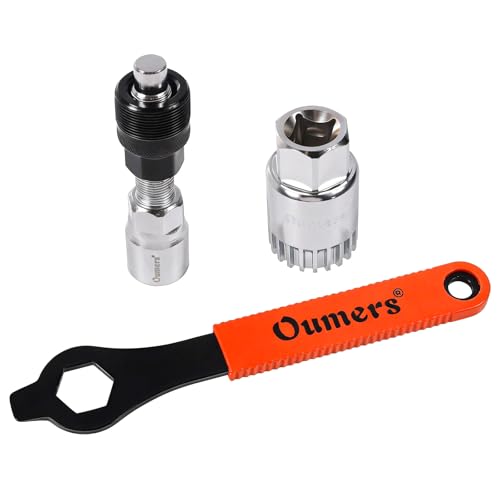
Oumers Crank and Bottom Bracket Tool Set combines a crank extractor with a 20-tooth bottom bracket remover and a 16 mm wrench. The crank puller is specified for standard square-taper cranksets and 20-tooth splined systems; the bottom bracket remover is intended for any 20-tooth splined bottom bracket. This makes the set useful when a job involves both crank removal and a compatible bottom bracket. The manufacturer says the remover can be turned with a 24 mm socket, wrench, or adjustable spanner. The 20-tooth interface is a firm limitation: count and match the notches before using the socket.
Bottom line: Choose this set when you need both a crank extractor and a matching 20-tooth bottom bracket tool.
How to choose a bicycle crank removal tool
Choose by crank standard first, then by whether you also need a bottom bracket socket. Square-taper arms and splined arms use different interfaces; splined systems include standards such as ISIS and Octalink, which are not interchangeable just because both have splines. A puller must thread into the crank arm and push against the spindle end. Remove the crank fixing bolt or nut before threading in the extractor, and engage the extractor fully before turning its forcing screw. A shallow or mismatched thread can damage the crank arm. If you cannot identify the crank system, read its marking or count the spline pattern rather than testing a near-fitting tool under load.
Use this match-up as a first filter, then check the exact crank interface.
| Crank or task | Tool requirement | Check before use |
|---|---|---|
| Square taper | Square-taper puller | Arm thread and spindle fit |
| ISIS or Octalink | Compatible splined puller | Named standard and any cap |
| Bottom bracket removal | Matching tooth-count socket | Notch count and socket drive |
Square-taper and splined crank fit
Square-taper pullers press on the end of a square spindle, while splined crank systems need clearance at the spindle end and the correct puller cap. A cap intended for oversized spindles can matter on some splined setups, but it does not make every puller compatible with every system. Before use, compare the crank’s standard with the tool’s fit and make sure the tool threads smoothly into the arm by hand. Stop if it binds or engages only a small portion of the threads; forcing it can strip the crank. A 20-tooth bottom bracket socket is a separate fit question from the crank puller, so verify tooth count independently.
Crank puller versus bottom bracket tool
A crank puller removes the arm from the spindle; a bottom bracket tool turns the bottom bracket cup or cartridge. A kit containing both can reduce tool changes during a service, but the two tools do not share an interface. Bottom bracket sockets commonly vary by tooth count and drive size, so match the socket to the component before applying leverage. With a puller, keep the tool aligned with the crank and ensure its threaded body seats squarely before turning the forcing screw. These tools transmit substantial force through small threads, so a mismatched socket or partially engaged puller can damage parts rather than loosen them.
Common crank removal mistakes
The most common mistake is trying to use a square-taper puller on an incompatible splined crank, or the reverse. Identify the crank standard before choosing a tool; if the crank says ISIS or Octalink, use a puller that explicitly supports that system. Another mistake is leaving the fixing bolt installed, which prevents the puller from reaching the spindle. Remove the bolt first, then thread the extractor body fully into the crank arm by hand. Keep the forcing screw centered on the spindle end and stop if resistance feels uneven. Do not use extra leverage to overcome a tool that is cross-threading or binding.
Frequently Asked Questions
Do I need to remove the crank bolt first?
Yes. Remove the crank fixing bolt or nut before threading in a crank puller. Some setups use a separate self-extracting cap, so identify that hardware before disassembly.
Can one crank puller fit square taper and ISIS?
Some pullers support both, but compatibility is tool-specific. Use a model that names ISIS support and its correct cap; a square-taper-only puller is not a safe substitute.
How do I tell whether a crank uses a 20-tooth bottom bracket?
Count the notches on the bottom bracket interface and compare them with the socket specification. A matching tooth count is essential, and the socket’s drive size must also fit your wrench.
Why is my crank puller not turning smoothly?
Stop if the puller binds or feels crooked; it may be cross-threaded or mismatched. Back it out and inspect the crank threads, then restart by hand with the puller aligned squarely.
Can I use a crank puller on a self-extracting crank?
Many self-extracting systems use a cap that pushes the arm off as the fixing bolt is loosened, so a separate puller may not be required. Check whether the crank has a retaining cap before removing hardware.