
Blackout Material for Projector Screens: 4 Options Compared

For a DIY projector screen, the Elite Screens CineGrey material is the clearest fit if you want a pre-cut 135-inch, 16:9 grey screen with black backing and 1.0 gain. The keyword also covers other blackout-backed fabrics, but choose a different option if you need a larger cut, a washable assembled screen, or material for a different frame size.
We earn a commission if you buy through links on this page. As an Amazon Associate I earn from qualifying purchases. Products are compared on manufacturer specifications, not hands-on testing.
- Best overall: Elite Screens CineGrey 135-inch Cut – Pre-cut 135-inch 16:9 CineGrey material pairs grey contrast-focused surface with black backing.
- Best for large DIY frames: Elastic Polyester 69 by 123 Inch – 69 by 123 inches, sized for DIY fixed frames up to 150 inches.
- Best for ambient light: Grey EPPE Ambient-Light Fabric – Grey multilayer polymer fabric has 0.85 gain and is intended for ambient-light viewing.
- Best for portable use: IOLIEO 120-Inch Foldable Screen – A complete 120-inch foldable screen is washable and suited to indoor or outdoor setups.
| Product | Best for | Screen size or cut | Material | Gain | Shop |
|---|---|---|---|---|---|
| Elite Screens CineGrey 135-inch Cut | Fixed frame DIY | 135-inch diagonal | Textured PVC | 1.0 | Check Price on Amazon |
| Elastic Polyester 69 by 123 Inch | Large DIY frames | 69 by 123 inches | Polyester textile | — | Check Price on Amazon |
| Grey EPPE Ambient-Light Fabric | Ambient-light rooms | 69 by 118 inches | EPPE polymer | 0.85 | Check Price on Amazon |
| IOLIEO 120-Inch Foldable Screen | Portable movie nights | 120-inch diagonal | Polyester screen | — | Check Price on Amazon |
Blackout material for projector screens compared
Compare the screen format, surface material, and gain before choosing a fabric for your setup.
Elite Screens CineGrey 135-inch Cut
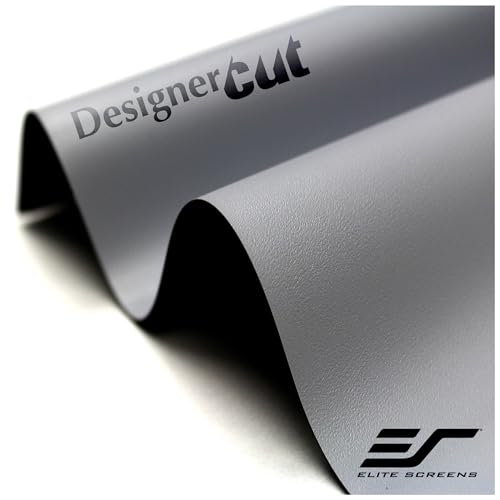
The Elite Screens CineGrey is the only pre-cut 135-inch option here, with a 16:9 view area measuring 70 by 124 inches. Its grey surface is designed for contrast enhancement, and black backing helps block light penetration. The 1.0-gain surface has a 160-degree viewing angle and can be cleaned with mild soap and water. It suits a custom fixed-frame installation when those dimensions fit; the frame is not included. This material is not compatible with triple-laser projectors, so owners of those projectors should choose another screen surface.
Bottom line: Choose this for a fixed-frame 135-inch setup, unless you use a triple-laser projector.
Elastic Polyester 69 by 123 Inch

The elastic polyester fabric offers the largest DIY frame coverage in this group: 69 by 123 inches, intended for fixed screens under 150 inches. Its light silver-gray surface is designed to improve contrast and color reproduction, while the black back blocks more than 90% of projected light from passing through. The maker says the surface has a viewing angle greater than 160 degrees and transmits sound. This is a front-projection fabric rather than a rear-projection material, and it needs to be stretched and fixed on all four sides for a frame build.
Bottom line: Choose this for a large fixed-frame front-projection build with sound passing through the screen.
Grey EPPE Ambient-Light Fabric

The grey EPPE polymer fabric is the ambient-light-oriented option, with 0.85 gain and a three-layer construction rather than a polyester textile or textured PVC surface. The maker says it retains clear imagery in daily ambient-light and reports a resolution of 125 line pairs per millimeter, plus a viewing angle above 160 degrees. The cut measures 69 by 118 inches, for a smaller maximum screen size than the larger polyester option. The grey material is not recommended by its maker for projectors below 2,000 ANSI lumens, so check projector brightness before selecting it.
Bottom line: Choose this for a grey ambient-light surface when your projector is at least 2,000 ANSI lumens.
IOLIEO 120-Inch Foldable Screen

The IOLIEO is a complete 120-inch foldable screen, not a cut of raw material for a custom fixed frame. Its black backing is intended to reduce light bleed, and the polyester screen is washable and described by its maker as wrinkle-resistant. The 16:9 size suits temporary indoor or outdoor viewing, with several mounting approaches using the included tailored accessories. Choose it when portability matters more than tailoring raw fabric to a frame. Buyers seeking only blackout fabric for a permanent DIY build should select one of the cut materials instead.
Bottom line: Choose this for a portable 120-inch screen rather than raw material for a fixed frame.
How to choose blackout projector screen material
Choose by projector type, room light, and frame dimensions before focusing on color. Grey surfaces can help preserve perceived contrast in rooms with some ambient-light, but they reduce reflected brightness compared with a white surface; the right choice depends on projector output and seating. A gain rating near 1.0 is a useful neutral reference, while lower gain such as 0.85 trades some brightness for a more controlled image. Match the fabric’s viewing angle to seating spread, and verify the usable image area rather than relying on diagonal size alone. For the CineGrey cut, the frame must accommodate a 70-by-124-inch view area.
Black backing and front projection
Black backing helps limit light passing through the screen and reflecting from the wall behind it, which matters most when the screen is mounted away from a dark, solid surface. Front-projection fabric is designed to reflect light back toward viewers; a sound-transparent weave allows speakers behind a screen but may alter image sharpness compared with a solid surface. Rear projection instead requires a material made to transmit and diffuse an image from behind, so do not use front-projection fabric for that arrangement. For a build where sound must pass through, confirm the weave and speaker placement before stretching the material; this group includes a sound-transmitting polyester option.
Screen size and frame fit
Calculate the frame opening from aspect ratio, not just diagonal. A 16:9 screen’s width is about 1.78 times its height, so a 70-inch-tall view area needs roughly 124 inches of width, before adding material for wrapping or tensioning. Leave extra fabric around the image area so all four edges can be attached evenly; uneven tension can create waves and distort geometry. Measure the finished frame’s inner opening and mounting allowance before cutting. When available wall space is below 124 inches wide, select a smaller screen format rather than trying to compress a fixed-aspect image.
Projector screen material types at a glance
Polyester textile, multilayer polymer, and textured PVC suit different installation priorities. Polyester can be flexible for DIY stretching and may permit sound passage, while polymer and PVC cuts offer defined surface properties and fixed dimensions. A complete foldable screen solves a different problem: quick setup and portability rather than custom frame fabrication.
Use this comparison to narrow the format first, then confirm the image area against your frame and projector setup.
| Need | Material direction | Fit check |
|---|---|---|
| Custom large fixed frame | Stretchable textile | Allow edge material for tensioning |
| Grey high-contrast fixed screen | Textured PVC | Match the view area |
| Temporary portable display | Foldable assembled screen | Confirm mounting method and ratio |
Frequently Asked Questions
Does black-backed screen fabric stop all light?
Black backing reduces light passing through but does not make a screen fully opaque. The polyester material here is specified to block more than 90% of projected light, so use a dark backing surface if stray light behind the screen is a concern.
Can projector screen material be used for rear projection?
Only use material intended for rear projection, which must transmit and diffuse light from behind the screen. The black-backed polyester cut here is explicitly for front projection and is not suitable for rear projection.
How much extra fabric should a DIY frame allow?
Leave several inches beyond the visible image area on each edge so the material can wrap or be tensioned on the frame. Measure the attachment method and frame depth before cutting, since the required margin changes with the build.
Will grey projector screen material work with a dim projector?
Grey material can make an image appear dimmer than a brighter white surface, and the grey EPPE fabric’s maker does not recommend it below 2,000 ANSI lumens. In a dark room or with a lower-output projector, prioritize a surface that does not sacrifice as much brightness.
How do you remove creases from folded screen fabric?
Stretch the fabric evenly across all four sides of its frame, since tension can help relax folds. Avoid high heat unless the material maker permits it, because heat can damage synthetic screen surfaces.