
BOSS 10 Inch Subwoofer Options Compared by Fit

The BOSS CH10DVC is the best fit for a conventional 10-inch subwoofer setup because its dual 4-ohm coils offer two wiring options and its mounting depth is 4.63 inches. Choose an amplified model instead if you want the amplifier and subwoofer combined in one unit.
These options include standalone drivers, which need a separate amplifier and enclosure, as well as powered subwoofers with built-in amplification.
We earn a commission if you buy through links on this page. As an Amazon Associate I earn from qualifying purchases. Products are compared on manufacturer specifications, not hands-on testing.
- Best overall: BOSS CH10DVC Chaos Series – Dual 4-ohm coils and a 4.63-inch mounting depth suit a conventional amp-and-enclosure setup.
- Best for higher RMS handling: BOSS Phantom P106DVC – Its 1,050-watt RMS rating provides the highest continuous power handling among these standalone drivers.
- Best for under-seat space: BOSS BASS10 Under Seat – The amplified subwoofer combines the driver and amp in a slim 3.15-inch-high enclosure.
| Product | Best for | Type | Shop |
|---|---|---|---|
| BOSS CH10DVC Chaos Series | Conventional installs | Standalone driver | Check Price on Amazon |
| BOSS Phantom P106DVC | Higher RMS handling | Standalone driver | Check Price on Amazon |
| BOSS BASS10 Under Seat | Under seat installations | Amplified subwoofer | Check Price on Amazon |
| BOSS BAB10 Amplified Subwoofer | Remote control | Amplified subwoofer | Check Price on Amazon |
BOSS 10 Inch Subwoofer Options
Choose between standalone subwoofer drivers and amplified all-in-one models based on your available space and amplifier setup.
BOSS CH10DVC Chaos Series
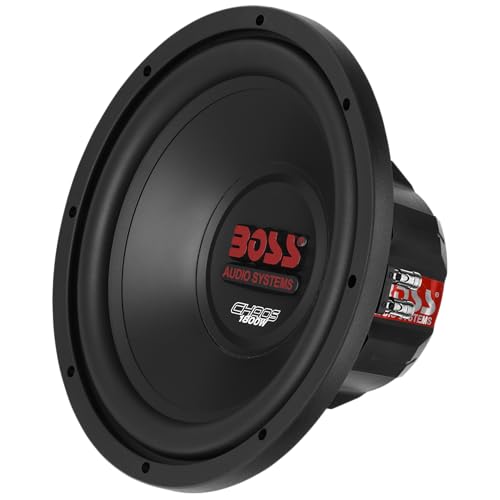
The CH10DVC is a standalone driver with a 1,500-watt maximum rating, a 4.63-inch mounting depth, and a 9.25-inch mounting hole. Its dual 4-ohm voice coils can be wired in series or parallel, but the resulting load must be compatible with the amplifier. The polypropylene cone, rubber surround, and stamped basket define its construction. This option suits buyers building a separate amp-and-enclosure system; it does not include an amplifier or enclosure. BOSS recommends professional installation and offers a three-year online dealer warranty subject to its purchase terms.
Bottom line: Choose this for a conventional system when its mounting dimensions and coil wiring suit your setup.
BOSS Phantom P106DVC

The Phantom P106DVC stands apart with a 1,050-watt RMS handling rating and a 2,100-watt maximum rating. Its dual 4-ohm voice coils allow series or parallel wiring, producing a nominal 8-ohm or 2-ohm load; confirm the amplifier supports the chosen load. The poly injection cone, 35 Hz to 2.2 kHz frequency response, and competition-style binding posts are among its features. This is a standalone driver for buyers pairing a separate amplifier and enclosure. Confirm its mounting dimensions will fit your intended location before ordering.
Bottom line: Pick this if the 1,050-watt RMS rating matches your amplifier and system plan.
BOSS BASS10 Under Seat

The BASS10 is an amplified 10-inch subwoofer, so its main distinction from the standalone drivers is the combined subwoofer-and-amplifier design. Its dimensions are 13.58 by 10.43 by 3.15 inches, giving buyers a clear starting point for checking under seat clearance. Its features include a variable low-pass filter and pulse-width modulation. It suits space-constrained vehicles where a separate amplifier is not the desired arrangement. Measure the available space and check clearance around seat movement before installation.
Bottom line: Choose this when the 3.15-inch height fits the intended under seat space.
BOSS BAB10 Amplified Subwoofer

The BAB10 differentiates itself with a built-in amplifier rated at 1,200 watts maximum and a remote control. Like the BASS10, it combines the amp and 10-inch subwoofer in one unit, avoiding a separate amplifier component. Its features also include pulse-width modulation and a variable low-pass filter. Check that the enclosure fits the available space before installation, and do not use the maximum rating as an RMS match.
Bottom line: Pick this for a combined subwoofer and amp with remote control.
Choosing a BOSS 10-Inch Subwoofer Setup
Start by deciding whether you need a standalone driver or a powered subwoofer. A standalone driver requires a separate amplifier and enclosure; a powered model combines the driver and amplifier, which can reduce the number of components but still needs vehicle power and signal connections. For standalone drivers, compare the amplifier’s RMS output at the final speaker load with the subwoofer’s RMS handling, not just a maximum-watt figure. A dual 4-ohm voice-coil driver can present a nominal 2-ohm load in parallel or 8 ohms in series. Use the 2-ohm option only if the amplifier is stable at 2 ohms. Check the vehicle’s available mounting space and enclosure plan before selecting a driver.
Matching Voice-Coil Wiring to an Amplifier
Dual 4-ohm coils can be wired in parallel for a nominal 2-ohm load or in series for a nominal 8-ohm load. The amplifier must be rated for the chosen impedance; a 2-ohm connection can overload an amp that is only stable at 4 ohms. With multiple subwoofers, the total load depends on how each coil and driver is connected, so map the wiring before installation rather than assuming the labeled coil impedance is the final load. Speaker impedance also varies with frequency, so amplifier stability ratings matter. Use the amplifier maker’s wiring diagram and secure all terminals to prevent stray wire strands from touching adjacent connections.
Planning Enclosure and Vehicle Fit
Measure the mounting hole, driver depth, and space behind the mounting surface before cutting or fastening a subwoofer. A nominal 10-inch driver does not mean every 10-inch cutout is the same; the CH10DVC has a 9.25-inch mounting hole and 4.63-inch depth. Enclosure volume and design also affect the result: sealed boxes are typically more compact, while ported boxes need extra space for the port. Check the specific driver’s enclosure requirements before building a box, because an incorrect internal volume can change response and increase the risk of over-excursion. Leave clearance for wiring and avoid placing a powered unit where seat movement can crush cables or block ventilation.
Setting Power and Filters Safely
Match amplifier output by RMS rating at the intended impedance, not by comparing peak or maximum numbers alone. A low-pass filter limits higher frequencies sent to the subwoofer; a common starting crossover range in car audio is around 80 Hz, then adjust to integrate with the door speakers and avoid a gap or overlap. Set gain as an input-matching control, not as a volume boost. Subwoofer wiring draws substantial current, so use a properly sized fuse near the battery and cable gauge appropriate to the amplifier’s current draw and cable length. Disconnect the battery before electrical work and secure the enclosure so it cannot move during sudden braking.
Frequently Asked Questions
What ohm load can a dual 4-ohm subwoofer use?
A dual 4-ohm voice-coil subwoofer can be wired for a nominal 2-ohm load in parallel or 8 ohms in series. Use only a load the amplifier is rated to handle.
Should I match subwoofer watts to amp RMS?
Yes, compare the amplifier’s RMS output at the intended impedance with the subwoofer’s RMS handling. Maximum or peak power figures are not equivalent to continuous RMS ratings.
How much space does a 10-inch subwoofer need?
A 10-inch label describes the driver size, not the full cutout or enclosure dimensions. Measure the mounting hole, depth, enclosure volume, and cable clearance; the CH10DVC, for example, has a 9.25-inch mounting hole and 4.63-inch mounting depth.
Where should I set a car subwoofer low-pass filter?
About 80 Hz is a common starting point for a car subwoofer low-pass crossover. Adjust from there to blend with the main speakers, since speaker placement and response affect the best transition.
Does an amplified subwoofer need a separate amp?
An amplified subwoofer has an amplifier built into the unit, unlike a standalone driver that needs a separate amp. It still needs suitable vehicle power, audio signal, grounding, and secure installation.