
Briggs and Stratton Points Conversion Kit Options Compared

For a Briggs & Stratton engine you want to run without breaker points, Briggs & Stratton 5-hp Points-Eliminating Coil is the closest match because its name identifies a 5-hp coil intended to eliminate points. Choose a points-and-condenser set instead if you want to retain and service the existing point ignition.
These products cover different engine ranges and purposes, so identify the engine model and ignition type before choosing; the generic conversion-kit name on HXLSDMGP Conversion Kit does not identify a specific engine fit.
We earn a commission if you buy through links on this page. As an Amazon Associate I earn from qualifying purchases. Products are compared on manufacturer specifications, not hands-on testing.
- Best overall: Briggs & Stratton 5-hp Points-Eliminating Coil – Its name explicitly identifies a coil to eliminate points on a 5-hp Briggs & Stratton engine.
- Best for broad compatibility claims: HXLSDMGP Conversion Kit – The product is called a conversion kit and claims universal adaptation, but its specific fit needs confirmation.
- Best for cast-iron engines: 298185 Points and 298060 Condenser Set – The points and condenser set names 8–16 hp cast-iron engines and several model families.
| Product | Best for | Ignition purpose | Engine fit | Named model coverage | Shop |
|---|---|---|---|---|---|
| Briggs & Stratton 5-hp Points-Eliminating Coil | 5-hp conversion | Eliminates points | 5 hp | — | Check Price on Amazon |
| HXLSDMGP Conversion Kit | Unspecified conversion | Conversion kit | — | — | Check Price on Amazon |
| 298185 Points and 298060 Condenser Set | Cast-iron engines | Retains points | 8–16 hp cast iron | 19D, 23D, 193400, 200400, 243400, 300420 | Check Price on Amazon |
| Points and Condenser Kit for 5012/5020 Series | Older small engines | Retains points | 2–8 hp | 5012, 5012H, 5012B, 5020B, 5012D, 5020 | Check Price on Amazon |
| REDEEMX Points-Ignition Coil Armature | Small engine coil | Supports points ignition | 2–4 hp | Sprint, Quattro, Classic | Check Price on Amazon |
Briggs and Stratton points conversion kit options
Match the ignition approach and engine identification before choosing among conversion parts and replacement sets.
Briggs & Stratton 5-hp Points-Eliminating Coil

For a points-free ignition approach, this is the only item whose name explicitly says it eliminates points, and it is identified for 5-hp Briggs & Stratton engines. This option suits an owner seeking to remove breaker points; it is not a points-and-condenser service set for someone keeping the original ignition arrangement.
Bottom line: Pick this when you have a 5-hp engine and want a points-eliminating coil.
HXLSDMGP Conversion Kit

Unlike the model-specific point sets, this item is labeled a conversion kit and claims compatibility across mainstream brands, but it names no Briggs & Stratton engine models or horsepower range. The broad wording may suit someone whose generator application is confirmed with the seller, but it is not enough to establish that it converts a particular Briggs & Stratton points ignition. Confirm the engine model and included ignition components before choosing it.
Bottom line: Consider it only after confirming the engine fit and conversion components.
298185 Points and 298060 Condenser Set

For keeping and servicing breaker-point ignition rather than converting away from it, this set pairs points part 298185 with condenser 298060. It identifies 8–16-hp cast-iron engines and gives a list of model families, making its fit scope more concrete than the generic conversion kit. It is a replacement-parts choice, not an electronic ignition conversion: the points remain part of the system. Match the engine family and ignition configuration before ordering, since the fit list does not cover every Briggs & Stratton engine.
Bottom line: Choose this to refresh a compatible 8–16-hp cast-iron points system.
Points and Condenser Kit for 5012/5020 Series
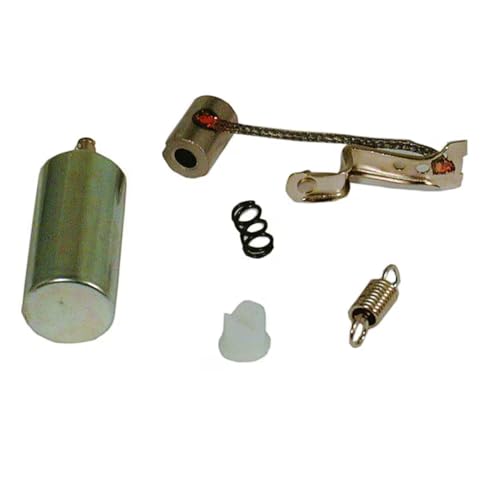
This points-and-condenser assembly is aimed at a different engine group from the cast-iron set: it names 2, 3, 3½, 4, 5, 7, and 8-hp engines, plus specific 5012 and 5020 series references. The model coverage also includes several engine-family numbers, so compare those identifiers rather than relying on horsepower alone. Because this is a points-and-condenser replacement, it retains breaker-point ignition instead of removing it. It suits a compatible small engine needing ignition service, but not someone seeking a points-free conversion.
Bottom line: Pick this for a named 5012/5020-series engine that will retain points.
REDEEMX Points-Ignition Coil Armature

For smaller engines that already use breaker points, this armature differs from the point-and-condenser sets by replacing the ignition coil assembly. It is identified for 2–4-hp Briggs & Stratton Sprint, Quattro, and Classic models, and its features name replacement numbers 298502, 395488, 298968, 697036, and 460014. The maker says it is designed for points-and-condenser systems and not solid-state ignition. It is therefore a coil replacement for a compatible points setup, not a conversion to eliminate points.
Bottom line: Choose this when replacing a coil on a compatible 2–4-hp points engine.
How to choose a Briggs & Stratton points conversion
Start by deciding whether the goal is to remove breaker points or repair the existing point ignition. A coil identified as eliminating points serves the first purpose; a points-and-condenser set serves the second and leaves the breaker-point system in place. Magneto ignition depends on the flywheel magnet passing the coil, while breaker points open and close the primary circuit to trigger the spark. A replacement coil must match the ignition arrangement, not just the brand name or horsepower. If your engine has solid-state ignition, a points-system armature is the wrong type; conversely, point replacement parts do not convert an engine to electronic ignition. Confirm engine model and existing ignition layout before selecting a part.
Check engine fit by model and ignition type
Model-family numbers are a stronger fit check than horsepower alone because Briggs & Stratton engines with similar output can use different ignition hardware. Match the stamped model, type, and code on the engine, then compare them with the fit names for the part. A 5-hp label by itself does not establish compatibility, and a points-based coil should not be substituted into a solid-state setup. For the products here, the point sets name specific model groups, while the proposed points-eliminating coil is identified by horsepower without model numbers. Verify that conversion’s fit and coil arrangement before ordering. Do not assume a kit’s generic compatibility language means it includes the exact components your engine needs.
Points conversion versus points replacement
A points conversion changes the ignition approach; replacement points and condensers keep the original breaker-point setup. The distinction matters because a replacement set cannot eliminate the maintenance or adjustment associated with mechanical points. Typical small-engine breaker-point gaps are around 0.020 inch, but the correct gap and timing procedure vary by engine, so use the engine’s service specification rather than treating that typical figure as universal. A wrong gap can affect when the points open and therefore ignition timing. Use the following distinction to narrow the part type before checking the engine’s model fit.
| Need | Part type | Fit check |
|---|---|---|
| Remove breaker points | Points-eliminating ignition coil/conversion components | Confirm engine and coil compatibility |
| Restore existing points ignition | Points and condenser set | Match engine family and ignition layout |
| Replace a failed coil, retain points | Points-system coil armature | Match model and replacement number |
Installation and ignition safety
Disconnect the spark-plug lead before working around the flywheel, coil, or points, and keep the lead away from the plug so the engine cannot start unexpectedly. Flywheel magnets and ignition parts must maintain the specified air gap; a typical small-engine coil gap is roughly 0.010–0.014 inch, but the engine service specification takes precedence. Points timing is set by when the contacts begin to open, so changing the gap can change timing as well. Keep tools and loose hardware clear of the flywheel, and reinstall its cover before running the engine.
Frequently Asked Questions
Can a points-and-condenser set eliminate breaker points?
No, a points-and-condenser set replaces service parts while retaining the breaker-point system. Choose a conversion component specifically identified as points-eliminating if the goal is to remove that system.
What points gap is typical on a small Briggs engine?
Around 0.020 inch is a common small-engine breaker-point gap, but the correct value depends on engine model. Use the engine-specific service specification before setting the contacts.
How do I identify my Briggs and Stratton engine?
Find the stamped model, type, and code on the engine and compare those identifiers with the part’s fit. Horsepower alone is not a reliable compatibility check because ignition arrangements can differ.
Can a points ignition coil work with solid-state ignition?
No, a coil armature identified for points-and-condenser ignition is not intended for a solid-state setup. Confirm the existing ignition type before choosing a coil.
What safety step comes before ignition work?
Disconnect the spark-plug lead before touching ignition parts, and keep the lead clear of the plug to prevent accidental starting. Reinstall the flywheel cover before running the engine.