
Brush Cleaner for Straws: 4 Long-Handle Sets

For most reusable straws, 12-Inch Straw Brushes, 10-Pack is a practical pick because its 12-inch length and 12 mm diameter suit wider openings and reach into long tubes. Choose Stanley Straw Brushes, 4-Pack instead for a four-brush set sized for Stanley mug straws, or 10.6-Inch Straw Brushes, 2-Pack for a smaller two-brush pack.
A straw-cleaning brush is a narrow bristled tool that passes through a reusable straw to dislodge residue. Match the brush diameter to the straw opening, especially with glass or soft silicone straws.
We earn a commission if you buy through links on this page. As an Amazon Associate I earn from qualifying purchases. Products are compared on manufacturer specifications, not hands-on testing.
- Best overall: 12-Inch Straw Brushes, 10-Pack – Its 12-inch length and 12 mm diameter favor long straws with wider openings.
- Best for four-piece set: Stanley Straw Brushes, 4-Pack – Four brushes measure 11.8 inches long and 0.40 inches wide.
- Best for two-piece set: 10.6-Inch Straw Brushes, 2-Pack – A two-brush set offers 10.6-inch length and a 0.47-inch width.
| Product | Best for | Length | Brush diameter | Pack count | Shop |
|---|---|---|---|---|---|
| 12-Inch Straw Brushes, 10-Pack | Wider openings | 12 in | 12 mm | 10 | Check Price on Amazon |
| Stanley Straw Brushes, 4-Pack | Stanley mug straws | 11.8 in | 10.16 mm | 4 | Check Price on Amazon |
| 10.6-Inch Straw Brushes, 2-Pack | Two-brush pack | 10.6 in | 11.94 mm | 2 | Check Price on Amazon |
| Buenalife Heavy-Duty Brushes, 4-Pack | Stiffer bristles | — | — | 4 | Check Price on Amazon |
Brush cleaner for straws
Compare the brush lengths, diameters and set sizes to find a brush that fits your straw opening.
12-Inch Straw Brushes, 10-Pack

For a longer reach and wider brush, this set pairs a 12-inch brush with a 12 mm diameter, larger than the brushes in Stanley Straw Brushes, 4-Pack and 10.6-Inch Straw Brushes, 2-Pack. Each brush has a 304 stainless steel wire handle and nylon bristles, with a coated end intended to protect glass or soft tubes from scratches. The ten-piece set suits households cleaning several long straws or tubes.
Bottom line: Choose this set for long straws with openings wide enough for a 12 mm brush.
Stanley Straw Brushes, 4-Pack
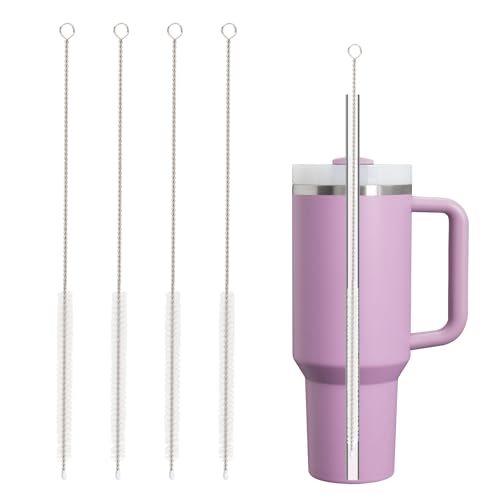
For Stanley mug straws, this four-pack is the only set here that specifically names 14-, 20-, 30- and 40-ounce mugs as intended fits. The reusable brushes are 11.8 inches long and 0.40 inches wide, with 304 stainless steel wire and a coated tip for glass or soft tubing. The maker says they are dishwasher safe. This pack suits someone who wants several brushes for compatible straws; its 0.40-inch diameter is narrower than 10.6-Inch Straw Brushes, 2-Pack, but still needs to fit the actual straw opening.
Bottom line: Pick this set for the Stanley mug straw sizes and a four-brush pack.
10.6-Inch Straw Brushes, 2-Pack

For a two-brush pack with a wider stated diameter, this set measures 10.6 inches long and 0.47 inches wide. It uses 304HC stainless steel wire and nylon bristles, and the maker says the coated end is intended to protect glass straws and soft silicone pipes. The width is greater than Stanley Straw Brushes, 4-Pack’s 0.40 inches, while the length is shorter. This option suits buyers whose straws can accept that width and who prefer a compact pack; it may not pass through narrower openings.
Bottom line: Choose this pack when a 0.47-inch brush fits and two brushes are sufficient.
Buenalife Heavy-Duty Brushes, 4-Pack

For buyers who want firmer bristles rather than a brush diameter, this four-piece set uses nylon bristles described as medium-soft and a 1/8-inch double stainless steel rod. It includes a thinner, more flexible rod on the thinnest brush, which gives the set a different approach from the single-diameter brushes in 12-Inch Straw Brushes, 10-Pack, Stanley Straw Brushes, 4-Pack and 10.6-Inch Straw Brushes, 2-Pack. The maker says the brushes are dishwasher safe. This set suits cleaning jobs where added scraping action matters; without a given brush diameter, confirm that a brush fits the straw before ordering.
Bottom line: Pick this set if stiffer bristles and varied rod flexibility are priorities.
How to choose a straw brush diameter
Choose a brush slightly narrower than the straw opening so the bristles can move without forcing the rod through. The diameters here are 0.40 inches, 0.47 inches and 12 mm (about 0.47 inches); those sizes are not interchangeable for every straw. Measure the inside opening at its narrowest point, since bends or tapered ends can restrict a brush even when the mouth looks wide. For glass or soft silicone, stop if the rod binds rather than pushing harder. Stainless wire can put concentrated pressure on a thin wall, while a tight brush can snag or deform flexible tubing.
Match brush length to straw length
A brush must reach through the full straw, with enough handle left outside to grip and withdraw it. The options with lengths range from 10.6 to 12 inches, so compare those measurements with the straw rather than choosing by cup capacity alone. Cup ounce size does not give the straw’s exact length or inner diameter. For a long straw, choose a brush at least as long as the straw and avoid a brush that barely reaches the far end. For short or narrow straws, excess length is less important than a diameter that slides through without force.
Straw brush materials and care
Reusable straw brushes generally combine a narrow wire or rod with bristles that scrub the inside surface; these sets specify stainless steel handles or rods and nylon bristles. Rinse residue from the bristles after use and let the brush dry fully before storage, since trapped moisture can linger in a dense brush head. A dishwasher-safe claim applies to Stanley Straw Brushes, 4-Pack and Buenalife Heavy-Duty Brushes, 4-Pack; do not assume the same for other sets. Inspect bristles and the metal rod regularly, and replace a brush if the bristles shed, the rod bends sharply or the tip coating wears away. Avoid forcing a damaged brush into glass or silicone.
Common straw-cleaning fit mistakes
The most common sizing mistake is using the outside brush width as if it guaranteed compatibility: straw openings and brush shapes differ, and a snug fit can bind inside a bend. Use this quick rule: if a brush will not pass freely through the opening by hand, choose a narrower one rather than twisting or pushing. A brush should travel through the full straw and come back out without its bristles catching. Do not leave a wet brush sealed inside a straw; remove it, rinse both parts, and allow them to dry separately. For coated-tip brushes, check that the protective end remains intact before using one on delicate glass or soft tubing.
Frequently Asked Questions
How do I measure a straw for a cleaning brush?
Measure the straw’s inside opening at its narrowest point, not the outer diameter. A brush diameter of 0.40 inches is smaller than 0.47 inches, but the straw’s bends and end openings also affect fit.
Can a straw brush clean a bent straw?
A flexible straw may be harder to clean at a tight bend because the rod can bind even when its brush fits the opening. Use gentle movement and stop if the brush does not pass freely; do not force a metal rod through a kink.
How often should I replace a straw brush?
Replace a straw brush when bristles shed, the rod develops a sharp bend or a protective end coating wears away. Rinsing after use and drying the brush fully between uses helps keep residue from accumulating in the bristles.
Can I put straw brushes in the dishwasher?
Only Stanley Straw Brushes, 4-Pack and Buenalife Heavy-Duty Brushes, 4-Pack are identified as dishwasher safe among these options. For other brushes, hand-rinse the bristles and let them dry completely rather than assuming the handle or bristles can withstand dishwasher heat.
Should the brush be wider than the straw?
No; a brush should pass through the opening without being forced. If a 0.47-inch brush catches in a narrower straw, use a smaller diameter instead of pushing or twisting hard.