
Bypass Heater Control Valve Options Compared by Fit

Old Air Products Cable Bypass Valve Kit #50-1553 suits buyers seeking a 5/8-inch cable-operated bypass heater control valve, with its hose size and operating style as the deciding fit. Choose an adjustable electronic valve instead if you need servo control or compatibility with 3/4-inch hose.
A bypass heater valve changes coolant flow through or around the heater core, which affects cabin heat output.
We earn a commission if you buy through links on this page. As an Amazon Associate I earn from qualifying purchases. Products are compared on manufacturer specifications, not hands-on testing.
- Best overall: Old Air Products Cable Bypass Valve Kit #50-1553 – Its 5/8-inch size and cable operation are both identified.
- Best for servo control: Electronic Servo Bypass Valve Kit #50-1555 – It uses an electronic servo and is made for 5/8-inch heater hose.
- Best for hose flexibility: Auto AC Solutions Adjustable Electronic Bypass Valve – It works with 5/8-inch or 3/4-inch heater hose and allows adjustable flow.
| Product | Best for | Hose fit | Control style | Shop |
|---|---|---|---|---|
| Old Air Products Cable Bypass Valve Kit #50-1553 | 5/8-inch cable control | 5/8 in. | Cable-operated | Check Price on Amazon |
| Electronic Servo Bypass Valve Kit #50-1555 | Electronic adjustment | 5/8 in. | Electronic servo | Check Price on Amazon |
| Auto AC Solutions Adjustable Electronic Bypass Valve | Two hose sizes | 5/8 or 3/4 in. | Electronic adjustable | Check Price on Amazon |
| Cable Bypass Heater Valve #25-1018 | Pull-to-open cable | 5/8 in. | Cable, pull to open | Check Price on Amazon |
Bypass heater control valves
Match the hose diameter first, then choose cable or electronic control to suit the vehicle and installation.
Old Air Products Cable Bypass Valve Kit #50-1553

The Old Air Products kit is the cable-operated option with a 5/8-inch size. Its valve regulates coolant flow to adjust heater temperature, so it suits an installation where a physical cable control is preferred. The kit measures 7 inches in height, length, and width and weighs 1.5 pounds. Its main limitation is the fixed 5/8-inch hose fit; buyers with 3/4-inch heater hose should choose a compatible valve rather than assume this kit adapts.
Bottom line: Choose this kit when the system uses 5/8-inch hose and cable actuation.
Electronic Servo Bypass Valve Kit #50-1555
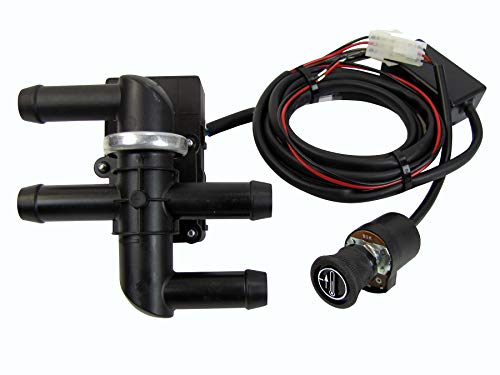
The electronic servo separates this kit from the cable-operated choices: the maker says its high-torque motor can be adjusted to control heater temperature. The kit fits 5/8-inch heater hose and is identified as suitable for LS engine swaps, making it a candidate when that combination matches the build. Its dimensions are 8 inches high and long, and it weighs 2 pounds. The hose fit is narrower than the adjustable option that accepts either 5/8-inch or 3/4-inch hose.
Bottom line: Pick this kit for a 5/8-inch LS swap that calls for servo adjustment.
Auto AC Solutions Adjustable Electronic Bypass Valve

The Auto AC Solutions valve accepts either 5/8-inch or 3/4-inch heater hose, giving it the broadest hose fit among these choices. The maker says it adjusts from no coolant flow to full flow, and it can be mounted wherever the installation has room. It is described as compatible with Mercury vehicles and includes installation instructions.
Bottom line: Choose it when the hose is 5/8 or 3/4 inch and adjustable electronic flow matters.
Cable Bypass Heater Valve #25-1018

The #25-1018 is distinguished by its pull-to-open cable operation and a 5/8-inch heater-hose fit. Its purpose is to let coolant bypass the heater core to reduce heat inside the vehicle, and the maker also identifies it for LS engine swaps. The dimensions are 7 inches high, long, and wide, with a weight of 1.5 pounds. Unlike an infinitely adjustable electronic design, the defining control here is a cable-operated pull-to-open action.
Bottom line: Pick this valve for a 5/8-inch system requiring pull-to-open cable control.
How to choose a bypass heater control valve
Choose by hose diameter, valve routing, and actuator before comparing other dimensions. Heater valves commonly control coolant entering the heater core, while bypass arrangements provide another route for coolant when cabin heat is reduced; the hose routing must match the vehicle’s cooling-system layout. Measure the hose’s inside diameter and compare it with the valve connection size, since a mismatch can leak or restrict flow. A 5/8-inch hose is common in automotive heater plumbing, and 3/4-inch hose is also used. Then decide whether the installation calls for a cable or an electronic actuator. If the planned mounting space is tight, measure that space and leave clearance for hose bends and actuator movement.
Heater hose sizing and valve fit
Heater hose sizing is based on the hose’s inside diameter, so confirm the actual hose measurement rather than estimating from the outside. A 5/8-inch hose is 0.625 inch across internally, while 3/4-inch hose is 0.75 inch; a 1/8-inch difference is enough to make an incompatible barb connection unreliable. Use clamps sized for the hose and connection, and avoid forcing a hose over an undersized or oversized barb. The table below maps the valve hose fits to a practical selection rule.
| Hose measurement | Choice rule |
|---|---|
| 5/8 inch | Select a valve whose fit includes 5/8-inch hose |
| 3/4 inch | Select a valve explicitly compatible with 3/4-inch hose |
When the hose size is unknown, measure its inside diameter with the engine fully cold before choosing a valve.
Cable versus electronic heater valve control
Cable-operated valves use a mechanical connection between a control and the valve; electronic valves use a powered actuator. Pick a cable design when the vehicle’s control arrangement calls for a cable, and choose electronic actuation when the installation is built for servo control. Some electronic valves advertise continuously adjustable flow, but that feature does not establish that the valve will communicate with any vehicle control system. Confirm the electrical connector, voltage, and controller compatibility for the specific vehicle before ordering. Also check whether the chosen valve’s actuator can move freely after the hoses and nearby components are installed.
Safe heater valve installation and coolant service
Work on heater hoses only after the engine and cooling system are completely cool; hot coolant is pressurized and can cause severe burns. Never remove a radiator or coolant-system pressure cap while hot. Before opening a hose, place a drain pan under the work area and capture coolant rather than leaving it where children or pets can reach it. Refill with the coolant type and mixture specified for the vehicle, then check for leaks after the system is filled and brought up to operating temperature. A loose clamp or twisted hose can leak, so inspect both connections and verify that the hose does not kink through the full range of valve movement.
Frequently Asked Questions
Can a bypass heater valve reduce cabin heat?
Yes, reducing coolant flow through the heater core can reduce heat output. Some bypass arrangements route coolant around the core, so the valve must match the vehicle’s hose routing.
How do I measure heater hose for a valve?
Measure the hose inside diameter, not its outside diameter. Common heater-hose sizes include 5/8 inch and 3/4 inch, and the valve connection must match the measured size.
Should I replace a heater valve with a cold engine?
Yes, let the engine and cooling system cool completely before disconnecting a heater hose. Hot coolant can remain pressurized and cause serious burns.
Do electronic heater valves need vehicle compatibility checks?
Yes, confirm the actuator’s electrical connector, voltage, and control compatibility for the vehicle. A valve’s hose fit alone does not establish that its electronic control will work.
How can I check a heater valve after installation?
After refilling the system with the vehicle-specified coolant, inspect both hose connections for leaks as the engine reaches operating temperature. Recheck clamps and hose routing once the system is cool again.