
Cassette Tape Deck Belts: 4 Repair Sets Compared

100-Piece Flat Cassette Belts is the broadest general-purpose choice here, with 100 belts and a 40–135 mm sizing range; match the replacement to the deck’s original belt path and profile. Choose another set if you need round or square belts rather than a 1 mm-wide flat belt.
Cassette deck drive belts transfer motor motion to the transport, often turning the capstan flywheel and take-up reel.
We earn a commission if you buy through links on this page. As an Amazon Associate I earn from qualifying purchases. Products are compared on manufacturer specifications, not hands-on testing.
- Best overall: 100-Piece Flat Cassette Belts – Its 100-piece assortment spans a 40–135 mm range and uses a 1 mm-wide flat profile.
- Best for square belts: 30-Piece Square Belt Assortment – The 30-piece set includes ten square-belt sizes from 25 to 65 mm, measured by half-perimeter.
- Best for round belts: 20-Piece Round Cassette Belts – The 20-piece set uses a round profile and is specified as 1.5 mm thick.
| Product | Best for | Pack size | Sizing | Profile | Shop |
|---|---|---|---|---|---|
| 100-Piece Flat Cassette Belts | Broad size assortment | 100 belts | 40–135 mm | Flat, 1 mm wide | Check Price on Amazon |
| 30-Piece Square Belt Assortment | Square belt repairs | 30 belts | 25–65 mm half-perimeter | Square, 1.1–1.2 mm | Check Price on Amazon |
| 56-Piece 1 mm Recorder Belts | Multi-device repairs | 56 belts | 40–120 mm | Rubber, 1 mm wide | Check Price on Amazon |
| 20-Piece Round Cassette Belts | Round belt replacement | 20 belts | — | Round, 1.5 mm thick | Check Price on Amazon |
Cassette Tape Deck Belts Compared
Compare each set’s belt profile and sizing before opening a deck or ordering replacements.
100-Piece Flat Cassette Belts

The 100-piece flat-belt assortment covers the widest range here, from 40 to 135 mm, with a 1 mm width. The manufacturer says the rubber belts are intended for cassette-player repairs and also names DVD, CD, LD and VCR equipment. This set suits repairers who need several flat-belt sizes on hand rather than a single replacement. The range does not identify which belt fits a particular deck, so measure the removed belt and compare its profile before choosing; this set is not the round or square option.
Bottom line: Choose this set when you need a broad range of flat belt sizes in one assortment.
30-Piece Square Belt Assortment

The square cross-section sets this 30-piece assortment apart from the flat and round options. It includes ten sizes from 25 to 65 mm, with three belts per size; the measurements are half-perimeter, not full circumference. That sizing convention matters when matching a replacement, so compare the old belt using the same convention. The maker identifies cassette, CD and DVD machines as intended uses. Choose it when the original belt has a square profile; the assortment does not cover the larger sizes in the flat-belt sets.
Bottom line: Pick this set when the deck calls for a square belt in its 25–65 mm half-perimeter range.
56-Piece 1 mm Recorder Belts
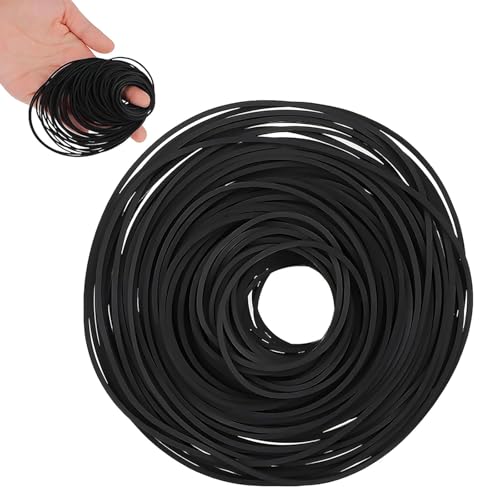
The 56-piece set is a mid-sized assortment of 1 mm-wide black rubber belts, with a 40–120 mm range. The maker lists cassette players alongside DVD, CD and Walkman devices, making the set relevant to repair benches handling several kinds of playback equipment. Its range is narrower than the 100-piece flat set, but it provides more pieces than the round-belt pack.
Bottom line: Choose this multi-device assortment when a 40–120 mm, 1 mm-wide belt matches the original.
20-Piece Round Cassette Belts

The round profile is the key distinction of this 20-piece replacement set; each belt is specified as 1.5 mm thick. The maker names cassette players, tape decks and CD mechanisms as intended uses. A round belt is not interchangeable with a flat or square belt just because its loop length seems close: profile affects how it seats on pulleys and runs through the mechanism. This set suits a deck whose removed belt is round and measures 1.5 mm thick.
Bottom line: Pick this set when the removed belt is round and measures 1.5 mm thick.
How to Match Cassette Belt Size and Profile
Match belt profile first, then match loop size; a nearly correct length cannot compensate for a flat belt where a square groove or round pulley is designed for another shape. Remove the old belt if possible and note whether it is flat, square or round, along with its width or thickness. Belts can stretch or turn gummy with age, so a stretched loop may overestimate the original size. For a square belt assortment measured by half-perimeter, do not compare its number directly with a full-circumference measurement. If the old belt has broken, trace its path and measure the pulley route, allowing for a snug fit rather than a loose loop.
Flat, Round and Square Deck Belts
Choose the cross-section that matches the pulleys and belt path inside the transport. Flat belts commonly drive a flywheel or capstan from a motor pulley, while square and round belts appear in mechanisms designed with matching grooves or pulley surfaces. A belt that is too wide can rub nearby parts; one that is too thin or narrow may slip. Record the old belt’s profile, width or thickness, and loop measurement before shopping. The table summarizes the profiles in these sets; it is a starting point, not a substitute for measuring the belt in the machine.
| Need | Choose by | Set profile |
|---|---|---|
| Broad flat-belt assortment | 40–135 mm, 1 mm wide | Flat |
| Square belt sizes | 25–65 mm half-perimeter | Square |
| Round belt replacement | 1.5 mm thickness | Round |
Replacing a Cassette Deck Belt Safely
Disconnect the deck from power before opening its case, and keep fingers and tools away from the mains power-supply area. Many cassette transports use multiple belts, so photograph the belt routing before removal and change one belt at a time to avoid confusing paths. Clean pulley surfaces with a lint-free swab; grease or residue can encourage slipping. Do not lubricate a belt or belt contact surface. After installation, turn the mechanism by hand if the design allows, checking that the belt stays seated and does not twist or rub. If the deck has a separate service manual, use its routing diagram for that specific transport.
Common Cassette Belt Matching Mistakes
The most common matching error is choosing by length alone and overlooking profile or width. A second is mixing half-perimeter and full-loop measurements: the same belt can appear to have different numbers under those conventions. Measure a relaxed old belt without pulling it taut, and treat a cracked, sticky or visibly stretched belt as an unreliable size reference. Also check that the belt route matches the machine’s original path; routing around the wrong pulley can alter speed or prevent the take-up reel from turning. When replacing multiple belts, label each one by location and size before removing it.
Frequently Asked Questions
How do I measure a cassette deck belt?
Measure the relaxed belt’s full loop circumference with a flexible tape, and record its width or thickness and cross-section separately. A square-belt assortment measured by half-perimeter uses a different number, so do not compare that figure directly with circumference.
Can I use a flat belt instead of a square belt?
Use the same profile as the original whenever possible; flat and square belts seat differently on their pulleys. A width mismatch can also cause rubbing or slipping, even when the loop length is close.
Why does a cassette player need more than one belt?
Some transports use separate belts for the capstan/flywheel and reel drive, so a single deck may have multiple belt paths. Check the transport’s routing before removing parts, since belt count and layout vary by mechanism.
What causes a new cassette belt to slip?
A belt that is too long, the wrong profile, or contaminated by oil or grease can slip. Clean pulley surfaces and verify the belt remains seated through a full manual rotation before powering the deck.
Should I lubricate a cassette deck belt?
No; keep the belt and its pulley contact surfaces free of lubricant because residue can reduce grip. Lubrication may be appropriate for specific moving parts, but not on the belt itself.