
Cat 6 RJ45 Connectors: 3 Plug Types Compared

For most custom Cat 6 cables, Cable Matters Cat 6 Pass-Through Plugs is the stronger fit because it supports 23–24 AWG conductors and rates for 10 Gigabit Ethernet. Choose CableCreation Cat 6 RJ45 Plugs or ZOERAX Cat 6 Pass-Through Plugs instead if your cable uses 24–26 AWG wire or you need a fit for round or flat stranded cable.
We earn a commission if you buy through links on this page. As an Amazon Associate I earn from qualifying purchases. Products are compared on manufacturer specifications, not hands-on testing.
- Best overall: Cable Matters Cat 6 Pass-Through Plugs – Supports 23–24 AWG conductors and is rated for 10 Gigabit Ethernet.
- Best for flat cable: CableCreation Cat 6 RJ45 Plugs – Specifies round or flat stranded cable from 24–26 AWG.
- Best for mixed cable gauges: ZOERAX Cat 6 Pass-Through Plugs – Supports 24–26 AWG stranded wire and 23 AWG solid cable.
| Product | Best for | Wire gauge | Cable fit | Shop |
|---|---|---|---|---|
| Cable Matters Cat 6 Pass-Through Plugs | 10G cable builds | 23–24 AWG | Solid or stranded UTP; up to 6.1 mm OD | Check Price on Amazon |
| CableCreation Cat 6 RJ45 Plugs | Flat stranded cable | 24–26 AWG | Solid or stranded UTP; round or flat stranded | Check Price on Amazon |
| ZOERAX Cat 6 Pass-Through Plugs | 23 AWG solid cable | 23 AWG solid; 24–26 AWG stranded | Up to 6.1 mm OD; round or flat stranded | Check Price on Amazon |
Cat 6 RJ45 connectors compared
Match the plug’s supported wire gauge and cable shape to the cable you plan to terminate.
Cable Matters Cat 6 Pass-Through Plugs
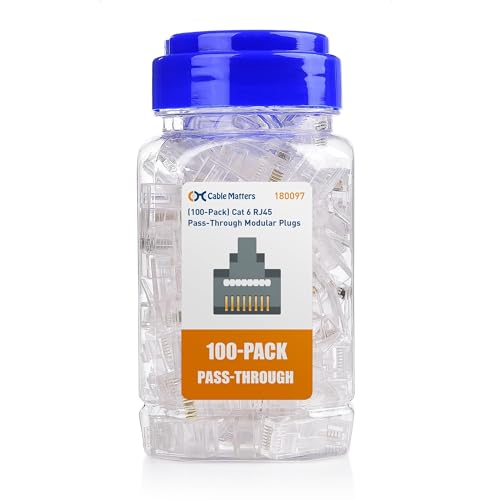
Cable Matters Cat 6 Pass-Through Plugs stands apart with a 10 Gigabit Ethernet rating, while the other two plugs specify Gigabit performance. The 100-pack is designed for solid or stranded UTP cable with 23–24 AWG wire, insulated conductors measuring 0.97–1.07 mm, and an overall cable diameter up to 6.1 mm. Its pass-through layout lets conductors extend through the front before crimping, and staggered three-point contacts make the connection. This is a fit for custom cable runs where the cable dimensions match. The 23–24 AWG limit matters if your cable uses thinner 25 or 26 AWG conductors.
Bottom line: Pick it for a 10 Gigabit build using compatible 23–24 AWG UTP cable.
CableCreation Cat 6 RJ45 Plugs

CableCreation Cat 6 RJ45 Plugs is the clearest match for flat stranded cable, which the other two plugs do not specifically call out. This 100-pack accepts 24–26 AWG solid or stranded unshielded twisted-pair cable, including round or flat stranded cable, and fits standard RJ45 ports. Three-pin contact tabs penetrate the conductors; the plugs are specified for Gigabit Ethernet and backward compatibility with Cat 5e. Choose these when cable shape and smaller wire gauge are the deciding factors. The performance is Gigabit, so a buyer seeking a 10 Gigabit rating should compare that against Cable Matters Cat 6 Pass-Through Plugs instead.
Bottom line: Choose it for 24–26 AWG flat or round stranded UTP cable.
ZOERAX Cat 6 Pass-Through Plugs

ZOERAX Cat 6 Pass-Through Plugs has a different gauge split: it accepts 23 AWG for solid cable and 24–26 AWG for stranded wire. The pass-through design and staggered three-point contacts support crimp-style termination, and the plug accommodates round or flat stranded conductors in cable up to 6.1 mm in outer diameter. It is rated for Gigabit Ethernet and backward compatible with Cat 5e. This option suits a builder who needs that 23 AWG solid-cable allowance alongside stranded-cable flexibility. It does not state a 10 Gigabit rating, so that distinction matters for buyers planning a higher-rate link.
Bottom line: Pick it when you need 23 AWG solid or 24–26 AWG stranded cable support.
How to choose Cat 6 RJ45 connectors
Choose a plug by conductor gauge, conductor insulation diameter, cable shape and cable jacket diameter—not by the Cat 6 label alone. The 23–24 AWG range is thicker wire than 26 AWG, and a plug designed for one range may not accept another reliably. For pass-through plugs, conductors feed through the plug nose and are trimmed during crimping; standard plugs require precise wire trimming and placement before insertion. Match the connector’s supported cable construction and diameter to your cable, then use a crimper specifically compatible with that plug style. A matching gauge is not enough if the insulated conductors or jacket exceed the plug’s physical limits.
Pass-through and standard plugs
Pass-through RJ45 plugs allow the eight conductors to extend beyond the nose before crimping, making wire order easier to inspect and trim in one operation. They require a compatible pass-through crimper with a cutting blade; a conventional crimper may leave protruding wire ends. Standard plugs instead hold conductors inside the front of the plug, so trim all eight evenly and verify the sequence before crimping. In either style, follow the T568A or T568B wiring scheme consistently at both ends; mixing schemes creates a crossover cable rather than a straight-through cable. Choose a pass-through design when its crimper and plug dimensions match the cable.
| Need | Connector choice | Check before crimping |
|---|---|---|
| Inspect wire order easily | Pass-through | Compatible cutting crimper |
| Use a conventional crimper | Standard plug | Even conductor trim |
| Terminate a thicker cable | Plug rated for the gauge | Insulation and jacket diameter |
Wire order and cable fit
RJ45 Ethernet plugs have eight positions for four twisted pairs, and the usual straight-through termination uses the same T568A or T568B pinout at both ends. Keep each pair twisted as close to the contacts as practical; excessive untwisting can impair signal performance. Check the plug’s supported solid or stranded conductors before starting, because solid conductors and flexible stranded conductors interact differently with contact blades. Also confirm that the cable’s overall diameter fits the plug’s entry and strain relief. If the jacket is too large or too small for the plug, the termination may not hold securely even when each wire fits its channel.
Crimping Cat 6 plugs safely
Use a cable stripper that removes the jacket without nicking conductor insulation, and keep cut wire scraps away from children and pets because the small pieces can be swallowed. Arrange the conductors in the selected wiring sequence, inspect all eight positions, then crimp with the tool made for that plug style. A cable tester that checks all eight conductors can catch opens, shorts and crossed pairs before installation; basic continuity testing does not certify Cat 6 channel performance. For permanent in-wall runs, solid-copper cable is typically used, while stranded cable is commonly chosen for flexible patch cords. Avoid forcing an oversized cable into a connector or reusing a crushed plug.
Frequently Asked Questions
Can Cat 6 plugs work with Cat 5e cable?
Yes, Cat 6 plugs are generally backward compatible with Cat 5e cable when the conductor gauge and construction fit the connector. The product specs here specifically state Cat 5e compatibility for CableCreation Cat 6 RJ45 Plugs and ZOERAX Cat 6 Pass-Through Plugs.
Should both ends use T568A or T568B?
Use the same scheme at both ends for a standard straight-through Ethernet cable. T568A and T568B each arrange the four pairs differently, so consistency avoids an unintended crossover termination.
Does a pass-through RJ45 plug need a special crimper?
Yes, use a crimper designed to cut wires flush at the front of pass-through plugs. A standard crimper may not trim the protruding conductors, leaving exposed ends that can cause shorts or snagging.
How much of each pair should I untwist?
Keep each pair twisted close to the plug contacts; a common installation target is no more than about 0.5 inch of untwist. More untwisting can increase crosstalk and make a Cat 6 run less reliable.
How can I check a newly crimped Ethernet cable?
Use an eight-wire cable tester to check continuity and pair order at both ends before installing the cable. A basic tester finds wiring faults but does not certify Cat 6 bandwidth or channel performance.