
Clear Coat Remover for Cars: Compounds Compared

For clear-coat defects, Meguiar’s Ultimate Compound is the named product’s closest match because it is a clear-coat-safe compound for scratches, swirls, and oxidation. Compounds correct surface imperfections; they are not chemical removers for peeling clear coat.
Choose a different product if you need to strip a coating or address peeling paint: a general paint-and-varnish stripper is not identified for automotive clear coat, while an emulsion claims to rejuvenate peeling clear coat.
We earn a commission if you buy through links on this page. As an Amazon Associate I earn from qualifying purchases. Products are compared on manufacturer specifications, not hands-on testing.
- Best overall: Meguiar’s Ultimate Compound – A clear-coat-safe compound for scratches, swirls, and oxidation.
- Best for fast correction: Chemical Guys C4 Clear Cut Compound – A fast-cutting compound intended for automotive paint defects.
- Best for two-step correction: Chemical Guys C4 & P4 Correction Kit – Pairs a defect-cutting compound with a finishing polish.
| Product | Best for | Volume | Purpose | Use method | Shop |
|---|---|---|---|---|---|
| Meguiar’s Ultimate Compound | Clear-coat defects | 15.2 oz | Scratches, swirls, oxidation | By hand or DA polisher | Check Price on Amazon |
| Chemical Guys C4 Clear Cut Compound | Fast defect cutting | 16 oz | Scratches, swirls, holograms | Compound; polishing step | Check Price on Amazon |
| Chemical Guys C4 & P4 Correction Kit | Two-step correction | 32 oz total | Defects, then micro-marring | Compound and polish | Check Price on Amazon |
Clear coat remover for cars
Match the product to the job: polishing compounds correct paint defects, while a stripping gel serves a different purpose.
Meguiar’s Ultimate Compound

For clear-coat surface defects, this is the closest match to a remover: it is a compound, not a chemical stripper. Meguiar’s says its micro-abrasive formula removes scratches, swirls, oxidation, and water spots without hazing on clear coats and gloss paint. The 15.2-ounce container can be applied by hand or with a dual-action polisher. Choose it when the paint is intact but marked; a compound is not a remedy for clear coat that is lifting or peeling, and polishing removes some paint material.
Bottom line: Choose this for scratches and oxidation on intact clear coat.
Chemical Guys C4 Clear Cut Compound

The 16-ounce C4 is aimed at faster cutting through heavier paint defects, setting it apart from the more general compound choices. Chemical Guys says its abrasives address scratches, swirls, oxidation, and holograms while finishing to a smooth surface. The formula is for automotive paint correction, not stripping clear coat off a vehicle.
Bottom line: Choose this when faster cutting is the priority for paint correction.
Chemical Guys C4 & P4 Correction Kit
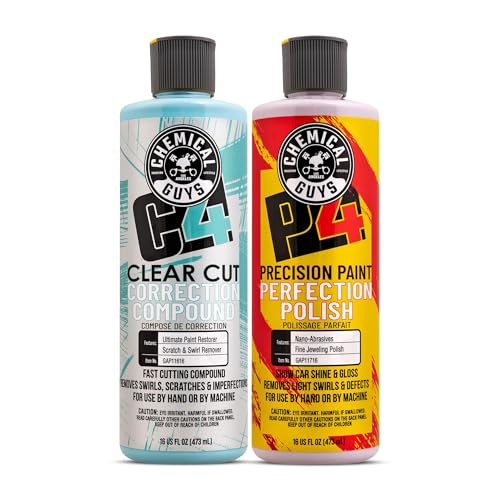
This 32-ounce combined kit stands apart by including both a defect-cutting compound and a finishing polish. Chemical Guys says C4 targets scratches, swirls, oxidation, towel marks, and etching, while P4 refines the finish by addressing micro-marring and enhancing gloss. It is intended for clear coat, single-stage, and ceramic-coated paint. The two steps make it a better fit for someone planning correction followed by refinement; it is not a one-step chemical remover, and the kit is more involved than a single compound.
Bottom line: Choose this for a planned compound-then-polish correction.
How clear coat correction differs from removal
Automotive compounds abrade and level a very thin portion of the finish to reduce surface defects; they do not dissolve and lift clear coat like a stripper. Clear coat is the transparent top layer over color, and aggressive or repeated polishing can wear through it, especially at edges and body lines where the film is thinner. Use a compound only for intact paint with surface-level marks; peeling or flaking means the coating has failed, and polishing cannot restore a sound layer. If the clear coat is visibly lifting, stop abrasive correction and seek a refinishing solution rather than treating a paint stripper as a car-safe shortcut.
How to choose a car paint compound
Choose by defect severity and how many steps you want: a correction compound cuts marks, while a polish refines the finish afterward. A hand application generally cuts less uniformly than a machine pass, and a dual-action polisher is typically easier to control than a rotary. Before treating a whole panel, test a small inconspicuous area and inspect the result under bright light; if the mark remains after a modest pass, do not keep compounding blindly. Clear-coat thickness is finite, and no product quantity here specifies how much material a given job will remove.
| Need | Product type | Key distinction |
|---|---|---|
| Surface scratches or swirls | Correction compound | Abrasive leveling for intact paint |
| Refine after compounding | Polish | Finishing step to improve gloss |
| Strip a coating | Paint stripper | Substrate compatibility must fit |
When peeling clear coat needs a different fix
Peeling clear coat is a coating failure, not simply oxidation or a scratch, so polishing compounds cannot reattach or replace the missing film. For a small area that is already flaking, avoid sanding or polishing across sound paint without a repair plan; a correct refinishing job commonly requires removing failed material, preparing the surface, and recoating. Automotive refinishing materials also require ventilation, appropriate protective equipment, and careful masking, because solvents and overspray can damage nearby finishes or harm the user. A general-purpose paint stripper should not be used on a vehicle unless its manufacturer explicitly confirms compatibility with the specific automotive substrate and coating.
Safe use and common correction mistakes
Compounding creates friction and can heat paint, so keep the pad moving and avoid prolonged work on one spot; heat and excessive pressure increase the risk of damaging a thin finish. Wash and dry the panel before correction because trapped grit can add scratches, and use a clean pad rather than carrying abrasive residue across the paint. Work in small sections and check the result between passes instead of repeating until a deep scratch disappears. If a defect catches a fingernail or cuts through the clear layer, a polishing compound is unlikely to remove it safely; choose a repair method that does not require removing excessive surrounding paint.
Frequently Asked Questions
Can a compound remove peeling clear coat?
No; a compound corrects surface defects in intact paint and cannot replace a coating that is lifting. Peeling usually calls for refinishing rather than more polishing.
Is paint stripper safe on automotive clear coat?
Do not assume a general paint stripper is safe on a car finish. Confirm explicit compatibility with the vehicle coating and substrate before use, since stripping products can attack underlying layers.
Should I apply compound by hand or machine?
Hand application is suitable for small areas and light correction, while a dual-action polisher is typically more consistent on larger panels. Use a test spot first and stop if the finish heats or the defect does not improve.
Can compounding remove a deep scratch completely?
A compound may reduce shallow surface marks, but a scratch that catches a fingernail can extend too deep for safe polishing. Avoid removing excessive clear coat to chase a deep defect.
What should I do before compounding a car panel?
Wash and dry the paint first so dirt does not become abrasive during correction. Then test a small inconspicuous spot and inspect the result before treating the rest of the panel.