
Controller for Brushless Motor 48V: 4 Options Compared

For a strictly 48V brushless motor setup, NULKOMMA JH4AS5238DZMN-D 48V 30A is the closest match because it is a 48V-only controller rated for up to 30A. Choose another option if your system needs a display kit, a lower current rating, or a specific communication protocol.
A motor controller regulates power from the battery to a brushless motor; voltage, current, wiring, and display compatibility all need to match the rest of the system.
We earn a commission if you buy through links on this page. As an Amazon Associate I earn from qualifying purchases. Products are compared on manufacturer specifications, not hands-on testing.
- Best overall: NULKOMMA JH4AS5238DZMN-D 48V 30A – Its 48V rating and 30A maximum current make it the most direct match for a 48V system.
- Best for display kit: 500W Controller and S866 LCD Kit – The 500W kit includes an LCD display and is rated for 24V, 36V, and 48V systems.
- Best for lower current: Chiffonade 350W Protocol 1 Controller – Its 13A rating and 350W output suit a lower-power setup, provided the vehicle uses Protocol 1.
| Product | Best for | Voltage | Current | Power | Shop |
|---|---|---|---|---|---|
| NULKOMMA JH4AS5238DZMN-D 48V 30A | 48V systems | 48V DC | 30 ± 1A max | — | Check Price on Amazon |
| JN Sine Wave 30A Controller | Smooth acceleration | 24V / 36V / 48V | 30 ± 1A max | 750W / 1000W | Check Price on Amazon |
| 500W Controller and S866 LCD Kit | Display included | 24V / 36V / 48V | 25A | 500W | Check Price on Amazon |
| Chiffonade 350W Protocol 1 Controller | Lower-power builds | 24V / 36V / 48V | 13A | 350W | Check Price on Amazon |
48V brushless motor controllers
Compare operating voltage, current, and power first, then confirm that the controller matches your motor, display, and wiring.
NULKOMMA JH4AS5238DZMN-D 48V 30A

Unlike the multi-voltage choices, this controller is specified for DC 48V and a maximum current of 30 ± 1A. Its low-voltage protection activates at 39 ± 1V, and its aluminum housing measures 5.79 × 2.05 × 1.1 inches. A low-level brake signal input and multiple connector types are included for integration with e-bike components. It is the most direct fit for a 48V build when the motor and wiring also match.
Bottom line: Choose this for a 48V setup when a 30A-class controller and low-level brake input suit the system.
JN Sine Wave 30A Controller

This controller stands out for its sine wave design and stated compatibility with UART No. 2 protocol. It supports 24V, 36V, and 48V systems, offers 30 ± 1A maximum current, and is described for 750W/1000W applications. The maker says its sine wave operation gives quieter running and smoother acceleration; it also supports motors with or without Hall sensors. That makes it a candidate for a higher-power build needing No. 2 protocol. The main limitation is protocol specificity: it is not the right choice for a display or vehicle requiring a different communication protocol.
Bottom line: Choose this for a compatible No. 2 protocol system needing sine wave control and up to 30A.
500W Controller and S866 LCD Kit

This is the only option here supplied as a controller-and-display kit, with an S866 LCD display. It supports 24V, 36V, and 48V systems and pairs a 500W controller with a 25A rating. Its functions include brake power-off, undervoltage protection, and overcurrent protection, while the controller is specified as compatible with Hall-equipped motors. It suits a replacement build where the included display is useful and the motor system matches its rating. The limitation is that a display kit still needs compatible connectors and signals; check those against the existing bike before choosing it.
Bottom line: Choose this when an S866 display kit and a 25A, 500W rating match the bike.
Chiffonade 350W Protocol 1 Controller
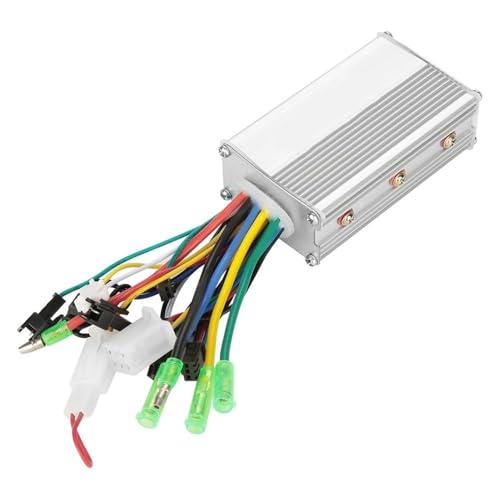
This is the lowest-current choice, rated at 13A and 350W, with support for 24V, 36V, and 48V systems. Its aluminum-alloy case measures about 3.5 × 2 × 1.1 inches, and it supports 60- or 120-degree motor phase angles. The maker says the grooved shell helps dissipate heat during extended use. It can suit a modest-power replacement where the wiring, phase angle, and system voltage match. Its critical limitation is protocol: it works only with Protocol 1, so a Protocol 2 display or vehicle rules it out.
Bottom line: Choose this for a 350W-class setup only when the vehicle uses Protocol 1.
How to match a controller to a 48V motor
Match the controller to the battery voltage, motor current needs, and system signals before choosing by wattage. A 48V label describes nominal voltage, not the battery’s maximum charging voltage; a common 13-series lithium-ion pack reaches 54.6V when full. The controller must tolerate the battery’s actual voltage range, not just its nominal label. Current also matters: watts are approximately volts multiplied by amps, so 48V at 25A corresponds to about 1,200W of electrical input, not necessarily the motor’s rated mechanical output. If the motor is rated below 750W, do not select a higher-current controller without confirming the motor and battery limits. Match phase angle and Hall sensor support as well.
Protocol, display, and wiring compatibility
Communication protocol can determine whether an e-bike controller works with its display, even when voltage and plugs appear to match. The Chiffonade option is restricted to Protocol 1, while the JN controller specifies UART No. 2; these are not interchangeable claims. Connector shape alone does not establish electrical compatibility because pin assignments and signal levels can differ. Before replacing a controller, identify the display protocol, motor Hall sensor arrangement, throttle connector, brake signal type, and battery connector. If the original controller has labeled wires or a model number, record them and compare the functions, not just colors. A mismatched brake or throttle signal can prevent proper operation.
Compare controller current and power ratings
Use current and wattage together rather than treating either number as a complete compatibility check. At 48V, a 13A controller represents roughly 624W of electrical input, while 25A corresponds to roughly 1,200W and 30A to roughly 1,440W; real output depends on voltage under load and system losses. The products’ stated wattage ratings differ, so a higher current number alone does not establish that a controller suits a particular motor. This table is a first-pass screen, not a substitute for matching the motor, battery, display, and wiring:
| Need | Starting point | Check before choosing |
|---|---|---|
| Lower-current replacement | 13A, 350W | Protocol 1 and phase angle |
| Display included | 25A, 500W kit | S866 display and connectors |
| Higher-current setup | 30 ± 1A option | Battery and motor current limits |
Heat, protection, and safe installation
Controller heat rises with current and restricted airflow, so mount the unit where its case can shed heat and keep it clear of insulating covers. Aluminum housings and grooves aid heat dissipation, but they do not override the controller’s current or operating limits. Undervoltage protection helps reduce excessive battery discharge; for example, the 48V NULKOMMA unit specifies a 39 ± 1V threshold. That cutoff is not a universal battery-safe value, since battery chemistry and pack design affect the correct limit. Disconnect the battery before wiring, secure exposed conductors against short circuits, and verify brake cut-off operation at low speed in a safe area before normal riding.
Frequently Asked Questions
Will any 48V controller work with my e-bike motor?
No; the battery voltage is only one compatibility requirement. Match the motor’s power and current needs, Hall sensor or sensorless setup, phase angle, connectors, and display protocol before installing a controller.
How many watts is a 48V controller at 25 amps?
At nominal voltage, 48V multiplied by 25A is about 1,200W of electrical input. Battery voltage under load and system losses mean that figure is not the motor’s exact mechanical output.
What does a 48V battery measure when fully charged?
A typical 13-series lithium-ion e-bike battery reaches 54.6V when fully charged. Confirm the chemistry and series count because other battery designs have different full-charge voltages.
Can I use a controller with a different display protocol?
A different protocol can stop the display and controller from communicating correctly, even if the connectors fit. Confirm the protocol explicitly; one controller here specifies Protocol 1 only and another specifies UART No. 2.
What does low-voltage protection do on a controller?
Low-voltage protection cuts or limits operation when battery voltage falls to a threshold to reduce excessive discharge. Thresholds vary by controller and battery, so the cutoff must suit the pack rather than be treated as a universal setting.