
COSLUS Water Dental Flosser: 5 Models Compared

COSLUS C20 Water Flosser is the named COSLUS water dental flosser, with a 300 mL tank and cordless design; choose it if you want that model, while COSLUS E2 Water Flosser suits buyers who prioritize a larger tank and COSLUS C51 Water Flosser adds built-in nozzle storage.
A water flosser directs a pulsed stream between teeth and along the gumline. Compare tank capacity and pressure adjustment first, especially if you share a device or have sensitive gums.
We earn a commission if you buy through links on this page. As an Amazon Associate I earn from qualifying purchases. Products are compared on manufacturer specifications, not hands-on testing.
- Best overall: COSLUS C20 Water Flosser – The named C20 model pairs a 300 mL tank with a cordless design.
- Best for larger tank: COSLUS E2 Water Flosser – Its 600 mL tank is twice the capacity of the 300 mL models.
- Best for nozzle storage: COSLUS C51 Water Flosser – Two nozzles store inside the compact body.
| Product | Best for | Tank capacity | Pressure settings | Nozzles | Shop |
|---|---|---|---|---|---|
| COSLUS C20 Water Flosser | Named C20 model | 300 mL | — | — | Check Price on Amazon |
| COSLUS C30 Water Flosser | Adjustable pressure | 300 mL | 30–150 PSI; 11 levels | 4 nozzles | Check Price on Amazon |
| COSLUS E2 Water Flosser | Larger tank | 600 mL | 10–160 PSI; 12 levels | 5 tips | Check Price on Amazon |
| COSLUS C51 Water Flosser | Stored nozzles | 300 mL | 6 pressure settings | 2 stored nozzles | Check Price on Amazon |
| COSLUS C50 Water Flosser | Four cleaning modes | — | 5 intensity levels | — | Check Price on Amazon |
COSLUS water dental flosser models
Compare tank size, pressure controls and nozzle arrangements to match a model to your routine.
COSLUS C20 Water Flosser

COSLUS C20 Water Flosser is the named C20 option, with a 300 mL tank and cordless construction for home or travel. COSLUS says its dual-thread pulse system runs at 1,400–1,800 pulses per minute; that maker claim is the model’s distinguishing cleaning specification here. The fields identify orthodontic and sensitive-gum use as intended applications. Choose it if you want the C20 specifically and its 300 mL reservoir suits your routine. The maker does not identify its pressure settings or nozzle count, so buyers who need those numbers to compare options should favor a model with controls.
Bottom line: Choose it if you specifically want the C20 and a 300 mL tank.
COSLUS C30 Water Flosser
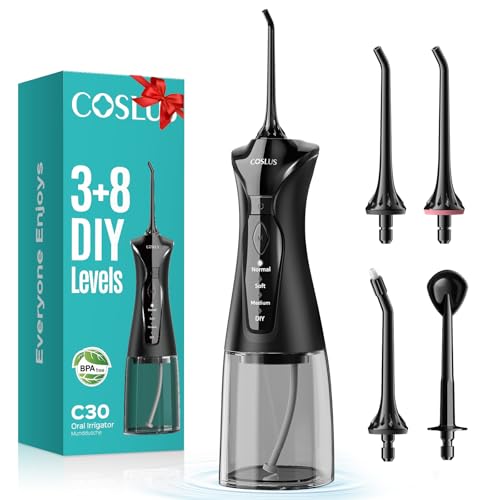
COSLUS C30 Water Flosser stands out for its adjustable pressure range: 30–150 PSI across 11 intensity levels, alongside four operating modes. COSLUS says it delivers 1,400–1,800 dual-pulse streams per minute. The 300 mL tank and four nozzles suit buyers who want several tips and granular pressure selection in one cordless unit. Its feature set is more control-focused than the simpler mode and level combinations on some other models. The tank is smaller than the 600 mL E2 reservoir, so it may be less convenient when longer sessions or fewer refills matter most.
Bottom line: Pick it if fine-grained pressure adjustment matters more than tank size.
COSLUS E2 Water Flosser
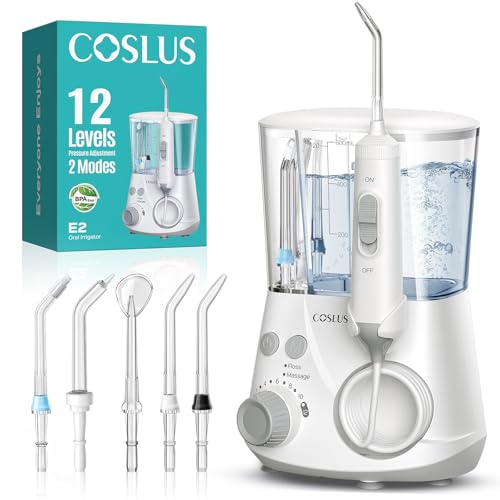
COSLUS E2 Water Flosser has the largest reservoir in this group: 600 mL, compared with 300 mL on the other models with a capacity. Its two modes, 12 pressure levels and five jet tips make it the most fully specified option here for households wanting several tips and a wide adjustment range. COSLUS says the unit operates from 10–160 PSI at 1,400 pulses per minute. Choose it for home use when capacity is the priority. Its dimensions and weight are larger than the compact C51’s, making it a less travel-oriented choice.
Bottom line: Choose it for a larger reservoir and multiple included tips.
COSLUS C51 Water Flosser

COSLUS C51 Water Flosser separates itself with storage for two nozzles inside its compact body, plus a 300 mL tank. It has three modes and six pressure settings, a simpler adjustment range than the C30 or E2. COSLUS identifies the unit as cordless and compact for travel, and gives its weight as 0.59 lb. The built-in storage can help keep the two tips together without a separate case. Choose another model if you want a larger stated tank or a broader number of pressure levels; COSLUS E2 Water Flosser has a 600 mL tank and 12 levels.
Bottom line: Pick it if compact travel storage for two tips is useful.
COSLUS C50 Water Flosser

COSLUS C50 Water Flosser offers four cleaning modes and five intensity levels in a cordless design intended for home and travel. COSLUS says the model was developed with dental professionals and identifies braces, orthodontics and sensitive gums among its intended uses. Its pink finish distinguishes it from the black C20 and C30 and white E2 and C51. Choose it if the four-mode setup and color suit your preferences.
Bottom line: Choose it if you want four modes and a pink cordless model.
How to choose a COSLUS water dental flosser
Start with tank capacity, then compare pressure adjustment and tips. A 600 mL reservoir can reduce refills relative to a 300 mL tank, while a smaller unit can be easier to pack; choose the larger tank for shared or extended routines and the smaller format when bag space matters. Pressure ranges and level counts are not interchangeable: a PSI range shows the endpoints, while the number of settings indicates how many steps are offered. For sensitive gums, begin at the lowest comfortable setting and increase gradually rather than starting at maximum pressure. If several people will use one unit, check how many tips are included and keep each person’s tip separate.
Water flosser pressure and gumline technique
Use a low setting first and aim the stream along the gumline rather than forcing the tip into gum tissue. Water flossers are interdental cleaners: the stream can flush around braces and between teeth, but daily brushing remains important and a water flosser does not replace professional dental care. Move slowly from tooth to tooth, pausing briefly at spaces and around orthodontic brackets; a rushed pass can leave areas untreated. Pressure labels such as PSI describe water pressure, not a guarantee of cleaning results. If use causes persistent pain or bleeding, stop and ask a dental professional for guidance, particularly after oral surgery or if you have a dental condition.
Tank size and travel fit
A 300 mL tank is half the capacity of a 600 mL tank, so reservoir size is a practical way to distinguish portable formats from a larger home option. Check the unit’s full dimensions, not only its tank: a narrow body can still be tall, and weight matters if it travels in a toiletry bag. For the models here, compare the dimensions and weight where available, and confirm that the charging cable and power source fit your routine before travel. Empty and dry the reservoir after use to reduce standing water; detachable tanks are easier to rinse when the design allows removal. Do not assume every model uses the same charging connection.
Water flossers versus string floss
String floss uses physical contact to wipe tooth sides, while a water flosser directs a stream into interdental spaces and around appliances. Both are ways to clean between teeth; technique and consistency matter more than choosing a device with the most modes. A water flosser can be easier to maneuver around braces or bridges, while string floss is compact and needs no charging or reservoir. Choose a water flosser if its handling makes daily interdental cleaning more practical, and keep string floss available if you prefer direct contact on certain gaps. For braces, use a slow pass around brackets and wires rather than aiming high pressure at one spot.
Frequently Asked Questions
How often should I use a water flosser?
Use an interdental cleaner once each day as part of a regular oral-care routine. Consistency matters more than choosing the highest pressure setting.
Should I use a water flosser before or after brushing?
Either order can work, but brushing twice daily with fluoride toothpaste remains essential. Use the water flosser slowly enough to clean each gap and along the gumline.
What pressure should I start a water flosser on?
Start at the lowest comfortable setting, especially if your gums are sensitive or you are new to water flossing. Increase only if it remains comfortable; maximum PSI is not a requirement for routine use.
Can I use a water flosser with braces?
Yes, a water flosser can direct water around brackets and wires where food can collect. Move the stream slowly around each bracket and use a comfortable pressure rather than holding it on one spot.
How should I clean a water flosser tank?
Empty leftover water after each session and let the reservoir air-dry to limit standing water. Rinse removable tanks regularly, and use the manufacturer’s cleaning method for the unit’s internal water path.