
Costway Air Conditioner Options Compared by Room Fit

For most people, COSTWAY 10,000 BTU Portable Air Conditioner, Gray is the clearest fit because its 10,000 BTU capacity is paired with cooling, fan, drying and sleep modes for rooms up to 350 square feet. Choose COSTWAY 10,000 BTU Portable Air Conditioner, Black and White if its black-and-white finish and oscillation range suit your room better, or Costway 10,000 BTU Portable AC, R32 if you prefer its R32 refrigerant.
A portable air conditioner cools a room while exhausting warm air through a window vent; plan for a nearby window and an unobstructed exhaust path.
We earn a commission if you buy through links on this page. As an Amazon Associate I earn from qualifying purchases. Products are compared on manufacturer specifications, not hands-on testing.
- Best overall: COSTWAY 10,000 BTU Portable Air Conditioner, Gray – Combines cooling, fan, drying and sleep modes with a 10,000 BTU rating for up to 350 square feet.
- Best for airflow adjustment: COSTWAY 10,000 BTU Portable Air Conditioner, Black and White – Its oscillation is 65° horizontally and up to 100° vertically by manual louver adjustment.
- Best for R32 refrigerant: Costway 10,000 BTU Portable AC, R32 – Uses R32 refrigerant and shares a 10,000 BTU rating for rooms up to 350 square feet.
| Product | Best for | Refrigerant | Shop |
|---|---|---|---|
| COSTWAY 10,000 BTU Portable Air Conditioner, Gray | All-mode cooling | R410A | Check Price on Amazon |
| COSTWAY 10,000 BTU Portable Air Conditioner, Black and White | Adjustable airflow | — | Check Price on Amazon |
| Costway 10,000 BTU Portable AC, R32 | R32 preference | R32 | Check Price on Amazon |
Costway Air Conditioner Options
Compare the key differences in refrigerant, airflow and controls before matching a unit to your room.
COSTWAY 10,000 BTU Portable Air Conditioner, Gray

COSTWAY 10,000 BTU Portable Air Conditioner, Gray is the gray option with four named modes: ventilation, drying, air cooling and sleep. The 10,000 BTU unit is intended for rooms up to 350 square feet, has two fan speeds and includes a remote and window venting kit. Its adjustable temperature range is 60.8°F to 89.6°F. This mix suits a bedroom or living room where mode choice and remote operation matter. The maker gives the remote range as 16.5T, an unusual unit; confirm the usable remote distance before relying on it across a large room.
Bottom line: Pick this if you want a four-mode portable unit for a room up to 350 square feet.
COSTWAY 10,000 BTU Portable Air Conditioner, Black and White

COSTWAY 10,000 BTU Portable Air Conditioner, Black and White is distinguished by its airflow adjustment: horizontal oscillation reaches 65° automatically, while vertical direction is adjusted manually up to 100°. It is a 10,000 BTU portable air conditioner for spaces up to 350 square feet, with a remote, LCD panel, timer and four universal casters. The feature set includes fan and dehumidifier functions as well as cooling. This configuration suits a room where the airflow needs to be redirected across occupants. Buyers who need to identify the refrigerant should confirm its type before choosing.
Bottom line: Choose this when manually adjustable vertical airflow is a priority.
Costway 10,000 BTU Portable AC, R32
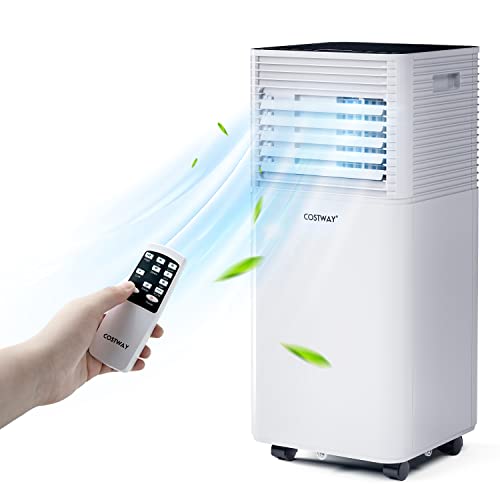
Costway 10,000 BTU Portable AC, R32 shares the four-mode setup and room rating of the gray model but uses R32 refrigerant. It offers ventilation, drying, air cooling and sleep modes, two fan speeds, a remote, a 24-hour timer and a window venting kit. Its temperature setting spans 60.8°F to 89.6°F, and its oscillation is 140° vertically and 50° horizontally. This option suits buyers comparing refrigerant type within this set. The maker gives the remote range as 16.5T; confirm its usable distance if remote reach is important.
Bottom line: Pick this if R32 is the deciding specification among these options.
Choosing a portable air conditioner by room size
Match the unit’s cooling capacity to the room, but treat the area as a ceiling rather than a guarantee. A common sizing rule is about 20 BTU per square foot under ordinary conditions, so 10,000 BTU corresponds roughly to 500 square feet before heat and humidity adjustments; the products here instead give a 350-square-foot room rating. Sun exposure, high ceilings, cooking heat and several occupants can increase the load. For a room with strong afternoon sun or a ceiling above 8 feet, favor more capacity or a lower coverage target rather than assuming the maximum area will cool quickly.
Portable units need a path to expel hot air. Place the unit near a window, keep the exhaust hose as short and straight as the installation allows, and seal gaps around the vent panel to limit warm-air return.
Air conditioner modes and airflow controls
Mode names describe different jobs: cooling uses the compressor, fan mode circulates room air, and dry or dehumidifier mode removes moisture. Sleep mode changes operation for nighttime comfort, but exact behavior can differ by model. A 24-hour timer schedules operation; it does not replace choosing a suitable room size or closing doors to adjacent spaces.
Oscillation angles matter most when air must spread across a seating area; manual louvers let you aim a direction but require adjustment. Use this quick comparison to choose by the room need rather than treating modes as equal cooling capacity.
| Need | Feature to prioritize | Practical rule |
|---|---|---|
| Cooling a closed room | Cooling mode and vent kit | Keep doors and windows closed |
| Spreading air across seats | Oscillation and louvers | Aim airflow above occupants |
| Reducing damp-feeling air | Dry or dehumidifier mode | Expect less temperature drop than cooling mode |
Window venting and portable AC placement
A portable air conditioner must exhaust heat outdoors; a window vent kit is useful only if its panel can fit the opening and the hose can reach without sharp bends. Measure the usable window opening and the distance from the intended unit position to the window before setup. Keep the intake and discharge grilles clear, with several inches of open space around the cabinet as a practical minimum, and avoid pinching the hose behind furniture.
Portable air conditioners also collect condensate as they remove moisture. Humid weather can mean more water to manage, so check the drain arrangement and empty or route water as directed by the unit’s manual. Do not operate cooling with the exhaust directed indoors.
Portable air conditioner refrigerants and upkeep
R410A and R32 are refrigerants used in air-conditioning equipment; neither label alone tells you how quickly a room cools or how much electricity a unit uses. Refrigerant is sealed in the system, so routine upkeep is mainly about airflow: inspect and clean the air filter about every two weeks during heavy use, and keep the condenser and exhaust path clear. A clogged filter reduces airflow and can impair cooling.
Never open a refrigerant circuit or attempt a refrigerant recharge yourself. If a unit stops cooling while the fan still runs, first check filter and vent obstructions; persistent trouble calls for qualified service rather than handling pressurized refrigerant.
Frequently Asked Questions
How large a room can a 10,000 BTU portable AC cool?
These Costway units are rated for rooms up to 350 square feet. Direct sun, high ceilings, humidity and heat-producing appliances can make a smaller room the practical limit.
Does a portable air conditioner need a window?
Yes, the unit must exhaust hot air outdoors, usually through a window vent panel and hose. Measure the opening and hose route before setup, and seal around the panel to reduce warm-air leaks.
How often should I clean a portable AC filter?
Inspect the filter every two weeks during frequent use and clean it when dust is visible. Dusty rooms may require more frequent checks because restricted airflow can weaken cooling.
Can I use fan mode instead of cooling mode?
Fan mode circulates room air but does not provide compressor-based cooling. Use cooling mode when you need the unit to lower room temperature, with the exhaust hose connected outdoors.
What is the difference between R32 and R410A?
R32 and R410A are different refrigerants used in air-conditioning systems, and refrigerant type does not by itself determine room-cooling performance. Never open a sealed refrigerant circuit; service should be handled by a qualified technician.