
David Burke Stainless Steel Pots Compared by Capacity

For a versatile smaller stock pot, choose David Burke Geoclad 8-Quart Stock Pot: its 8-quart capacity and tri-ply body distinguish it from the larger pots. David Burke stainless steel pots here are stock pots for soups, pasta and stews; choose a larger capacity if you regularly cook for a crowd or make big batches.
David Burke Prestige 20-Quart Stock Pot is the largest option at 20 quarts, while David Burke Splendor 13.5-Quart Stock Pot and David Burke Prestige 16.5-Quart Stock Pot offer middle capacities.
We earn a commission if you buy through links on this page. As an Amazon Associate I earn from qualifying purchases. Products are compared on manufacturer specifications, not hands-on testing.
- Best overall: David Burke Geoclad 8-Quart Stock Pot – Its 8-quart capacity and tri-ply body suit smaller batches and offer a clear construction distinction.
- Best for large batches: David Burke Prestige 20-Quart Stock Pot – The 20-quart capacity is the largest among these stock pots.
- Best for mid-size batches: David Burke Splendor 13.5-Quart Stock Pot – Its 13.5-quart capacity sits between the 8-quart and larger stock pots.
| Product | Best for | Capacity | Pot oven limit | Construction / finish | Shop |
|---|---|---|---|---|---|
| David Burke Geoclad 8-Quart Stock Pot | Smaller batches | 8 qt | 500°F | Tri-ply clad; ceramic valleys | Check Price on Amazon |
| David Burke Prestige 20-Quart Stock Pot | Large batches | 20 qt | 400°F; glass lid 350°F | Stainless steel; mirror finish | Check Price on Amazon |
| David Burke Splendor 13.5-Quart Stock Pot | Mid-size batches | 13.5 qt | 500°F; glass lid 350°F | Stainless steel; mirror finish | Check Price on Amazon |
| David Burke Prestige 16.5-Quart Stock Pot | Larger batches | 16.5 qt | 400°F; glass lid 350°F | Stainless steel; mirror finish | Check Price on Amazon |
David Burke Stainless Steel Pots
Compare these David Burke stock pots by capacity, oven limit and the construction or finish that sets each apart.
David Burke Geoclad 8-Quart Stock Pot

David Burke Geoclad 8-Quart Stock Pot is the only pot here with a tri-ply clad body and a patterned searing surface. Its thick aluminum core sits between stainless steel layers, and its laser-etched pattern forms stainless steel peaks over ceramic valleys. The maker says the ceramic coating is PFAS-, PFOA- and PTFE-free, and the pot is oven-safe to 500°F and suitable for all cooking surfaces. At 8 quarts, it suits smaller soup or pasta batches better than the 13.5- to 20-quart options. The lid’s oven limit is not included in the 500°F rating, so check that before heating it in the oven.
Bottom line: Choose this for smaller batches and a tri-ply clad body.
David Burke Prestige 20-Quart Stock Pot

David Burke Prestige 20-Quart Stock Pot has the largest capacity in this group at 20 quarts, making it the pick for large batches of soup, stew or pasta. The pot is stainless steel with a mirror finish and side handles. The maker says the pot is oven-safe to 400°F and its glass lid to 350°F. That lower lid limit matters when a recipe moves from stovetop to oven: remove the lid or keep the oven at or below its limit. Compared with the smaller options, its capacity can be more than needed for everyday portions, so consider storage space and your usual batch size before choosing it.
Bottom line: Choose this when large-batch capacity matters more than compact storage.
David Burke Splendor 13.5-Quart Stock Pot

David Burke Splendor 13.5-Quart Stock Pot offers a 13.5-quart capacity, between the 8-quart pot and the two larger models. Its stainless-steel body has a mirror finish and side handles. The maker says the pot is oven-safe to 500°F, while the glass lid is limited to 350°F. That difference gives the pot a higher oven limit than the Prestige models, but the glass lid remains the constraint if you bake with it covered. This size can suit households making larger soup or pasta batches without stepping up to 16.5 or 20 quarts. It is not the smallest choice for routine, modest servings.
Bottom line: Choose this for a mid-size stock pot with a higher pot oven limit.
David Burke Prestige 16.5-Quart Stock Pot
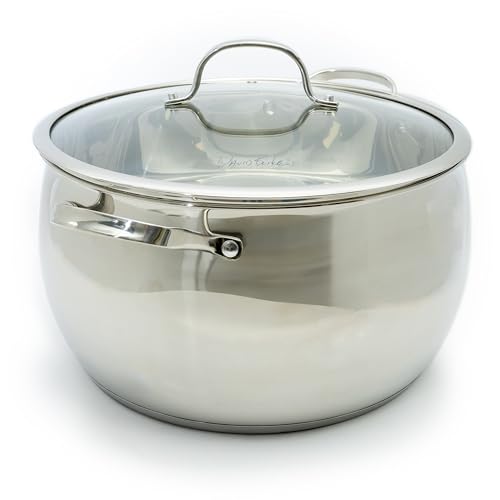
David Burke Prestige 16.5-Quart Stock Pot provides 16.5 quarts, a step up from the 13.5-quart Splendor and below the 20-quart Prestige. Its stainless-steel mirror finish distinguishes it by line rather than by a special layered construction. The maker says the pot is oven-safe to 400°F and glass lids to 350°F. For covered oven cooking, use the glass-lid limit rather than the pot’s higher rating. This is a reasonable middle ground for cooks whose usual batches exceed a 13.5-quart pot but do not call for the largest option. Its larger capacity may be awkward if cabinet space is tight.
Bottom line: Choose this for a capacity between the mid-size and largest pots.
How to Choose a Stock Pot Capacity
Choose capacity around the largest batch you make, while leaving room for liquid to bubble without spilling. An 8-quart pot is the smallest here; the 13.5- and 16.5-quart sizes provide a step up, and 20 quarts is for the biggest batches. A useful decision rule is to choose 13.5 quarts or more if your usual recipe fills an 8-quart pot close to the rim. Do not fill a pot to its brim: leave headroom for boiling and stirring, especially with pasta or thick soup. A bigger pot also takes more storage space and more liquid to reach a useful cooking depth, so extra capacity is not automatically an advantage.
How Tri-Ply and Stainless Steel Differ
Tri-ply cookware bonds an aluminum layer between stainless-steel layers; aluminum spreads heat more evenly than stainless steel alone. David Burke Geoclad 8-Quart Stock Pot has this construction, while the other stock pots are identified as stainless steel without a layered body specification. Stainless steel is durable and nonreactive with acidic foods such as tomato sauce, which makes it useful for long-simmered soups. For stainless steel cooking, preheat over moderate heat and add oil before food to reduce sticking. Avoid overheating an empty pot; excessive heat can discolor stainless steel and cause food to scorch. A patterned searing surface or mirror finish describes the surface, not the pot’s capacity or oven limit.
Oven Limits and Glass Lids
Use the lower oven limit when a pot and its lid have different ratings. For the glass-lidded models here, the maker’s lid limit is 350°F, even when the pot itself is rated higher. That means covered oven cooking should stay at or below 350°F; above that, remove the glass lid only if the recipe permits. Oven ratings apply to cookware, but stovetop handles can become hot, so use dry oven mitts when moving a hot pot. The Geoclad pot’s 500°F oven limit does not give a separate lid rating; verify the lid’s limit before putting it in an oven.
Which Stock Pot Fits Each Cooking Need
Match the pot to batch size first, then use oven rating as a tie-breaker. The table compares the sizes and ratings that separate these four stock pots. For stovetop use, check that the pot sits securely on the burner and keep the flame or heating element within its base rather than climbing the sides. Choose the smallest capacity that handles your regular largest recipe with room to stir; choose more capacity when you routinely cook large batches.
| Cooking need | Capacity to consider | Pot oven limit |
|---|---|---|
| Smaller batches; tri-ply body | 8 qt | 500°F |
| Mid-size batches | 13.5 qt | 500°F |
| Larger batches | 16.5 qt | 400°F |
| Largest batches here | 20 qt | 400°F |
Frequently Asked Questions
What size stock pot works for family soup batches?
A 13.5- or 16.5-quart pot offers more room than an 8-quart model for larger family batches. Leave headroom for bubbling and stirring rather than filling the pot to its rim.
Can a glass-lid stock pot go in the oven?
The glass lids on the 13.5-, 16.5- and 20-quart models are rated to 350°F by the maker. Keep covered oven cooking at or below that temperature, even if the pot has a higher oven rating.
Does tri-ply cookware heat more evenly?
A bonded aluminum core spreads heat more evenly than stainless steel alone, which is why tri-ply construction is used in clad cookware. The Geoclad model has a thick aluminum core between stainless-steel layers.
How do I reduce sticking in a stainless steel pot?
Preheat the pot over moderate heat and add oil before the food. Avoid overheating an empty pot, since excessive heat can scorch food or discolor stainless steel.
How much room should I leave in a stock pot?
Leave headroom for boiling and stirring instead of filling a stock pot to the brim. That is especially useful for pasta and thick soups, which can bubble up and spill over.