
DAYETTE Air Purifiers: 4 Models Compared by Room Fit

For most buyers, DAYETTE Pet Air Purifier 3400 is the strongest starting point because its name claims coverage up to 3,400 square feet and it has two H14 filters plus air-quality sensors. Choose DAYETTE Wi-Fi Air Purifier 2400 instead if Wi-Fi app control and a claimed 22 dB sleep mode matter more; check room-size claims against airflow needs, since square footage alone does not show how quickly air is cleaned.
We earn a commission if you buy through links on this page. As an Amazon Associate I earn from qualifying purchases. Products are compared on manufacturer specifications, not hands-on testing.
- Best overall: DAYETTE Pet Air Purifier 3400 – Combines two H14 filters, TVOC and PM2.5 sensors, and a claimed 3,400-square-foot coverage.
- Best for app control: DAYETTE Wi-Fi Air Purifier 2400 – Offers app control, scheduling, and a claimed 22 dB sleep mode.
- Best for dual filters: DAYETTE Air Purifier 3000 – Pairs two H14 filters with a washable prefilter and turbo mode.
| Product | Best for | Claimed coverage | Intake and filters | Notable controls | Shop |
|---|---|---|---|---|---|
| DAYETTE Pet Air Purifier 3400 | Pet homes | 3,400 sq ft | Dual intake; 2 H14 filters | TVOC and PM2.5 sensors | Check Price on Amazon |
| DAYETTE Air Purifier 3000 | Turbo airflow | 3,000 sq ft | Dual intake; 2 H14 filters | Turbo mode | Check Price on Amazon |
| DAYETTE Wi-Fi Air Purifier 2400 | App scheduling | 2,400 sq ft | Washable prefilter; HEPA 14 | Wi-Fi app; 22 dB sleep mode | Check Price on Amazon |
| DAYETTE Air Purifier 2400 3-Sided Intake | Three-sided intake | 2,400 sq ft | 3-sided intake; HEPA 14 | Enhanced pet mode | Check Price on Amazon |
DAYETTE Air Purifiers Compared
Compare the claimed coverage and features with your room size, airflow needs, and preferred controls.
DAYETTE Pet Air Purifier 3400

Two H14 filters and built-in TVOC and PM2.5 sensors distinguish this pet-focused model from the simpler DAYETTE options. It also has washable prefilters, auto and sleep modes, and an enhanced pet mode. The maker claims coverage up to 3,400 square feet; actual room fit depends on the airflow rate and the number of air changes you need. This configuration suits pet owners who want sensors and automatic operation alongside particle filtration. Its 12-by-5-by-15-inch body may be less convenient where floor space is tight.
Bottom line: Choose this if you want dual filters and onboard air-quality sensors.
DAYETTE Air Purifier 3000
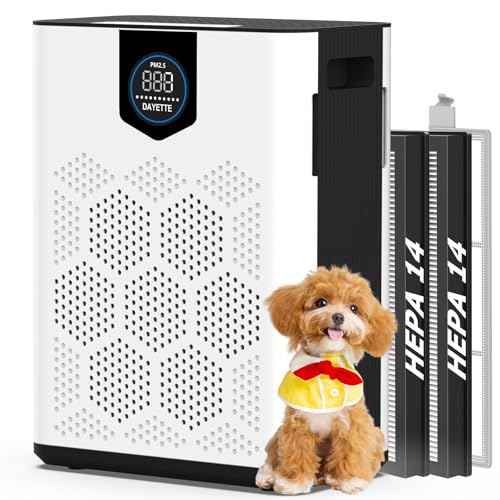
Turbo mode and two H14 filters set this model apart for buyers prioritizing airflow and a dual-filter setup. It also has a washable prefilter intended to catch larger debris such as pet hair and fibers. The maker claims purification for up to 3,000 square feet per hour in turbo mode, so compare that claim with your room’s volume and desired cleaning rate rather than treating it as a guaranteed room-size match. At 13 by 6 by 16 inches and 8 pounds, it is larger and heavier than the other options here.
Bottom line: Pick this when turbo mode and two filters are your main priorities.
DAYETTE Wi-Fi Air Purifier 2400

Remote app control makes this the standout choice for scheduling and changing settings away from the purifier. The maker says its app works on 2.4 GHz Wi-Fi and can control modes and fan speed, create schedules, set a timer, and track filter usage. A built-in fragrance diffuser and a claimed 22 dB sleep mode add bedroom-oriented features. The maker claims coverage up to 2,400 square feet. Choose another model if you do not need connected controls or prefer a product whose features specify dual filters.
Bottom line: Choose this for remote control, scheduling, and a quiet-mode claim.
DAYETTE Air Purifier 2400 3-Sided Intake

A front-and-side intake layout distinguishes this model from the dual-sided designs in this group. The maker says it can circulate and refresh air in rooms up to 2,400 square feet within 60 minutes in pet mode; that claim is most useful when compared with your room’s air-change target. Enhanced pet mode switches to maximum fan speed, and the purifier includes a washable prefilter and fragrance feature. Its 10-by-6-by-14.5-inch footprint is compact, but buyers seeking app control or specified air-quality sensors should consider another option.
Bottom line: Choose this for three-sided intake in a compact purifier.
How to size an air purifier for a room
Match clean-air delivery rate to room volume and your target air changes, not just the largest square-foot number. For a room with an 8-foot ceiling, a useful starting rule is a CADR of at least two-thirds of the room area in square feet for roughly five air changes per hour; a 300-square-foot room therefore calls for about 200 cubic feet per minute. Taller ceilings increase the needed airflow. The coverage claims here do not give CADR, so use them as manufacturer claims rather than proof of five air changes per hour. If you need frequent particle removal, prioritize a verified CADR and size for the room you actually use.
What dual and three-sided intakes change
Intake layout affects where a purifier can draw air, but it does not replace a clean-air delivery rate. A dual-sided intake needs clearance at both sides, while a three-sided design also draws from the front; keep vents unobstructed and leave open space around the unit. Filters work as a system: washable prefilters catch larger debris and can reduce loading on finer filters, while HEPA media targets smaller airborne particles. Hair that settles on floors or furniture is not airborne, so a purifier cannot collect it until it is lifted into the airflow. For pet hair, vacuuming and regular prefilter cleaning remain important companions.
How to compare HEPA labels and room claims
HEPA class labels and room coverage are different measures: a filter class describes particle capture under a test method, while room coverage depends on airflow, room volume, and operating speed. H14 is a European filter classification, not by itself a room-size rating or a guarantee that a complete appliance meets a particular performance level. The products here use H14 wording, but the figures do not include CADR. If you need a dependable room-specific comparison, check for an independently verified CADR and calculate the target using your ceiling height. A larger coverage number can be less useful than a lower number supported by an airflow figure that matches your room.
Filter care and purifier placement
Washable prefilters generally need more frequent attention than the main particle filter; inspect them every few weeks in dusty or high-shedding homes and clean them when visibly loaded, following the unit’s care directions. Main filters commonly need replacement about every 6 to 12 months, but dust, pets, use hours, and filter design can shorten or extend that interval. Place a purifier where air can circulate rather than in a corner or behind furniture, and keep its intake and outlet clear. Fragrance features add scent but do not substitute for particle filtration; people sensitive to fragrances may prefer to leave that feature unused.
Frequently Asked Questions
How many air changes should a bedroom purifier provide?
About 4 to 5 air changes per hour is a common target for general room air cleaning. Calculate room volume by multiplying floor area by ceiling height, then compare that volume with the purifier’s clean-air delivery rate.
What CADR do I need for a 300-square-foot room?
For an 8-foot ceiling and a five-air-change target, aim for about 200 cubic feet per minute of CADR. Higher ceilings or a faster cleaning target require more airflow.
Do washable prefilters remove pet odors?
Washable prefilters mainly catch larger debris such as hair and fibers; odor control generally requires an adsorbent such as activated carbon. Check the filter materials if odor reduction is a priority.
How often should an air purifier filter be replaced?
Many main filters are replaced about every 6 to 12 months, while washable prefilters may need cleaning every few weeks in homes with pets or heavy dust. Use the purifier’s replacement indicator and care instructions as the practical guide.
Where should I place an air purifier in a bedroom?
Set the purifier on a stable, open surface with its intake and outlet unobstructed. Leave several inches of clearance around vents and avoid corners, curtains, and furniture that block airflow.