
Decorations for Therapy Office: 5 Options by Use

For decorations for a therapy office, start with 10-Piece Care Mental Health Poster Set if you want a coordinated set of 10 colorful 10-by-14-inch posters covering several topics. Choose another style if you need a reversible privacy sign for the door, a small tabletop accent, or a different look for the walls.
Measure the intended wall or desk area before choosing: these options range from 5-inch desk decor to 10-by-14-inch posters.
We earn a commission if you buy through links on this page. As an Amazon Associate I earn from qualifying purchases. Products are compared on manufacturer specifications, not hands-on testing.
- Best overall: 10-Piece Care Mental Health Poster Set – The 10-piece set offers colorful posters in one consistent 10-by-14-inch size.
- Best for session privacy: Double-Sided In Session Door Sign – The reversible sign has an in-session message on one side and a welcome message on the other.
- Best for a desk: 5-Inch Wooden Desk Decor – The 5-by-5-inch wooden piece can stand on a tabletop or be mounted on a wall.
| Product | Best for | Format | Count | Size | Shop |
|---|---|---|---|---|---|
| 10-Piece Care Mental Health Poster Set | Colorful wall display | Posters | 10 | 10 × 14 in | Check Price on Amazon |
| Yookeer Pastel Affirmation Plaques | Pastel affirmations | Wooden plaques with flax ropes | 9 | 11.8 × 1.6 in | Check Price on Amazon |
| Blue Health Prints Canvas Set | Blue wall gallery | Unframed canvas prints | 9 | 8 × 10 in each | Check Price on Amazon |
| Double-Sided In Session Door Sign | Door privacy cue | Wooden hanging sign | 1 | 9.8 in | Check Price on Amazon |
| 5-Inch Wooden Desk Decor | Small desk accent | Wooden tabletop sign | 1 | 5 × 5 × 1.3 in | Check Price on Amazon |
Decorations for a Therapy Office
Match the format to the surface and purpose: wall art, a desk accent, or a door sign each serves a different role.
10-Piece Care Mental Health Poster Set

This set provides 10 colorful posters in a uniform 10-by-14-inch size, making it the broadest wall-art option here. The themes include a feelings wheel, self-care, anxiety coping statements, and a grounding technique, according to the maker. It may suit a counseling room with enough wall area for several pieces and a preference for varied subject matter. The posters are the choice to consider when you want a coordinated set rather than one focal plaque; the uniform size also means they need more continuous wall space than a compact accent.
Bottom line: Pick this set for a colorful wall display with several mental health themes.
Yookeer Pastel Affirmation Plaques

These nine pastel wooden plaques form a narrow affirmation display rather than a conventional poster set. The messages include reminders that feelings are valid, boundaries matter, and asking for help is okay. The plaques arrive with flax ropes fixed to the back, so they are intended to hang together as one piece. At about 11.8 inches long and 1.6 inches wide, the display suits a slim wall area or a room that needs a gentle visual accent. Its pastel palette and affirmation-focused messages are less suited to someone seeking colorful informational posters.
Bottom line: Choose this for a narrow pastel display centered on affirmations.
Blue Health Prints Canvas Set

This nine-piece set differs from the poster pack with blue health-themed canvas prints, each measuring 8 by 10 inches and sold unframed. The smaller repeated format can work for a grouped wall arrangement or for placing pieces around a room rather than filling one large area. The maker describes the prints as suitable for settings including offices and children’s rooms. Because the prints are unframed, plan for the look and support you want before arranging them; buyers seeking ready-framed artwork should choose a different format.
Bottom line: Pick these prints for a blue-toned grouped display and an unframed format.
Double-Sided In Session Door Sign
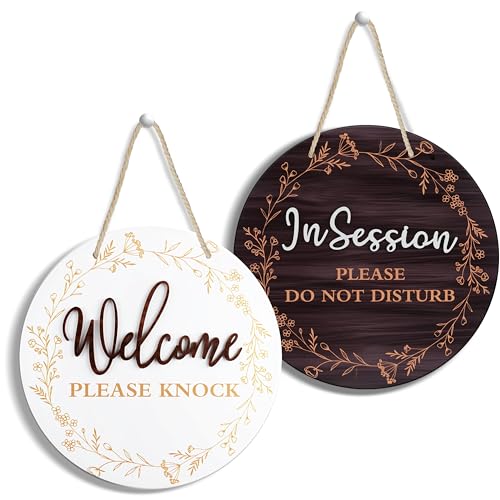
This is the only option here designed to communicate a room’s status at the door: one face says “In Session Please Do Not Disturb,” while the reverse says “Welcome Please Knock.” The wooden sign measures 9.8 inches and includes a hanging rope. That makes it a practical choice for a therapy or counseling room where visitors need a clear cue without adding more wall art. Its purpose is narrower than the other decor: it addresses entry and privacy messaging, not the visual treatment of a wall or desk.
Bottom line: Choose this when a reversible session-status message matters most.
5-Inch Wooden Desk Decor

This compact wooden piece is the only decor option in the group explicitly suited to either a tabletop or wall. Its message, “I Am Not What Happened to Me, I Am What I Choose to Become,” is paired with minimalist floral face line art. At 5 by 5 by 1.3 inches, it fits a desk or counter where larger art would take up too much space. The single-message format keeps it focused, but it does not provide the multiple themes of a poster set or the room-status function of a door sign.
Bottom line: Pick this for a small tabletop accent with a single encouraging message.
How to choose decorations for a therapy office
Choose by function first: wall art sets the room’s visual tone, a desk accent occupies a small surface, and a door sign communicates entry expectations. Measure the available area in inches and leave a margin around artwork so it does not feel crowded; a simple starting point is about 2 to 4 inches of clear space around a small piece. For a wall group, lay out paper templates at the actual print sizes before hanging. The 10-by-14-inch poster format needs substantially more wall area than an 8-by-10-inch print, while a 5-inch desk piece uses little tabletop space. If the room serves children, favor wording and imagery that are age-appropriate and easy to read from the intended viewing distance.
Planning wall art size and placement
Hang wall art with its center around 57 to 60 inches from the floor as a common gallery-placement guideline, then adjust for seated viewing and furniture height. Above a sofa or console, keep the artwork’s lower edge roughly 6 to 8 inches above the furniture so the grouping feels connected. For multiple pieces, keep spacing consistent—about 2 to 3 inches between frames is a useful starting point—and test the arrangement with paper templates first. These guidelines are starting points, not rules for every room: a narrow wall, a child-focused space, or a seated-only office may call for lower placement. Check the wall material and use a hanger rated for the full load; do not rely on adhesive alone for an item that could fall over a seating area.
Wall art, desk accents, and door signs compared
Wall art is best for visual atmosphere, desk decor for a small personal focal point, and a door sign for a functional privacy cue. The choice depends on what the room needs before adding another object. A useful distinction is surface and message: a poster or plaque stays visible inside the room, while a reversible sign can tell someone outside whether to wait or knock. Compare these formats before deciding where to spend limited wall or desk area.
| Need | Format to consider | Planning point |
|---|---|---|
| Several themes on a wall | Poster or print set | Confirm wall width and spacing |
| A compact focal point | Small tabletop decor | Check desk depth and visibility |
| Session entry cue | Reversible door sign | Make sure it hangs where visitors can see it |
Hanging and displaying office decor safely
Use a wall fastener matched to the wall type and the item’s weight; drywall anchors, masonry plugs, and wood screws are not interchangeable. Locate a stud when possible for heavier pieces, and keep hanging decor clear of door swings, vents, and frequently handled equipment. For a sign with a rope hanger, check that the hanging point keeps it stable and readable rather than tilted or obstructed. On desks and counters, leave working space around the decor and keep objects away from edges where a bump could knock them down. In rooms used by children, avoid placing small or breakable objects within reach, and secure wall-mounted pieces above seating so they cannot fall onto occupants.
Frequently Asked Questions
How high should therapy office wall art hang?
A common starting point is to place the artwork’s center 57 to 60 inches above the floor. Lower it for seated viewing or a child-focused room, and keep pieces about 2 to 3 inches apart in a grouped arrangement.
How much space should I leave between posters?
About 2 to 3 inches between pieces is a useful starting point for a gallery-style arrangement. Keep the gaps consistent and use paper templates to check the full layout before hanging.
What should I check before hanging wooden wall decor?
Match the fastener to the wall material and the item’s weight, and use a stud when possible for heavier pieces. Keep the decor away from door swings and secure it above seating to reduce the risk of a fall.
Where should a therapy in-session sign hang?
Hang the sign on the room’s entry door where an approaching visitor can read it before knocking. Keep the message unobstructed by the door frame, handle, or nearby wall fixtures.
How can I make wall decor easy for children to read?
Place the main message near a child’s seated or standing eye level and favor short, legible wording. Check the layout from the chair or play area children are most likely to use.