
Drill Bit Stop Collars: 5 Sets Compared by Fit

For most buyers, POWERTEC 7-Piece Split-Ring Set is the clearest all-around choice because its seven split-ring collars cover common 1/8- to 1/2-inch bit sizes and include three matching hex keys. Choose Bonsicoky Drill Stop Collar Set or Tiosamd 9-Piece Stop Collar Set instead if a 5/8-inch collar matters, and verify that size is included before ordering.
A drill bit stop collar clamps to the bit at a set distance from its tip, limiting how far the bit enters the workpiece.
We earn a commission if you buy through links on this page. As an Amazon Associate I earn from qualifying purchases. Products are compared on manufacturer specifications, not hands-on testing.
- Best overall: POWERTEC 7-Piece Split-Ring Set – Seven split-ring collars cover 1/8- to 1/2-inch bits, with three matching hex keys.
- Best for lighter collars: Professional Aluminum 8-Piece Set – Its eight-size split-ring set uses aluminum collars and spans 1/8 to 1/2 inch.
- Best for 5/8-inch bits: Tiosamd 9-Piece Stop Collar Set – Its size range includes 5/8 inch alongside seven smaller diameters.
| Product | Best for | Size range | Material | Clamp style | Shop |
|---|---|---|---|---|---|
| POWERTEC 7-Piece Split-Ring Set | Common bit sizes | 1/8–1/2 in. | Carbon steel | Split ring | Check Price on Amazon |
| Professional Aluminum 8-Piece Set | Lightweight collars | 1/8–1/2 in. | Aluminum | Split ring | Check Price on Amazon |
| Wolfride 8-Size Split-Ring Set | Carbon-steel range | 1/8–1/2 in. | Carbon steel | Split ring | Check Price on Amazon |
| Tiosamd 9-Piece Stop Collar Set | Larger bit sizes | 1/8–5/8 in. | Carbon steel | Split ring | Check Price on Amazon |
| Bonsicoky Drill Stop Collar Set | Multiple collar sets | 1/8–5/8 in.* | Carbon steel | Set screw | Check Price on Amazon |
Drill Bit Stop Collar Sets
Compare the bit diameters, collar materials and clamp designs to match a set to your drill bits and depth-control needs.
POWERTEC 7-Piece Split-Ring Set
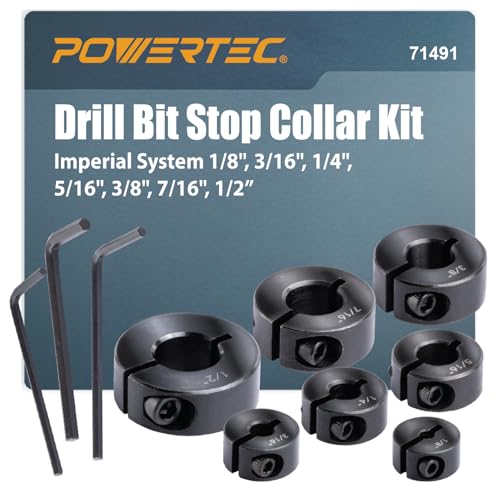
POWERTEC 7-Piece Split-Ring Set is distinguished by three size-matched hex keys, rather than a single wrench for the whole set. The seven carbon-steel collars fit 1/8-, 3/16-, 1/4-, 5/16-, 3/8-, 7/16- and 1/2-inch bits. Its split-ring clamp wraps around the bit; the maker says this design helps reduce marring, slippage and off-center twisting. The range suits common imperial woodworking bits, including bits used for doweling and pocket-hole work. The tradeoff is that the set tops out at 1/2 inch, so buyers using 5/8-inch bits should choose a set with that diameter instead.
Bottom line: Pick this set if your bits stay within 1/2 inch and you want size-matched keys.
Professional Aluminum 8-Piece Set
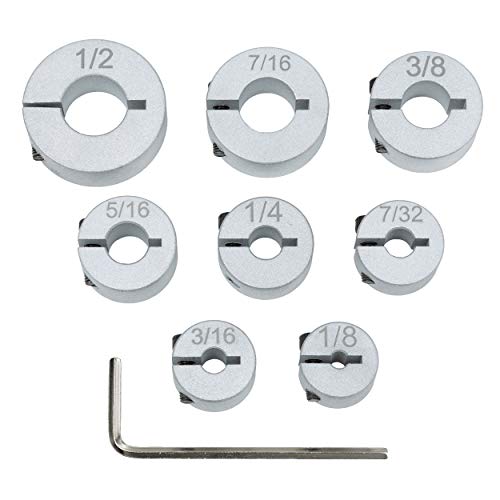
Professional Aluminum 8-Piece Set stands apart for its aluminum collars and eight-size range, adding 7/32 inch to the common imperial sizes from 1/8 to 1/2 inch. The split-ring design adjusts along the flutes or shaft, and the maker says it provides five times the holding power of a standard set-screw design. This is a useful match for buyers who want that extra intermediate diameter or prefer lightweight collars.
Bottom line: Choose this set if aluminum collars and the 7/32-inch size fit your work.
Wolfride 8-Size Split-Ring Set

Wolfride 8-Size Split-Ring Set includes 7/32-inch collars as well as the familiar seven sizes running from 1/8 to 1/2 inch. The carbon-steel collars use a single-opening split-ring design, and a 3 mm Allen wrench is included. The maker says the clamp supports precise positioning and alignment on drill and mill shafts. This choice suits buyers who want the additional 7/32-inch diameter in a steel set. The range does not include 5/8 inch, so it will not cover that larger bit size; check the actual bit diameter before choosing any collar, since collars need to match the shank.
Bottom line: Pick this set for a carbon-steel option that includes 7/32-inch collars.
Tiosamd 9-Piece Stop Collar Set

Tiosamd 9-Piece Stop Collar Set is the set here that explicitly includes a 5/8-inch collar, in addition to seven diameters from 1/8 through 1/2 inch and an Allen wrench. Its carbon-steel collars use a split-ring design that can be adjusted along the bit; the maker says the fixing screw holds the collar securely without damaging the bit. That larger diameter makes the set relevant for buyers whose bits exceed 1/2 inch. The tradeoff is a larger size spread than some jobs need, and the material calls the steel both high-carbon and carbonized, so do not rely on a more specific alloy grade.
Bottom line: Choose this set when a 5/8-inch bit is part of your work.
Bonsicoky Drill Stop Collar Set

Bonsicoky Drill Stop Collar Set is differentiated by its two-set wording and blackened carbon-steel collars, with an Allen wrench for tightening the set screws. The maker says the blackened surface improves rust resistance and that the collars are designed not to damage bits when tightened. This may suit buyers who want screw-clamp collars or multiple sets. Unlike a split-ring clamp, a set screw presses at one point, so tighten it evenly and avoid overtightening against a delicate bit.
Bottom line: Pick this if you prefer set-screw collars and can confirm the needed sizes.
How to choose drill bit stop collars
Match the collar’s inside diameter to the bit shank, then set the depth from the bit tip to the collar face. A collar that is too large can slide; one that is too small will not fit. These sets use fractional-inch sizes, so compare the stamped bit size with the collar size rather than estimating by eye. Split-ring collars close around the bit, while set-screw collars use a screw to press against it. Choose a split-ring design when you want a clamp distributed around the shaft; choose a screw type only when its size and clamping method suit the bit. For repeated holes, mark the desired depth on a test piece before drilling the workpiece.
Bit diameter, desired hole depth and the usable straight shank all affect fit. If the bit’s cutting length is shorter than the intended hole depth, a stop collar cannot make it drill deeper.
Setting a repeatable drilling depth
Set the distance from the bit tip to the collar’s workpiece-facing edge to the target depth. Measure along the bit, tighten the collar, then drill a test hole in scrap of the same thickness; a tape measure or depth gauge makes the setup easier to reproduce than visual estimation. The collar limits travel only when it contacts the work surface, so keep the drill square to the surface and use steady pressure. For a blind hole, leave enough material beneath the target depth to avoid breaking through. A depth stop controls penetration, not the drill’s angle or the bit’s tendency to wander.
Stop drilling when the collar meets the workpiece instead of forcing the rotating bit onward. Keep hands clear of the bit and secure small workpieces with a clamp; a spinning workpiece can injure fingers or damage the hole.
Split-ring versus set-screw collars
Split-ring and set-screw collars both limit bit travel, but they grip the shaft differently. A split-ring collar closes around more of the circumference; a set screw bears on one point of the bit. The products here include both designs, so choose by the collar style and size that match the job. A split ring can be adjusted along a smooth bit shaft, while a screw collar must be tightened enough to stay put without damaging the bit. Neither style replaces a drill press depth stop or a jig when the work requires controlled alignment as well as depth.
The table maps common needs to a practical choice; confirm that the bit diameter appears in the selected set before use.
| Need | Choice |
|---|---|
| Most common imperial bit sizes through 1/2 inch | Seven-size set |
| Additional 7/32-inch collar | Eight-size set that lists 7/32 inch |
| 5/8-inch bit | Set that explicitly includes 5/8 inch |
| Clamp distributed around bit | Split-ring collar |
Common stop collar mistakes
The most common setup mistake is choosing a collar by the hole depth rather than the bit diameter; collar size refers to the shaft it fits, not how deep it drills. Another error is measuring to the wrong collar edge: the workpiece contacts the face nearest the bit tip, so measure from the tip to that face. A collar can also slip if dust or oil keeps its clamp from gripping, so keep the bit and collar contact area clean. On a handheld drill, leaning the drill changes the hole’s path even if the stop is set correctly. Clamp the work, hold the drill square, and test the stop on scrap before making repeated holes.
Do not use a stop collar as a substitute for safe control of the tool. Disconnect power or remove the battery before adjusting the collar, and keep the bit pointed away from hands while making the test hole.
Frequently Asked Questions
How do you set a drill bit stop collar?
Measure from the bit tip to the collar face that will touch the workpiece, then tighten the collar at that distance. Test the setting in scrap of the same thickness before drilling the final piece.
Can a stop collar fit any drill bit?
No; the collar’s inside diameter must match the bit shank size, such as 1/4 or 3/8 inch. These sets cover defined fractional-inch sizes, so verify the exact diameter rather than assuming a nearby size will work.
Will a drill stop collar prevent drilling through wood?
A correctly set collar can limit bit travel when its face contacts the surface, but the depth must leave enough wood beneath the hole. Test on scrap first, especially when the remaining material is thin.
Should drill stop collars go on the flutes?
Place the collar on a section of the bit shaft where it can clamp securely and reach the work surface at the target depth. A collar positioned on an uneven cutting area may not sit squarely or hold consistently.
How do you keep a stop collar from slipping?
Use the collar size that matches the bit and tighten its clamp securely without overtightening. Clear dust or oil from the contact area and check the setting with a test hole before repeated drilling.