
Dual Spindle Doweling Joiners Compared by Fit and Setup

For dual spindle dowel drilling with up to 38 mm depth and a 10–43 mm material-thickness adjustment, AONLLEN DJ710 Dual Spindle Dowel Jointer is the closest match to the search. Choose igooo DJ710 Dual-Spindle Doweling Jointer instead if having 6, 8, 10 and 12 mm bits matters more; Makita PJ7000 Plate Joiner is a plate joiner for biscuit slots, not dowel holes.
We earn a commission if you buy through links on this page. As an Amazon Associate I earn from qualifying purchases. Products are compared on manufacturer specifications, not hands-on testing.
- Best overall: AONLLEN DJ710 Dual Spindle Dowel Jointer – Its 0–90° fence and 10–43 mm thickness adjustment suit a wide range of angled dowel joints.
- Best for bit choice: igooo DJ710 Dual-Spindle Doweling Jointer – It comes with 6, 8, 10 and 12 mm drilling bits.
| Product | Best for | Bit sizes | Drill depth | Thickness adjustment | Shop |
|---|---|---|---|---|---|
| AONLLEN DJ710 Dual Spindle Dowel Jointer | Angled dowel joints | 6 and 8 mm | Up to 38 mm | 10–43 mm | Check Price on Amazon |
| igooo DJ710 Dual-Spindle Doweling Jointer | More bit diameters | 6, 8, 10 and 12 mm | Up to 38 mm | 10–43 mm | Check Price on Amazon |
| Makita PJ7000 Plate Joiner | Biscuit slot joints | Biscuit cutter | — | 0°, 45° and 90° | Check Price on Amazon |
Dual Spindle Doweling Joiners
Compare the two doweling joiners by their bit sets, depth and workpiece adjustment range.
AONLLEN DJ710 Dual Spindle Dowel Jointer

AONLLEN DJ710 Dual Spindle Dowel Jointer pairs double or single drilling with a fence that locks anywhere from 0° to 90°, so it suits projects that need angled dowel joints as well as straightforward alignment. The rack-and-pinion adjustment covers 10–43 mm material thickness, and drilling depth is adjustable up to 38 mm. It includes 6 mm and 8 mm bits and 80 wooden dowel pins. The dust port can connect to extraction, and a clear viewing screen helps with alignment. The limitation is the bit range: woodworkers needing larger diameters should compare the 6–12 mm set in igooo DJ710 Dual-Spindle Doweling Jointer.
Bottom line: Pick it for adjustable-angle dowel work with 6 and 8 mm bits.
igooo DJ710 Dual-Spindle Doweling Jointer

igooo DJ710 Dual-Spindle Doweling Jointer stands out for its four-bit set, covering 6, 8, 10 and 12 mm dowels without changing to a different joiner. Like the other DJ710, it offers double or single drilling, depth adjustment up to 38 mm, a 10–43 mm thickness range and a fence that adjusts from 0° to 90°. Its calibrated viewer supports setup, and its dust port accommodates an extraction connection. This option is a practical fit when larger dowels are part of the plan; the set does not include the 80 pins noted with AONLLEN DJ710 Dual Spindle Dowel Jointer.
Bottom line: Choose it when the 10 or 12 mm bit sizes are useful.
Makita PJ7000 Plate Joiner
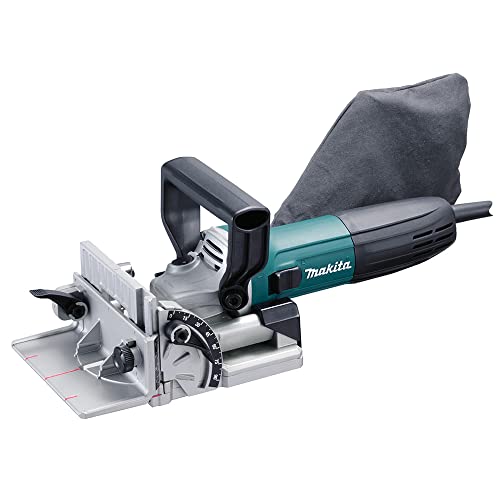
Makita PJ7000 Plate Joiner is a plate joiner, not a dual spindle doweling joiner: it cuts slots for biscuits rather than drilling paired dowel holes. Its 5.6-amp motor runs at 11,000 RPM, and the cast-aluminum pivot fence has positive stops at 0°, 45° and 90°. Six depth settings cover common #0, #10 and #20 biscuit sizes. The tool suits a woodworker who wants biscuit-slot alignment and already uses that joint style. It is the wrong choice when the job calls for dowels, since biscuit slots and dowel bores require different joinery hardware.
Bottom line: Pick it only for biscuit-slot joints rather than dowel drilling.
How to choose a dual spindle doweling joiner
Choose the doweling joiner by matching the bit diameter to the dowels and the thickness adjustment to the stock. These two DJ710 options support material from 10 to 43 mm and drilling depth up to 38 mm; their clearest difference is the bit range. A 6 or 8 mm dowel works with either bit set, while 10 or 12 mm dowels point to igooo DJ710 Dual-Spindle Doweling Jointer. A fence that moves from 0° to 90° helps set angled joints, but the workpiece still needs to be held securely and the drilling marks aligned. For repeatable work, make a test joint in scrap of the same thickness before drilling the finished pieces.
Doweling joiner setup and alignment
Accurate dowel joints depend on matching hole centers across both mating pieces, not just setting the fence. Mark the joint line, register the joiner consistently from the same face, and clamp the stock to prevent movement; a small shift can make pins bind during assembly. Keep paired holes parallel to the intended joint and dry-fit the parts before applying glue. A depth setting must leave room for the dowel and adhesive rather than letting the pin bottom out in both holes. Where a job uses several dowel sizes, verify bit diameter and pin fit on a scrap sample first instead of assuming the labeled size will compensate for wood movement or drilling error.
Dowel joiners versus plate joiners
Dowel joiners drill round holes for cylindrical pins, while plate joiners cut crescent-like slots for compressed wooden biscuits. Use dowels when the design calls for pinned alignment and matching bores; choose a plate joiner when the plan specifies biscuit sizes such as #0, #10 or #20. The fence details also differ: the dowel tools here offer continuously adjustable angles from 0° to 90°, whereas Makita PJ7000 Plate Joiner uses positive stops at 0°, 45° and 90°. This choice affects the joint hardware and layout, so a plate joiner is not a substitute for a dual spindle doweler even though both tools help align adjoining boards.
The table helps match the joiner type to the joint hardware.
| Joint method | Tool type | Decision rule |
|---|---|---|
| Round dowel pins | Dual spindle doweling joiner | Choose when the plan specifies dowel holes |
| #0, #10 or #20 biscuits | Plate joiner | Choose when the plan specifies biscuit slots |
Dust and safe dowel drilling
Wood dust is a respiratory hazard, so connect dust extraction when the tool allows it and wear a properly fitted particulate respirator during drilling. Clear chips from the work area only after the bit stops, and disconnect power before changing bits or adjusting near the cutter. Clamp the board rather than holding a small workpiece by hand, especially when drilling near an edge. Keep the bit sharp and use a steady feed; forcing a dull bit can increase heat and tear-out. Check hole depth on scrap before making a batch of joints, since a depth error repeated across paired holes can prevent a flush assembly.
Frequently Asked Questions
What dowel bit size should I choose for a joint?
Choose a bit that matches the dowel diameter and leaves enough wood around the hole for the board thickness. The 6 and 8 mm sizes suit thinner stock than 10 or 12 mm pins, so test the fit in scrap before drilling the project pieces.
How deep should dowel holes be drilled?
A dowel hole should provide room for the pin and glue without bottoming out during assembly. These joiners adjust to as much as 38 mm, but set the depth to the dowel length and split that allowance across the two mating holes.
Can a doweling joiner make angled joints?
Yes, a fence adjustable from 0° to 90° can set up angled drilling. Clamp the stock securely and test the angle on scrap, since the mating piece must mirror the same joint geometry.
How do I keep dowel holes aligned?
Register the joiner from the same reference face on both mating boards and keep the joint marks consistent. For repeated holes, clamp the boards and dry-fit one test pair before drilling the rest.
Is a plate joiner the same as a dowel joiner?
No: a plate joiner cuts slots for flat biscuits, while a dowel joiner drills round holes for pins. Use the tool type specified by the joint plan; biscuit size settings do not set dowel-hole diameter.