
Duracell Dual Power Lanterns: Models Compared

Duracell Tri-Power Rechargeable Lantern is the closest match for a Duracell dual-power lantern because it combines a Duracell name with a dual battery source and solar, USB, and Qi charging. Choose another model if you specifically want a D-battery option, a 5,000-lumen output, or a two-pack.
We earn a commission if you buy through links on this page. As an Amazon Associate I earn from qualifying purchases. Products are compared on manufacturer specifications, not hands-on testing.
- Best overall: Duracell Tri-Power Rechargeable Lantern – It is the Duracell model and specifies a dual battery source plus solar, USB, and Qi charging.
- Best for D batteries: Tri-Power Rechargeable 5,000-Lumen Lantern – It lists four D batteries alongside rechargeable and solar power.
- Best for emergency modes: 5,000-Lumen Solar Rechargeable Lantern – It includes red night vision and a red emergency flasher mode.
- Best for a bonus puck light: Energizer X1000 Power Cube Lantern – It includes a puck light and has two USB ports.
| Product | Best for | Maximum output | Power options | Special features | Shop |
|---|---|---|---|---|---|
| Duracell Tri-Power Rechargeable Lantern | Duracell shoppers | 3,000 lumens | Solar, USB, Qi; dual battery source | USB-C input and output | Check Price on Amazon |
| Tri-Power Rechargeable 5,000-Lumen Lantern | D-battery backup | 5,000 lumens | Rechargeable, solar, four D batteries | USB-C output; red mode | Check Price on Amazon |
| 5,000-Lumen Solar Rechargeable Lantern | Emergency signaling | 5,000 lumens | USB-in, rechargeable battery, D batteries | Red night vision and flasher | Check Price on Amazon |
| Rechargeable 1,800-Lumen Lantern, 2-Pack | Two-light coverage | 1,800 lumens | Rechargeable battery | 4,400 mAh; IP44 | Check Price on Amazon |
| Energizer X1000 Power Cube Lantern | USB device charging | 1,000 lumens | Rechargeable battery or AA battery | Two USB ports; bonus puck light | Check Price on Amazon |
Duracell Dual Power Lanterns and Alternatives
Compare the power choices and lighting features to find a lantern that fits your intended use.
Duracell Tri-Power Rechargeable Lantern

Duracell Tri-Power Rechargeable Lantern is the Duracell option in this group, with a dual battery source and three charging methods: solar, USB, and Qi. The maker rates its output at 3,000 lumens and lists high, medium, low, and power-save modes. USB-C input and output add a wired charging route for the lantern and connected devices. This is a fit for buyers who want the Duracell name and several ways to replenish power. Its output is lower than the 5,000-lumen options, which matters if maximum brightness is the priority.
Bottom line: Choose this if the Duracell name and multiple charging methods matter most.
Tri-Power Rechargeable 5,000-Lumen Lantern
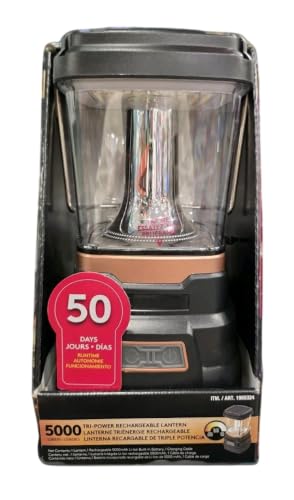
Tri-Power Rechargeable 5,000-Lumen Lantern differs from the Duracell model by naming four D batteries as one of its three power options. The maker rates this lantern at 5,000 lumens and lists high, medium, eco, and red modes, plus three color temperatures and dimming. USB-C supports charging the lantern and powering another device. It suits buyers who want a replaceable-battery option in addition to rechargeable and solar power. The mode set does not include a red emergency flasher, so choose another model if that signal mode is important.
Bottom line: Choose this if you want four D batteries as a backup power option.
5,000-Lumen Solar Rechargeable Lantern

5,000-Lumen Solar Rechargeable Lantern stands out for its red night-vision and red emergency-flasher modes, which are distinct from the other lanterns here. The maker rates its output at 5,000 lumens and says one hour of solar exposure provides approximately one hour of runtime in eco mode. It also has USB-in charging, a rechargeable battery, optional D batteries, and USB device charging. This combination may suit campers or households that value a signaling mode. The solar-runtime figure applies specifically to eco mode, so it should not be treated as an estimate for brighter settings.
Bottom line: Choose this if a red flasher mode is a priority.
Rechargeable 1,800-Lumen Lantern, 2-Pack

Rechargeable 1,800-Lumen Lantern, 2-Pack is a two-lantern set rather than a single high-output lantern, making it the option for placing light in separate areas. Each lantern has 46 LEDs, four light modes, a 4,400 mAh rechargeable battery, and a USB power-bank function. The maker says a full charge can last up to 12 hours. IP44 is the water-resistance rating; this is not a submersible-light specification. Its 1,800-lumen output is much lower than the 3,000- and 5,000-lumen models, so buyers prioritizing maximum area brightness should look elsewhere.
Bottom line: Choose this if having two rechargeable lanterns is more useful than maximum output.
Energizer X1000 Power Cube Lantern

Energizer X1000 Power Cube Lantern offers a different kind of dual-power setup: the features specify a rechargeable battery or an AA battery. The maker rates its cube-style area light at 1,000 lumens and lists two light modes with dimming. Two USB ports let it function as a power bank, and a bonus puck light adds a separate compact light source. It suits buyers looking for charging ports and a secondary light, rather than the highest lantern output. Its 1,000-lumen maximum is the lowest in this comparison.
Bottom line: Choose this if USB charging and a bonus puck light suit your setup.
How to choose a dual-power lantern
Start with the power source you can replace or replenish where you plan to use the lantern. Rechargeable-only models need a charging opportunity; models that also accept replaceable batteries can offer another route when an outlet is unavailable. Solar charging can help in daylight, but its usefulness depends on sunlight and the selected light mode. Compare output only after checking power: the maker-rated figures here range from 1,000 to 5,000 lumens. For a small tent or close task lighting, a dimmable lower setting can be more practical than running maximum output. If you expect to illuminate a broad area, favor a model whose maximum is higher and whose modes let you reduce brightness when full output is unnecessary.
| Need | Feature to prioritize |
|---|---|
| Backup power without an outlet | Replaceable battery option |
| Daylight replenishment | Solar charging |
| Charging a device | USB output or power-bank ports |
| Emergency signaling | Red flasher mode |
What dual power means for lanterns
Dual power generally means a lantern can operate from two power sources, such as a rechargeable battery and replaceable cells; charging methods are not always the same as operating sources. Some lanterns also accept solar or USB charging, which replenishes a battery rather than necessarily powering the light directly. Read the source distinctions carefully: a lantern can advertise three charging routes while still naming a separate dual battery source. If emergency use is the goal, pick a lantern whose backup battery type you can keep on hand. Confirm the exact replacement-battery type before ordering if you need cells you already stock.
USB output is useful for topping up small devices, but it does not establish how many device charges a lantern can provide. The comparison includes USB-C output, two USB ports, and other USB charging features; the number and type of ports vary. A red emergency flasher is also different from a steady red night-vision mode, so check for the mode you intend to use.
How to compare lantern brightness and modes
Compare the maximum lumen figure and the available settings together. A maximum output tells you the maker-rated peak, while low, eco, or power-save modes let you choose less light; dimming provides additional control where specified. In this group, the maximums span 1,000 to 5,000 lumens, so deciding whether you value output or runtime flexibility can narrow the choices. The maker says the 5,000-lumen lantern with solar charging returns about one hour of eco-mode runtime per hour of sunlight; that claim is specific to eco mode and does not give a runtime estimate for high output.
Color temperature can affect the feel of light, and one model lists three color temperatures with dimming. If you want a specific color or emergency signal, verify the named mode rather than assuming every lantern offers it. For broad lighting from a single lantern, prioritize a higher maximum; for close-range use, a lower setting can reduce glare and conserve power.
Lantern water resistance and safe use
Check the ingress-protection rating when a lantern may encounter rain or splashes. IP44 indicates protection against solid objects larger than 1 millimeter and water splashing from any direction; it does not mean a lantern can be submerged. Only one model here gives an IP44 rating, so do not assume the other lanterns have the same protection. Keep rechargeable lanterns and charging ports dry unless their rating supports the conditions you expect.
Lanterns can become warm during operation, particularly at high output. Keep the light clear of fabric, paper, and other materials that can obstruct it, and avoid leaving it where children can pull it down. Follow the lantern’s safety instructions for charging, and do not use a damaged battery or cable. For storm preparation, keep a compatible backup battery supply and a separate flashlight rather than relying on a single light source.
Frequently Asked Questions
Is solar charging enough for overnight lantern use?
Solar charging is a replenishment method, not a guaranteed overnight runtime. One model’s maker gives an estimate of about one hour of eco-mode runtime after one hour of sun exposure, so plan around the specified setting and available daylight.
What does a dual battery source mean on a lantern?
A dual battery source means the lantern has two battery power options, but the exact types must be checked for the particular model. Charging methods such as solar, USB, and Qi do not by themselves identify the battery types.
Can a lantern USB port charge a phone?
For device charging, check the required cable and whether the lantern’s port is output rather than input.
Does an IP44 lantern work underwater?
No, IP44 is not a submersion rating; it covers splashing water and protection from solid objects larger than 1 millimeter. Use a lantern with an appropriate immersion rating if it must operate underwater.
How many lumens are useful for camping?
The models here range from 1,000 to 5,000 maker-rated lumens, so intended area and mode control matter. Choose a higher maximum for broader illumination and use lower or dimmed settings for close tasks or a tent.