
Dynamo Emergency Band Radio: 4 Models Compared

For a dynamo emergency band radio with the most documented charging choices and weather alerts, start with FosPower A1 Emergency Weather Radio, which pairs AM/FM/weather-band reception with hand-crank, solar, and AAA battery power. Choose another model if you need features such as USB-C charging, an SOS siren, or a larger battery capacity; confirm that the radio’s supported bands match the broadcasts you need.
We earn a commission if you buy through links on this page. As an Amazon Associate I earn from qualifying purchases. Products are compared on manufacturer specifications, not hands-on testing.
- Best overall: FosPower A1 Emergency Weather Radio – Lists AM/FM/weather-band reception, three power sources, and a 2,000mAh power bank.
- Best for larger battery: Raynic 12,000mAh NOAA Radio – Has a 12,000mAh battery and automatic NOAA alerts.
- Best for USB-C: USB-C SOS Hand Crank Radio – Offers USB-C charging and an SOS alarm.
| Product | Best for | Radio bands | Power sources | Battery capacity | Shop |
|---|---|---|---|---|---|
| FosPower A1 Emergency Weather Radio | Preparedness basics | AM/FM/weather band | Hand crank, solar, AAA | 2,000mAh | Check Price on Amazon |
| Raynic 12,000mAh NOAA Radio | Longer reserve | AM/FM/SW/NOAA | Hand crank, solar, Type-C | 12,000mAh | Check Price on Amazon |
| USB-C SOS Hand Crank Radio | SOS signaling | AM/FM/NOAA | Hand crank, solar, USB-C | 2,000mAh | Check Price on Amazon |
| Solar Hand Crank AM/FM/NOAA Radio | Simple charging | AM/FM/NOAA | Hand crank, solar, USB | — | Check Price on Amazon |
Dynamo Emergency Band Radios
Compare radio bands and power options first, then choose added features that fit your emergency plan.
FosPower A1 Emergency Weather Radio

FosPower A1 Emergency Weather Radio is the most clearly specified match for a basic emergency setup: it receives AM, FM, and weather-band broadcasts and can draw power from a hand crank, solar panel, or AAA batteries. Its maker also describes a 2,000mAh power bank, an SOS alarm, a flashlight, and a four-LED reading light. The three replenishment options suit a kit that may sit unused until a power outage. Its 2,000mAh capacity is smaller than the 12,000mAh figure given for Raynic 12,000mAh NOAA Radio, so it is a less compelling choice if battery capacity is your main priority.
Bottom line: Choose it for three power options and weather-band reception in one radio.
Raynic 12,000mAh NOAA Radio

Raynic 12,000mAh NOAA Radio stands apart with a 12,000mAh battery and automatic NOAA alert scanning, plus AM, FM, and shortwave reception. Its maker also describes a digital-tuning LCD that shows battery level and frequency, a flashlight, phone charging, Type-C charging, and an SOS siren. The larger stated capacity makes it a fit for buyers who want more reserve than FosPower A1 Emergency Weather Radio’s 2,000mAh power bank. The specifications do not give a charging runtime or alert configuration range, so do not assume a particular operating duration from capacity alone.
Bottom line: Pick it when a 12,000mAh battery and automatic weather alerts are priorities.
USB-C SOS Hand Crank Radio

USB-C SOS Hand Crank Radio combines AM/FM/NOAA reception with USB-C, solar, and hand-crank charging, and it has an SOS siren rated above 80 dB. Its 2,000mAh battery gives a concrete comparison point against Raynic 12,000mAh NOAA Radio’s 12,000mAh capacity. The described alarm activation requires holding the SOS button for 3 seconds. A compact 5.15-by-2.6-by-2-inch body may suit a small emergency bag, while buyers who want more battery reserve should compare the higher-capacity option instead.
Bottom line: Choose it if an SOS siren and USB-C charging matter more than maximum capacity.
Solar Hand Crank AM/FM/NOAA Radio
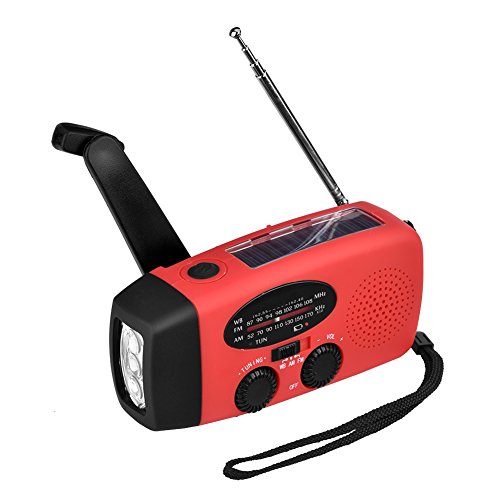
Solar Hand Crank AM/FM/NOAA Radio covers AM/FM/NOAA broadcasts and offers solar, hand-crank, and USB input charging, with a built-in battery and a USB port for emergency phone charging. Its described three-LED flashlight adds a basic light source without the reading-light configuration on FosPower A1 Emergency Weather Radio. This is a straightforward fit for someone prioritizing multiple charging methods and weather broadcasts.
Bottom line: Pick it for AM/FM/NOAA coverage and three charging methods.
How to choose an emergency band radio
Start by matching the radio bands to the broadcasts you need, then compare power sources and battery capacity. NOAA weather radio broadcasts use the VHF weather band, while AM and FM serve conventional local stations; shortwave is a separate band and does not substitute for NOAA reception. For a household outage kit, prefer a model that explicitly includes weather-band reception and at least two ways to recharge or power it. Hand cranks and small solar panels are useful backup sources, but their presence alone does not establish how quickly a battery can be replenished. If you expect to recharge a phone, compare mAh figures and remember that conversion losses mean the radio’s battery capacity is not all usable at the phone.
Emergency radio power sources and battery capacity
Hand-crank, solar, USB, and replaceable batteries solve different backup problems. Cranking can supply power without grid access or sunlight, solar charging depends on exposure and panel size, and USB charging is useful when power is available before an outage. AAA batteries can be stored separately, while rechargeable built-in batteries reduce the need to keep disposable cells on hand. Capacity helps compare energy reserves: 12,000mAh is six times 2,000mAh on the mAh figures, though real phone charging is lower after voltage conversion and device losses. A useful decision rule is to favor a radio with a capacity if phone charging is central to your plan; otherwise prioritize reception bands and independent power methods.
NOAA weather band, alerts, and reception
NOAA weather-band reception lets a radio tune broadcasts that AM/FM-only models cannot receive. A weather receiver and automatic alert scanning are distinct features: a radio may let you tune weather broadcasts without claiming to scan and alert automatically. Antenna placement affects reception, so raise or extend the antenna and move the radio away from large metal objects if a signal is weak. Local NOAA broadcasts operate on seven VHF frequencies between 162.400 and 162.550 MHz. An alert feature is useful only when the radio can receive the relevant local signal; verify reception in the intended area before relying on it for warnings.
Emergency radio safety and kit planning
An emergency radio is a source of updates, not a replacement for an evacuation plan or official instructions. NOAA alerts can communicate hazards, but a charged phone, spare batteries, water, and a written meeting plan address needs the radio cannot. Keep a hand-crank radio accessible and test reception and the light periodically; a device stored in a sealed kit may have a depleted battery when needed. Do not assume an SOS siren contacts emergency services: a siren attracts nearby attention but does not call for help. For severe weather, use alerts as prompts to follow local emergency management guidance and move to the designated safe location.
Frequently Asked Questions
What frequencies does NOAA Weather Radio use?
NOAA Weather Radio broadcasts on seven VHF channels from 162.400 to 162.550 MHz. A radio must explicitly support weather band or NOAA reception to tune those broadcasts.
How much phone charging can a 2,000mAh radio provide?
A 2,000mAh rating does not translate to a full 2,000mAh delivered to a phone because voltage conversion and charging losses reduce usable energy. Treat it as emergency top-up capacity rather than assuming a particular number of full phone charges.
Does an SOS siren call emergency services?
An SOS siren makes a sound to attract attention; it is not the same as a phone call or a satellite emergency message. Keep another way to contact emergency services when possible.
Is a hand crank enough to power a radio all night?
A hand crank is a manual backup, but runtime depends on the radio’s power draw and the energy stored in its battery.
What is the difference between weather band and shortwave?
Weather band receives NOAA’s local VHF broadcasts, while shortwave covers a different set of broadcasts and does not replace NOAA weather reception. Choose a radio that names NOAA or weather-band support when emergency alerts are the priority.