
Edifier T5 Powered Subwoofer: Models Compared

The Edifier T5 is the direct match, with an 8-inch driver, 70W RMS output, and a frequency response down to 38 Hz. Choose a different model if you want a lower stated bass limit or adjustable phase control.
A powered subwoofer has its own amplifier and adds low-frequency sound to a speaker system; matching its crossover and placement to the main speakers matters as much as driver size.
We earn a commission if you buy through links on this page. As an Amazon Associate I earn from qualifying purchases. Products are compared on manufacturer specifications, not hands-on testing.
- Best overall: Edifier T5 8-Inch Powered Subwoofer – The exact T5 match pairs an 8-inch driver and 70W RMS output with response down to 38 Hz.
- Best for tuning: Edifier T5s 8-Inch Powered Subwoofer – Offers a 30–160 Hz low-pass filter and 0°/180° phase selector.
- Best for a narrow space: Edifier T5s Renewed 8-Inch Subwoofer – Its width is 6.69 inches, narrower than the other models here.
| Product | Best for | Driver | Frequency response | Dimensions (H × W × D) | Shop |
|---|---|---|---|---|---|
| Edifier T5 8-Inch Powered Subwoofer | Direct T5 match | 8 in | Down to 38 Hz | 14.57 × 13.66 × 16.50 in | Check Price on Amazon |
| Edifier T5s 8-Inch Powered Subwoofer | Crossover and phase | 8 in | Down to 35 Hz | 16.14 × 6.69 × 15.71 in | Check Price on Amazon |
| Edifier T5s Renewed 8-Inch Subwoofer | T5s renewed option | 8 in | Down to 35 Hz | 16.14 × 6.69 × 15.71 in | Check Price on Amazon |
| Polk Audio PSW10 10-Inch Subwoofer | Larger driver | 10 in | — | 14.4 × 14.0 × 16.2 in | Check Price on Amazon |
Edifier T5 Powered Subwoofer Options
Compare the original T5 with related Edifier models and a different 10-inch alternative.
Edifier T5 8-Inch Powered Subwoofer

The Edifier T5 is the direct match for this search, with an 8-inch driver, 70W RMS output, and a low-pass filter. Edifier says its response reaches down to 38 Hz. Its MDF enclosure is intended to reduce acoustic resonance, and automatic standby reduces power use when idle. At about 19.1 pounds, it is a substantial cabinet, so measure the intended spot before choosing it. The main limitation is that its features do not provide the T5s model’s adjustable phase selector; buyers who need that control should consider another option.
Bottom line: Choose this if you want the Edifier T5 specifically and its 38 Hz response suits your system.
Edifier T5s 8-Inch Powered Subwoofer
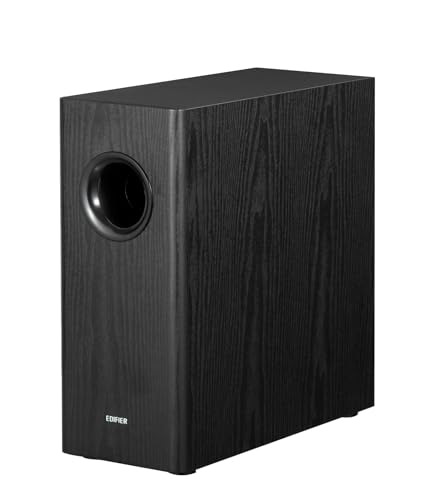
The Edifier T5s differs from the original T5 with a lower stated bass limit and two integration controls: a 30–160 Hz low-pass filter and a 0°/180° phase selector. Edifier specifies a 70W RMS Class-D amplifier, 8-inch long-throw woofer, and 18 mm MDF cabinet. The cabinet is only 6.69 inches wide, which may help when floor space is tight, though its 16.14-inch height still needs checking. This is a related model rather than the T5 itself, so choose it only if those changes matter more than getting the exact T5.
Bottom line: Choose this if adjustable phase and a lower stated bass limit matter more than the exact T5 model.
Edifier T5s Renewed 8-Inch Subwoofer
This renewed option is based on the T5s rather than the original T5, so its distinguishing specifications include the T5s’s 8-inch long-throw woofer, 70W RMS Class-D amplifier, 30–160 Hz low-pass filter, and phase selection at 0° or 180°. Edifier’s T5s specifications give a 35 Hz low-end response and an 18 mm MDF cabinet. Its dimensions match the other T5s entry, making the narrow 6.69-inch width useful for constrained placements. The renewed condition is the key tradeoff; buyers seeking a new, exact T5 should select the original model instead.
Bottom line: Choose this if you want the T5s feature set in a renewed version rather than the original T5.
Polk Audio PSW10 10-Inch Subwoofer
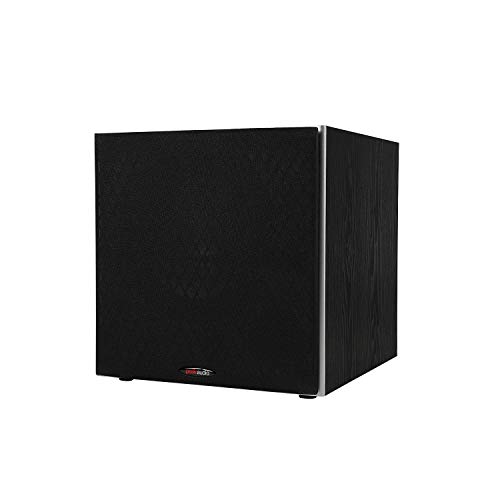
The Polk Audio PSW10 is the different-brand alternative here, with a 10-inch Dynamic Balance driver and a built-in 50-watt RMS amplifier; Polk also gives it a 100-watt maximum figure. Its directed port and positioning for small-to-mid-size rooms distinguish it from the Edifier models. The 10-inch driver is larger than the 8-inch drivers in the T5 family, but driver diameter alone does not establish deeper bass or better system matching.
Bottom line: Choose this if you prefer Polk’s 10-inch driver and its room-use positioning.
How to Match a Subwoofer Crossover
A starting crossover near 80 Hz works for many home-theater systems, but the main speakers’ usable bass range should decide the setting. Small bookshelf speakers often need a higher handoff than floorstanding speakers that can play lower; a subwoofer’s low-pass control determines which upper bass frequencies it handles. If the receiver already manages bass management, avoid setting conflicting crossover points on both devices. Raise the handoff when the main speakers sound thin, and lower it if bass becomes too localized near the subwoofer. The useful range is the one that blends smoothly at the listening position, not simply the lowest number on a dial.
Where to Place a Powered Subwoofer
Placement changes bass response because room boundaries reinforce some low frequencies and cancel others. Start near the front wall, then move the cabinet in small increments and listen for even bass across the main seat; corners can increase output but may make some notes boomy. Keep the driver and port clear of walls, furniture, and curtains, especially for a front-firing design with a side-firing port. A practical fit rule is to leave at least 2 to 3 inches of unobstructed space around a port unless the manufacturer specifies otherwise. Measure cabinet height, width, depth, and cable clearance before settling on a position.
How the T5 Models Differ
The Edifier T5 is the exact model sought, while both T5s entries add phase selection and a wider low-pass adjustment range. The Polk PSW10 changes brand and driver size, so compare it as an alternative rather than as another T5 version. This table separates the models by distinction; a dash means the maker does not support a direct frequency comparison.
| Model | What stands out | Fit consideration |
|---|---|---|
| Edifier T5 8-Inch Powered Subwoofer | 38 Hz response; automatic standby | Confirm its larger cabinet footprint |
| Edifier T5s 8-Inch Powered Subwoofer | 35 Hz response; phase selector | Narrow listed width, taller height |
| Edifier T5s Renewed 8-Inch Subwoofer | T5s controls in renewed condition | Condition differs from standard T5s |
| Polk Audio PSW10 10-Inch Subwoofer | 10-inch driver; 50W RMS amp | Frequency response not comparable here |
Safe Setup and Everyday Care
A powered subwoofer should sit on a stable, level floor with its ventilation openings and driver unobstructed. Keep power cords away from walkways, and switch off the system before changing connections to reduce the chance of a loud pop or accidental short at the equipment end. Dust the cabinet and grille with a dry soft cloth; liquids and sprays can damage finishes or enter the driver. Avoid pushing the gain until the bass sounds strained, since clipping and excessive driver movement can damage audio equipment. For a shared living space, keep the listening level comfortable and secure loose objects that may rattle against the cabinet.
Frequently Asked Questions
What crossover should I start with for a subwoofer?
An 80 Hz crossover is a common starting point for home theater. Use a higher handoff for small speakers that cannot play bass as low, then adjust to blend without making bass sound localized.
Does a larger subwoofer driver always play deeper bass?
No; driver diameter alone does not establish low-frequency extension. Compare a frequency-response limit and system integration, since the 10-inch Polk entry has no comparable response figure here.
What does a phase selector do on a subwoofer?
A 0°/180° selector changes the subwoofer’s polarity relationship with the main speakers. Try both positions from the listening seat and use the one with fuller, more even bass around the crossover.
How much room should I leave around a subwoofer port?
Leave at least 2 to 3 inches of clear space around a port as a practical starting point. A side-firing port needs open space on that side, so account for nearby walls and furniture when measuring.
Can I put a powered subwoofer inside a cabinet?
An enclosed cabinet can block the driver or port and trap heat from the amplifier. Use an open position with several inches of clearance and avoid enclosing the subwoofer unless its manufacturer permits it.