
Edifier T5 Subwoofer: T5 and T5s Specs Compared

The Edifier T5 suits most listeners who want an 8-inch powered subwoofer with a 38Hz low-end response and automatic standby. Choose the T5s instead if adjustable phase and a 30Hz–160Hz low-pass filter matter more; the renewed T5s shares those controls but is a renewed model.
A powered subwoofer has its own amplifier and handles low frequencies below the range of the main speakers.
We earn a commission if you buy through links on this page. As an Amazon Associate I earn from qualifying purchases. Products are compared on manufacturer specifications, not hands-on testing.
- Best overall: Edifier T5 – Its 8-inch driver, 70W RMS rating, and automatic standby cover straightforward bass extension.
- Best for tuning: Edifier T5s – The 30Hz–160Hz low-pass filter and 0°/180° phase selector allow more setup adjustment.
- Best renewed option: Edifier T5s Renewed – It offers the T5s’ 35Hz response and adjustable filter in a renewed model.
| Product | Best for | Bass response | Low-pass filter | Cabinet dimensions | Shop |
|---|---|---|---|---|---|
| Edifier T5 | Simple bass extension | Down to 38Hz | Low-pass filter; range — | 16.5 × 13.7 × 14.6 in | Check Price on Amazon |
| Edifier T5s | Adjustable integration | Down to 35Hz | 30–160Hz; 0°/180° phase | 15.7 × 6.7 × 16.1 in | Check Price on Amazon |
| Edifier T5s Renewed | Renewed T5s option | Down to 35Hz | 30–160Hz; 0°/180° phase | 15.7 × 6.7 × 16.1 in | Check Price on Amazon |
Edifier T5 Subwoofer Options
Compare the original T5 with two T5s variants by bass range, tuning controls, and footprint.
Edifier T5

The Edifier T5 is the straightforward choice among these options: it pairs an 8-inch driver with a 70W RMS rating and automatic standby. Edifier says its low-pass filter lets the subwoofer handle frequencies too low for the main speakers, while the MDF enclosure is intended to reduce acoustic resonance. Its dimensions are about 16.5 × 13.7 × 14.6 inches, so measure the intended spot before choosing it. The main trade-off is less documented tuning flexibility than the T5s, whose filter range and phase selector are specified.
Bottom line: Choose this model for a powered 8-inch subwoofer with automatic standby and a simpler control set.
Edifier T5s
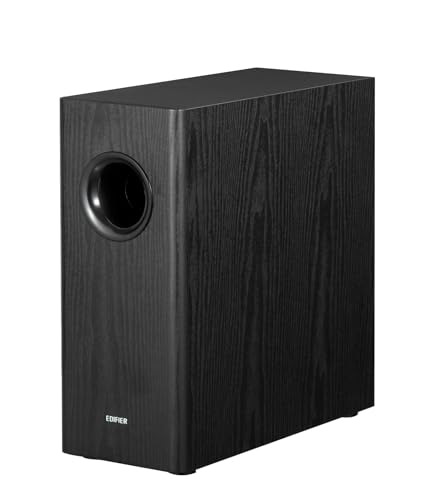
The T5s stands apart with explicit integration controls: its low-pass filter adjusts from 30Hz to 160Hz, and a phase selector switches between 0° and 180°. Edifier says the 8-inch long-throw woofer reaches 35Hz and is driven by a 70W RMS Class-D amplifier. The 18mm MDF cabinet has a front-firing driver and right-firing port. At about 15.7 × 6.7 × 16.1 inches, its width is narrower than the original T5’s; leave room for the side-firing port rather than pressing that side against a wall.
Bottom line: Pick this version when you want a defined crossover range and phase adjustment for system matching.
Edifier T5s Renewed
The renewed T5s is the renewed-condition alternative to the T5s, with the same core audio figures: an 8-inch long-throw woofer, 70W RMS output, and bass down to 35Hz. Its 30Hz–160Hz low-pass filter and 0°/180° phase selector provide the same kind of integration control as the other T5s option. The cabinet dimensions are about 15.7 × 6.7 × 16.1 inches. Its key distinction is condition, not a different tuning feature set; buyers who specifically want a standard-condition product should choose the other T5s entry.
Bottom line: Choose this one if you want the T5s specifications and are comfortable selecting a renewed unit.
How to Choose an Edifier T5 Subwoofer
Choose based on how much control you need over the handoff between the subwoofer and your main speakers. A common starting crossover is about 80Hz; small bookshelf speakers may need a higher handoff, while larger speakers can often blend lower. The T5s gives a 30Hz–160Hz filter range and a 0°/180° phase selector, while the original T5 lists a low-pass filter without a range. Start with the filter near 80Hz, then adjust by ear to avoid a gap or a thick overlap in the bass. If you have little space, compare cabinet measurements and allow clearance for the T5s’ right-firing port.
Matching a Subwoofer to Your Speakers
Match the crossover to the lowest frequencies your main speakers reproduce cleanly, not simply to the subwoofer’s lowest bass figure. A typical 80Hz crossover is a useful starting point because it keeps the subwoofer focused on low bass while the main speakers cover voices and most instruments. Placement changes the result: bass can become stronger near a wall or corner, so move the subwoofer and listen before changing settings. Phase controls help address timing differences between subwoofer and speakers; compare both available phase positions from the listening seat. No single setting fits every room, so use familiar music or dialogue and make one adjustment at a time.
Powered Subwoofer Setup and Placement
Place a powered subwoofer where its driver and port have breathing room, and keep the unit stable on a level floor. A side-firing port needs open space beside it; avoid blocking it with furniture or pushing it flush against a wall. Connect the subwoofer using compatible audio connections for your system, then set the crossover and volume conservatively before fine-tuning. Room boundaries can create uneven bass, so testing a few locations often helps more than turning up the level. Keep power and signal cables routed so they do not become trip hazards, and do not cover ventilation openings on powered audio equipment.
Understanding Bass Response Figures
A subwoofer’s lowest-frequency figure indicates how deep its output is claimed to reach, not how evenly or loudly it plays across a room. The T5 is specified down to 38Hz, while the T5s variants are specified down to 35Hz; that difference alone does not determine which will sound better in a particular space. Deep bass varies with room size, placement, speaker settings, and listening level. A common mistake is to set the crossover too high, making bass seem localized at the subwoofer; another is setting it too low and leaving a gap between the sub and small speakers. Use filter adjustment and placement to find a seamless transition.
Frequently Asked Questions
What crossover frequency should I start with?
Start near 80Hz, a common crossover point for home audio systems. Small bookshelf speakers may blend better with a higher setting, while speakers with stronger low-frequency output may work lower.
Does a 35Hz rating mean deeper bass in every room?
No; 35Hz is a low-frequency response figure, not a guarantee of the same output in every room. Placement, room dimensions, and listening level all affect perceived bass.
What does a subwoofer phase switch change?
A phase switch changes the subwoofer’s alignment relative to the main speakers. Try both 0° and 180° from the listening position, keeping the setting that gives a fuller, more even bass transition.
How much space should I leave around a subwoofer port?
Keep a port unobstructed and avoid placing it directly against furniture or a wall. For a side-firing port, leave open space on that side and test placement because nearby boundaries can change bass strength.
Can I use a powered subwoofer with bookshelf speakers?
Yes, if the speakers and subwoofer can connect through compatible audio inputs and outputs. Set the crossover around 80Hz as a starting point, then adjust to the speakers’ low-frequency capability and the room.