
Elmer’s All Purpose Glue Stick: Sizes Compared

For most home and craft users, Elmer’s All Purpose Glue Sticks, 22g is the most versatile choice because its 22g sticks come in a 12-pack and its formula is described as photo-safe and acid-free. Choose a smaller 7g stick pack instead if you want compact sticks for classroom projects or need a larger quantity.
Glue sticks are solid adhesives applied directly to a surface; they work best for light paper-based projects rather than durable or structural bonds.
We earn a commission if you buy through links on this page. As an Amazon Associate I earn from qualifying purchases. Products are compared on manufacturer specifications, not hands-on testing.
- Best overall: Elmer’s All Purpose Glue Sticks, 22g – The 22g sticks offer a larger format in a 12-pack for home and craft use.
- Best for classrooms: Elmer’s All Purpose School Glue Sticks, 7g, 60 Count – The pack includes 60 washable 7g sticks for group projects.
- Best for smaller packs: Elmer’s All Purpose School Glue Sticks, 7g, 30 Count – The 30-count pack provides 7g sticks for school and craft projects.
| Product | Best for | Count | Stick size | Washable | Shop |
|---|---|---|---|---|---|
| Elmer’s All Purpose Glue Sticks, 22g | Home and crafts | 12 | 22g | — | Check Price on Amazon |
| Elmer’s All Purpose School Glue Sticks, 7g, 60 Count | Classroom quantities | 60 | 7g | Yes | Check Price on Amazon |
| Elmer’s All Purpose School Glue Sticks, 7g, 30 Count | School projects | 30 | 7g | Yes | Check Price on Amazon |
| Elmer’s All Purpose Glue Sticks, 0.21 oz, 4 Count | Small home packs | 4 | 6g | Yes | Check Price on Amazon |
Elmer’s All Purpose Glue Sticks Compared
Compare the stick size, pack quantity and formula to match the glue stick to your project and storage needs.
Elmer’s All Purpose Glue Sticks, 22g

The larger 22g stick format separates this pack from the smaller classroom sticks. The 12-count pack is intended for home, office, scrapbooking and arts-and-crafts use, and the formula is acid-free, photo-safe and nontoxic. The maker says it applies smoothly, dries quickly and clear, and works on a variety of paper types. Choose it when a larger stick suits your projects; the pack has fewer individual sticks than the 30- and 60-count options, so it is less suited to distributing among a large class.
Bottom line: Choose this pack for larger sticks and varied home or craft projects.
Elmer’s All Purpose School Glue Sticks, 7g, 60 Count
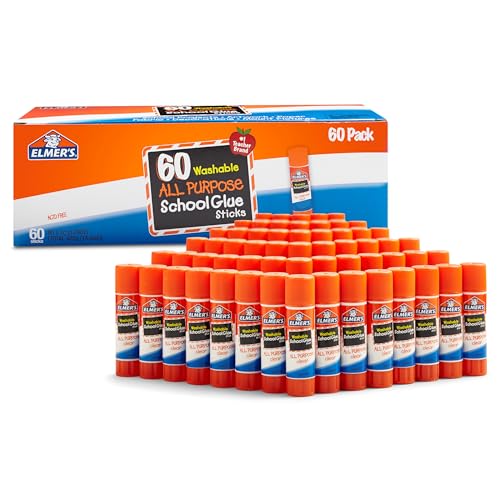
The 60-count pack offers the most individual sticks among these options, making it a fit for classrooms or group activities. Each stick is 7g, and the formula is washable, acid-free, photo-safe and nontoxic. The maker says it bonds paper, cardboard, foam board and display board, applies smoothly, and dries quickly and colorlessly. The compact stick size can suit individual student kits, but it means more frequent replacement than a 22g stick when projects use glue heavily.
Bottom line: Pick this pack when you need many washable sticks for group projects.
Elmer’s All Purpose School Glue Sticks, 7g, 30 Count

The 30-count pack keeps the same 7g washable school format as the larger classroom pack but includes half as many sticks. The formula is nontoxic, acid-free and photo-safe. The maker says it bonds paper, cardboard, foam board and display board, applies without clumps, and dries quickly and colorlessly. This pack suits school projects and posters when a moderate quantity is enough; for repeated group activities, the 60-count option supplies more individual sticks.
Bottom line: Choose this pack for school and poster projects that need 7g sticks in a moderate quantity.
Elmer’s All Purpose Glue Sticks, 0.21 oz, 4 Count

The four-count pack is the smallest option here, with 0.21-ounce sticks suited to occasional home or office use. The formula is nontoxic, acid-free and photo-safe, and the maker says it is washable with soap and water, bonds paper, cardboard and foam board, and dries quickly and colorlessly. Its small pack is easy to allocate for a limited project, but the four sticks provide less reserve than the classroom packs or the 12-count option.
Bottom line: Choose this pack for occasional paper projects when a few compact sticks are enough.
How to choose an all purpose glue stick
Match the pack to how many people and projects will use it, then consider stick size. A 7g stick is compact for student kits and short tasks; a 22g stick holds more adhesive for repeated use. Glue sticks are most useful on porous surfaces such as paper and cardboard, where adhesive can grip the fibers. They are not the right choice for a load-bearing repair or a bond that must resist water. For photos or keepsakes, look for acid-free and photo-safe wording, and use a light, even coating to limit wrinkles. If the project needs a durable bond between unlike materials, choose an adhesive specifically made for those surfaces instead.
Glue stick sizes and pack counts
Small sticks are convenient to hand out, while larger sticks reduce how often you need to replace one during a project. Pack count matters most when several people are working at once; individual sticks also reduce sharing. The table distinguishes the sizes and quantities, rather than treating a larger pack as a better fit for every task.
| Need | Size and quantity | Practical fit |
|---|---|---|
| More adhesive per stick | 22g, 12 sticks | Repeated home or craft use |
| More sticks for a group | 7g, 60 sticks | Classroom distribution |
| Moderate classroom pack | 7g, 30 sticks | School projects |
| Occasional use | 6g, 4 sticks | Small home or office tasks |
Surfaces and application technique
Glue sticks work best on clean, dry, porous materials such as paper and cardboard; smooth plastic, metal and other nonporous surfaces generally need a different adhesive. For a neat paper bond, apply a thin, even layer across the edges and center, then press the pieces together promptly. Too much glue can wrinkle lightweight paper or squeeze beyond the edge. Test an inconspicuous area when appearance matters, especially with delicate papers or finished projects. Foam board and display board are included among the bonding surfaces for the school-stick options, but project weight and board coatings can affect how well any adhesive holds.
Washability and safe handling
Washable formulas are intended to make cleanup easier, but cleanup still depends on the surface and how long glue has dried. For washable glue on skin or washable fabric, soap and water are the relevant cleanup method; check fabric care guidance before treating a finished garment. Keep glue sticks capped between uses so the exposed surface does not dry out, and store them away from heat. Nontoxic does not mean edible: keep adhesive out of mouths and supervise young children during crafts. For school or photo projects, confirm that the package identifies the properties you need, such as washable, acid-free or photo-safe.
Frequently Asked Questions
What surfaces do glue sticks work best on?
Glue sticks work best on porous materials such as paper and cardboard because adhesive can grip the fibers. Smooth plastic and metal are nonporous, so use an adhesive made for those surfaces instead.
How do I keep paper from wrinkling with glue?
Apply a thin, even coat rather than a heavy layer, especially on lightweight paper. Press the pieces together promptly and avoid soaking the sheet with repeated passes.
Are washable glue sticks safe for young children?
A washable, nontoxic formula can simplify craft cleanup, but glue is not edible and should be kept out of mouths. Supervise young children and clean residue with soap and water while it is still fresh.
How should I store a glue stick between projects?
Replace the cap after each use and keep the stick away from heat so its exposed adhesive is less likely to dry out. Store it upright or on its side in a cool, dry craft or desk area.
Can glue sticks hold foam board securely?
Some school glue sticks are specified for foam board, but the strength depends on the board surface, bonded area and load. For a hanging or load-bearing project, use a product intended for that job rather than relying on a glue stick.