
Epoxy Putty for Metal: 5 Options Compared by Cure

For a compact metal repair with an one-hour cure, start with J-B Weld SteelStik 2 oz; its 2-ounce stick sets in 5 minutes and is rated for continuous temperatures up to 350°F. Choose another option if you need more material, a different set time or a broader stated use across materials.
Epoxy putty is a moldable two-part adhesive filler: kneading the components together starts the chemical cure, so prepare the repair area before mixing.
We earn a commission if you buy through links on this page. As an Amazon Associate I earn from qualifying purchases. Products are compared on manufacturer specifications, not hands-on testing.
- Best overall: J-B Weld SteelStik 2 oz – A 2-ounce steel-reinforced stick sets in 5 minutes and cures in 1 hour.
- Best for multipacks: J-B Weld SteelStik 2-Pack – The two-stick pack provides 4 ounces total with the same 5-minute set and one-hour cure.
- Best for fast setting: Flex Seal Epoxy Ultimate Putty 2 oz – Its 15-minute set time is quicker than the other products with a set time.
| Product | Best for | Pack size | Set / cure time | Shop |
|---|---|---|---|---|
| J-B Weld SteelStik 2 oz | single-stick repairs | 2 oz | 5 min / 1 hr | Check Price on Amazon |
| J-B Weld SteelStik 2-Pack | multiple repairs | 4 oz total | 5 min / 1 hr | Check Price on Amazon |
| Flex Seal Epoxy Ultimate Putty 2 oz | quick-setting repairs | 2 oz | 15 min set | Check Price on Amazon |
| Boncart AB Epoxy Putty 200 g | multi-material repairs | 7.1 oz | — | Check Price on Amazon |
| Hercules Pro Poxy 20 4 oz | larger metal repairs | 4 oz | — | Check Price on Amazon |
Epoxy Putty for Metal Compared
Compare the products by quantity and the cure or heat figures given for each formula.
J-B Weld SteelStik 2 oz
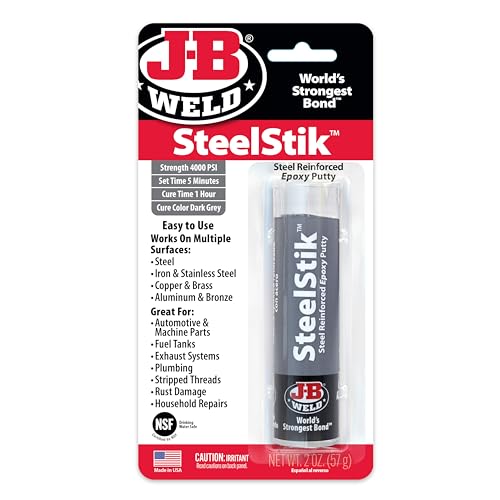
For a single repair, this steel-reinforced stick gives you 2 ounces rather than a multi-stick pack. J-B Weld says the kneaded putty sets in 5 minutes, cures in 1 hour, and has 900 psi lap shear strength; it also says the cured material resists petroleum and hydraulic fluids. The continuous temperature limit is 350°F, with intermittent exposure up to 450°F. The company says it is NSF certified and safe for potable-water contact. Its limitation is the small amount, which may not suit several repairs.
Bottom line: Choose this for a small metal repair when a one-hour cure and the temperature range fit the job.
J-B Weld SteelStik 2-Pack

The two-stick pack supplies 4 ounces total, making it the option to consider when one stick may not cover several repairs. J-B Weld says each kneaded stick sets in 5 minutes and cures in 1 hour, with 4,000 psi tensile strength. The temperature limits are 350°F continuously and 450°F intermittently, and the maker says the formula resists petroleum and hydraulic fluids. It is also described as NSF certified and safe for potable-water contact. The tradeoff is that the pack is more material than a one-off small patch may need.
Bottom line: Pick this when you want two sticks and the cure and temperature limits match the repair.
Flex Seal Epoxy Ultimate Putty 2 oz

Its 15-minute set distinguishes this 2-ounce stick from the other options with a set time. Flex Seal says the cured putty withstands temperatures up to 350°F and forms a waterproof barrier; the maker also describes it as impact-, chemical- and fuel-resistant. The putty can be shaped, filed, sanded, tapped, drilled and painted, which may suit repairs that need finishing after cure. The limitation is that the claims give a set time but not a full cure time, so do not treat 15 minutes as a complete cure.
Bottom line: Choose this when a 15-minute set and the post-cure temperature limit suit the repair.
Boncart AB Epoxy Putty 200 g

Its 200-gram quantity is the largest single container by weight among these options. Boncart describes this white, two-part putty for repairs, filling and bonding across metal and several other materials, including wood, tile and ceramic. The maker also says it can be used for sculpting and plumbing or pool leak repairs. That breadth may suit a mixed-material project rather than a metal-only patch.
Bottom line: Pick this for a larger, multi-material repair when cure timing is not your main constraint.
Hercules Pro Poxy 20 4 oz

The 4-ounce stick offers a larger quantity than the single 2-ounce sticks, while remaining focused on a kneadable compound. Hercules says the two-part putty kneads quickly and adheres to metals, masonry, wood, glass, ceramics and some plastics; it is intended to seal, mend, bond and repair. The broad material range makes it a candidate for jobs involving more than metal. The tradeoff is that no cure time or temperature rating is included among the claims, so it is less suitable when either figure controls the repair choice.
Bottom line: Choose this for a larger repair across listed materials when a cure or heat limit is not essential.
How to Choose Epoxy Putty for Metal
Choose by repair size, cure timing and the temperature the repaired part will face. A 2-ounce stick suits a small patch, while a multi-stick pack or a 4-ounce product gives more material for multiple areas; measure the gap and estimate how much putty it will take before mixing. Set time and cure time are different: a putty that sets quickly may still need longer before full service, so do not confuse the two. Temperature ratings also apply to cured material unless a maker says otherwise. For a joint exposed to heat, compare the continuous rating rather than relying on an intermittent maximum. A putty is a filler and adhesive, not a replacement for a mechanically loaded or safety-critical metal part.
Preparing Metal Before Applying Putty
Clean, dry metal gives epoxy putty a better chance to bond than oily, wet or loose surfaces. Remove rust, paint and scale from the repair area, then roughen smooth metal with abrasive paper; wipe away dust and let the surface dry before kneading. Round or bevel a crack edge where practical so the patch can overlap sound material instead of ending at a sharp seam. Mix only the quantity that can be applied promptly, because kneading starts the cure. Keep the patch supported and avoid moving it while it sets. Wear disposable gloves and eye protection, avoid skin contact, and keep uncured putty away from children; cured strength does not make a repair appropriate for every load.
Set Time, Cure Time and Heat Ratings
Set time describes when putty firms enough to hold its shape; cure time is the longer period needed for the maker’s cure. The figures vary across these options: one sets in 5 minutes and cures in 1 hour, while another gives a 15-minute set but no full cure time. Plan around the cure figure, not the earliest set claim, before sanding, drilling or returning a repair to service. Likewise, a temperature limit of 350°F once cured does not mean the fresh material can be exposed to that heat. Intermittent and continuous ratings describe different conditions, so select for the normal sustained temperature and treat brief peaks separately.
Matching the Putty to the Repair
Match the product claim to the material and exposure, then use a mechanical fastening method when a failed bond could cause injury or property damage. Broad adhesion claims do not establish suitability for every alloy, coating or joint shape; a small trial on a clean, inconspicuous area can reveal whether the material wets and holds the surface. Repairs involving pressure, moving parts, overhead loads or potable water need special caution: follow applicable equipment requirements, and confirm the product’s approval for the exact contact and use before relying on it. For a gap that will be drilled or sanded, check that the cured product is intended for that finishing step. Do not apply uncured epoxy where food, skin or water could be contaminated.
Frequently Asked Questions
How long does metal epoxy putty take to cure?
The products here with a full cure give a one-hour cure, while one other gives a 15-minute set but no full-cure figure. Set means the putty firms; wait for the cure before loading or finishing a repair.
Can epoxy putty bond rusty metal?
A durable bond generally needs sound, clean metal rather than loose rust. Remove rust and flaking coating, roughen the metal, and wipe away dust before mixing the putty.
Can epoxy putty be drilled after curing?
Some cured epoxy putties can be drilled, but that depends on the formula; one option here specifically says it can be drilled. Use a sharp bit and eye protection, and avoid drilling near edges that could split the patch.
Is epoxy putty suitable for a leaking pipe?
A putty may seal a repair only when its material, pressure and water-contact suitability match the pipe and the application. Depressurize and dry the area where possible, and do not rely on a patch as a substitute for a required code-compliant repair.
Can epoxy putty handle high temperatures?
Heat limits are product-specific: the options with a cured rating include a 350°F continuous limit or a 350°F maximum once cured. Compare the repair’s sustained temperature with the continuous rating, not an intermittent peak.