
Fender Flare Rubber Seal: 4 Trims Compared

MYFAMIREA T-Style EPDM Trim, 33 Ft suits most buyers who want T-style EPDM fender flare rubber seal and 33 feet of trim. Choose a different option if you need a wiper-style edge or want to match a specific run length more closely.
Fender flare seal is a flexible strip fitted between a wheel flare and the vehicle body to help close the gap and reduce contact between the parts.
We earn a commission if you buy through links on this page. As an Amazon Associate I earn from qualifying purchases. Products are compared on manufacturer specifications, not hands-on testing.
- Best overall: MYFAMIREA T-Style EPDM Trim, 33 Ft – It combines a T-style profile, EPDM rubber, and 33 feet of trim.
- Best for wiper profile: sdano Wiper-Style Fender Flare Trim, 30 Ft – Its wiper-style shape comes in a 30-foot length.
- Best for extra coverage: GOIMGN T-Style Wiper Trim, 34 Ft – Its 34-foot length is the longest option here.
- Best for stated dimensions: T-Style Fender Flare Seal, 33 Ft – Its size is 396 by 0.5 by 0.29 inches.
| Product | Best for | Length | Profile | Shop |
|---|---|---|---|---|
| MYFAMIREA T-Style EPDM Trim, 33 Ft | T-style installations | 396 in | T-style | Check Price on Amazon |
| sdano Wiper-Style Fender Flare Trim, 30 Ft | Wiper-style edges | 360 in | Wiper style | Check Price on Amazon |
| GOIMGN T-Style Wiper Trim, 34 Ft | Longest trim run | 408 in | T-style wiper | Check Price on Amazon |
| T-Style Fender Flare Seal, 33 Ft | Specified dimensions | 396 in | T-shaped | Check Price on Amazon |
Fender Flare Rubber Seal Options
Compare trim length and edge shape to match the flare gap and the amount of material your installation requires.
MYFAMIREA T-Style EPDM Trim, 33 Ft
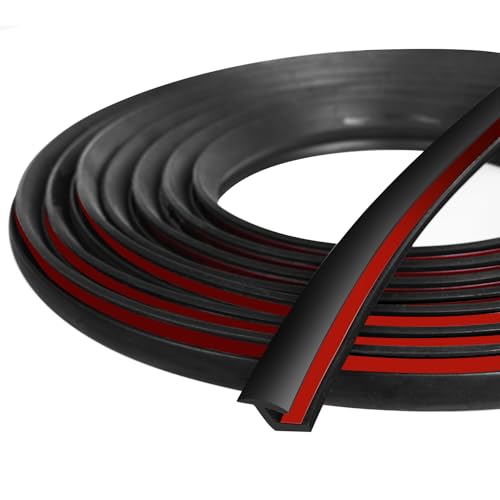
MYFAMIREA T-Style EPDM Trim, 33 Ft pairs a T-style edge with 33 feet of EPDM rubber trim, making it a straightforward choice when that profile and length suit the flare run. The product features describe automotive-grade adhesive tape and a double-edged design, with the purpose of helping reduce vibration, friction, and debris caught between flare and body. Flexible trim can follow a curved wheel opening more readily than a rigid strip, but the final fit still depends on the flare’s edge shape. Measure each run before cutting; this length may leave little spare material on vehicles with unusually large flares.
Bottom line: Choose it when a T-style profile and 33 feet match your flare layout.
sdano Wiper-Style Fender Flare Trim, 30 Ft

sdano Wiper-Style Fender Flare Trim, 30 Ft is the shortest option and uses a wiper-style shape rather than the T-style profile of several alternatives. It has 30 feet of EPDM trim with automotive-grade adhesive tape, and its features identify weather and ozone resistance as intended material properties. That profile is a fit to consider when a flare edge is designed to meet a wiper-shaped lip. Measure all four wheel openings instead of assuming the package length will cover them: vehicles with broad flares or longer perimeter runs may need more than 30 feet. Its distinctive profile may not suit a T-channel installation.
Bottom line: Pick it when the wiper-style edge matches your flare and 30 feet is enough.
GOIMGN T-Style Wiper Trim, 34 Ft

GOIMGN T-Style Wiper Trim, 34 Ft offers 34 feet, the longest run among these choices, with a T-style wiper profile in EPDM rubber. Its features describe the shape as intended to fit along a fender edge and help block dirt, moisture, and debris; the longer roll can be useful when a vehicle has extended flare perimeters or when extra allowance is desired for trimming. Match the actual cross-section to the flare before installation, since a longer strip does not compensate for a profile mismatch. The measurements don’t establish a full cross-section, so verify profile compatibility if the flare has a narrow channel.
Bottom line: Choose it when you want the longest length and a T-style wiper profile.
T-Style Fender Flare Seal, 33 Ft

T-Style Fender Flare Seal, 33 Ft gives a T-shaped EPDM strip in a 33-foot length and includes dimensions of 396 by 0.5 by 0.29 inches. Those measurements can help buyers compare the strip’s width and height with the available space at the flare edge. Its features describe the T structure as a barrier for the gap and as cushioning between parts. Unlike options whose specifications emphasize adhesive tape, this option is described as self-adhesive; plan the surface preparation around that attachment method. The profile dimensions may not fit every flare channel, so compare them with the vehicle’s trim interface.
Bottom line: Pick it when its 0.5-by-0.29-inch dimensions suit the flare edge.
How to Choose Fender Flare Rubber Seal
Choose by profile first, then confirm that the roll covers the full perimeter of every flare. A T-style seal and a wiper-style edge are different cross-sections, so a longer roll cannot fix a shape that will not seat against the flare. Measure each wheel opening along the actual mating edge; add a small allowance for trimming and corners rather than estimating from tire size. For a four-wheel installation, total the four measured runs before selecting length. Do not stretch EPDM trim to make a short roll reach, because tension can pull adhesive-backed material away from turns and ends. If the flare has a defined channel, compare that channel with the seal’s profile and dimensions before cutting.
Fit and Installation for Fender Flare Seal
Clean, dry contact surfaces matter more than forcing trim into a mismatched gap. Dirt, wax, road film, and moisture can undermine adhesive contact, so wash the area, dry it completely, and use an automotive-safe surface cleaner compatible with the paint and adhesive. Test-fit a short section around a curve before removing or pressing down the full run. Work in moderate temperatures; cold rubber is less pliable, while hot body panels can make adhesive tack quickly and reduce repositioning time. Cut the strip with a clean, square end and avoid leaving a stretched section at corners. Keep adhesive and trim clear of moving tire surfaces, door edges, and any fastener or opening that must remain accessible.
T-Style and Wiper-Style Profiles Compared
T-style trim and wiper-style trim serve the same gap-filling role but have different edge shapes. A T-shaped section typically has a stem that seats at the flare joint and a broader lip that covers the seam; wiper-style sections use a flexible projecting edge. The exact fit depends on the flare’s mating surface, not just the vehicle make or wheel size. Use this guide to narrow the shape before checking the physical cross-section against the existing flare.
| Need | Profile to consider | Fit check |
|---|---|---|
| Flare has a receiving edge or channel | T-style | Match stem and lip to the joint |
| Flare calls for a flexible wiping lip | Wiper-style | Confirm the lip can sit without folding |
| Unclear edge shape | Either, after a test fit | Compare a short sample section first |
Never choose on roll length alone; profile mismatch can leave an uneven seam even when enough trim is available.
Common Fender Flare Seal Mistakes
The most common mistake is cutting before confirming fit and total length. A 30-foot roll is 360 inches, while 33 feet is 396 inches and 34 feet is 408 inches; measuring the full path around all flares makes these differences meaningful. Another mistake is applying trim over a wet or contaminated surface, which weakens the adhesive bond. Avoid stretching the strip around tight corners, because elastic tension can make the ends lift later. Do not use a seal as a substitute for securing a loose flare or repairing damaged bodywork. After installation, check that the strip remains clear of the tire through steering movement and suspension travel; any contact can abrade the trim or interfere with the wheel.
Frequently Asked Questions
How much fender flare rubber seal do I need?
Measure the mating edge around all four flares and add a small allowance for cuts and corners. A 30-foot roll provides 360 inches, 33 feet provides 396 inches, and 34 feet provides 408 inches.
Can I use T-style trim on any fender flare?
No; the flare edge must accommodate the T-shaped stem and lip. Compare the profile with the actual joint and test-fit a short section before cutting the full roll.
How should I prepare the surface for adhesive trim?
The surface should be clean and completely dry before adhesive-backed trim is applied. Remove road film and residue with a cleaner safe for the vehicle finish, and avoid application to a cold, wet, or freshly waxed area.
Can fender flare seal stop rocks from hitting paint?
A seal can help close the gap where debris may collect between the flare and body, but it is not a replacement for a properly secured flare. Keep the strip clear of the tire and inspect the joint if the flare is loose or damaged.
When can I wash a vehicle after installing flare trim?
Give adhesive-backed trim time to bond before exposing it to water; a common automotive adhesive practice is to avoid washing for about 24 hours. The exact cure time depends on the adhesive and installation conditions.