
Fiber Optic Star Light Ceiling Kits Compared by Fit

AKEPO 375-Fiber Twinkle Kit suits most buyers who want app and remote control, music response and 375 fiber strands for a fiber optic star light ceiling. Choose 32W 1,000-Fiber Dual-Port Kit instead if a denser field of stars matters more, or 6-Pack Acoustic Foam Star Ceiling Kit if you want the lighting combined with acoustic panels.
A fiber optic star ceiling sends light from a separate engine through thin strands to create points of light; the engine location and available room for installation matter as much as the color modes.
We earn a commission if you buy through links on this page. As an Amazon Associate I earn from qualifying purchases. Products are compared on manufacturer specifications, not hands-on testing.
- Best overall: AKEPO 375-Fiber Twinkle Kit – Offers app and remote control, music response, and 375 strands in three lengths.
- Best for dense coverage: 32W 1,000-Fiber Dual-Port Kit – Includes 1,000 fibers, more than the other kits with a strand count.
- Best for acoustic panels: 6-Pack Acoustic Foam Star Ceiling Kit – Combines twinkle lighting with a six-panel foam wall set.
| Product | Best for | Fiber count | Fiber length | Shop |
|---|---|---|---|---|
| AKEPO 375-Fiber Twinkle Kit | App and music control | 375 | 9.8 ft | Check Price on Amazon |
| 32W 1,000-Fiber Dual-Port Kit | Dense star fields | 1,000 | 13.1 ft | Check Price on Amazon |
| AZIMOM 20W 860-Fiber Kit | Dual-head RGBW setup | 860 | 13.1 ft | Check Price on Amazon |
| 6-Pack Acoustic Foam Star Ceiling Kit | Acoustic wall decor | 360 | — | Check Price on Amazon |
Fiber optic star light ceiling kits
Compare strand count, length and controls to find a kit that fits your ceiling and installation plan.
AKEPO 375-Fiber Twinkle Kit

AKEPO 375-Fiber Twinkle Kit combines app control, a remote and sound-activated lighting in a 375-strand kit. Its RGBW light engine offers static colors and dynamic modes, while the strands come in three diameters. The 9.8-foot fibers suit installations where the light engine can sit within reach of the ceiling area. The maker says the kit supports adjustable twinkle speed, brightness and music sensitivity. Its fiber count is lower than 32W 1,000-Fiber Dual-Port Kit and AZIMOM 20W 860-Fiber Kit, so buyers aiming for a particularly dense star field should compare those larger bundles before choosing.
Bottom line: Pick this if app control and sound response matter more than maximizing strand count.
32W 1,000-Fiber Dual-Port Kit

32W 1,000-Fiber Dual-Port Kit stands apart with 1,000 fibers measuring 13.1 feet, the largest strand count among these kits. Its 32W dual-head engine supports a twinkle effect, and the kit includes app and remote control. The longer strands give more flexibility when the engine must sit farther from the ceiling surface. The maker says the sound-activated mode follows music beats. This kit is a better match for buyers prioritizing many light points than for a compact installation where a smaller strand bundle would be easier to route and manage.
Bottom line: Choose this for the highest fiber count and longer strand reach.
AZIMOM 20W 860-Fiber Kit

AZIMOM 20W 860-Fiber Kit offers 860 strands at 13.1 feet and a 20W dual-head RGBW light source. Its fibers include three diameters, and the maker says the engine can produce pure white as well as RGB mixed white. App and remote control support color and mode selection. This is a middle ground in strand count between AKEPO 375-Fiber Twinkle Kit and 32W 1,000-Fiber Dual-Port Kit, while matching 32W 1,000-Fiber Dual-Port Kit for stated strand length. The feature set is aimed at users who want a dual-head color engine; buyers chiefly seeking the greatest number of light points should consider the 1,000-strand alternative.
Bottom line: Pick this for a dual-head RGBW engine with a substantial strand bundle.
6-Pack Acoustic Foam Star Ceiling Kit
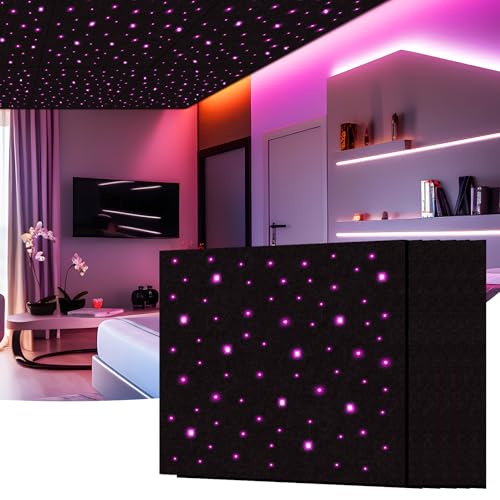
6-Pack Acoustic Foam Star Ceiling Kit pairs fiber-optic twinkle lighting with six acoustic foam panels, making it the option that combines light effects and wall treatment. Its controls include a Bluetooth app and a 28-key remote, with color and brightness adjustment. The maker claims the foam can reduce echoes by up to 85%; that performance claim should not be treated as a guaranteed room result. Unlike the other kits, this is a combined panel-and-light product rather than a strand-only setup. Confirm the panel dimensions and mounting method before planning a ceiling installation.
Bottom line: Choose this when acoustic panels are part of the project, not just star lighting.
How to choose a fiber optic star ceiling kit
Start with strand count and reach: more fibers can support more points of light, while longer strands make it easier to place the light engine away from the finished surface. Compare the number of fibers and their length against the area you plan to cover, then confirm there is room to route the bundles without tight bends. Fiber optics carry light from the engine to strand ends; the remote engine needs a suitable location and power access. Decide whether static white, color effects, twinkle or sound response matters, since each adds a different control feature rather than changing the physical coverage. For larger ceilings, sketch the layout and spread planned endpoints evenly instead of clustering strands near the access point.
Fiber length, placement and installation
Place the light engine where it remains accessible, then route the fibers toward their planned endpoints before trimming or fastening them. These listed kits use strands from 9.8 to 13.1 feet, so measure the real route, including turns, rather than relying on straight-line ceiling distance. Fiber strands should not be kinked or sharply bent; tight bends can impair light transmission or damage the strands. A car headliner installation also requires caution around wiring and airbag locations, while a home ceiling needs an appropriate mounting surface and a safe route to power. Plan endpoints first: an evenly distributed pattern usually looks more intentional than filling the nearest area and leaving distant sections sparse.
Fiber optic and acoustic panel kits compared
Choose a strand-only kit when the main goal is a custom star field; choose the panel combination when acoustic treatment is also needed. A light engine sends light through fiber strands, so the visible points are at the fiber ends rather than along the full length. Panel products add a separate mounting and room-layout decision. The table compares the fiber bundle attributes and primary use; a dash means a value is not available for this comparison.
| Kit type | Strand count | Stated length | Primary distinction |
|---|---|---|---|
| App and music kit | 375 | 9.8 ft | Three strand diameters |
| Dense dual-port kit | 1,000 | 13.1 ft | 32W engine |
| RGBW dual-head kit | 860 | 13.1 ft | 20W engine |
| Acoustic panel combination | 360 | — | Foam panels included |
Safety and common installation mistakes
Keep electrical components dry and use the light engine only in a suitable indoor location; fiber strands themselves do not make the powered engine waterproof. For vehicle installations, do not route fibers or tools across airbag deployment zones, and avoid cutting or drilling near wiring you cannot identify. A common mistake is choosing a bundle by strand count alone: longer routes, tight bends and uneven endpoint spacing can affect the finished result. Another is placing the engine somewhere inaccessible, making later adjustment or replacement difficult. Before making holes, mock up the star pattern and measure the fiber path; for a car, verify the headliner layout and clearances before removing trim.
Frequently Asked Questions
How many fiber strands should a star ceiling have?
A denser-looking ceiling generally benefits from more light points, and these kits range from 360 to 1,000 stated fibers. The right count also depends on the area and how evenly you distribute the endpoints.
Can a fiber optic star ceiling go in a car?
Yes, fiber-optic kits are used for car headliners, but installation must preserve airbag deployment zones and avoid wiring. Plan the fiber paths and engine location before removing trim or making holes.
Does a fiber optic ceiling need a light engine?
Yes, the engine is the light source that feeds illumination into the fiber strands. Keep the engine accessible and provide a safe route for its power connection.
Can fiber optic strands be bent around corners?
Strands can follow gradual curves, but avoid kinks and sharp bends that can reduce light transmission or damage the fiber. Measure the route with its turns included before choosing a strand length.