
Five Star TV Antenna: 5 Outdoor Models Compared

For a Five Star TV antenna serving up to five TVs, the amplified 200-mile model with 360-degree rotation is the closest match, while its receiver count and rotation distinguish it from the fixed-direction Yagi options. Choose another model if you need a particular package, such as a 40-foot cable or a kit for four TVs.
These are outdoor or attic over-the-air antennas that receive local broadcast signals; actual reception depends on nearby transmitters, terrain, and obstructions.
We earn a commission if you buy through links on this page. As an Amazon Associate I earn from qualifying purchases. Products are compared on manufacturer specifications, not hands-on testing.
- Best overall: Five Star Amplified Outdoor Antenna – The package supports up to five TVs and includes an amplified antenna with 360-degree rotation.
- Best for four TVs: Five Star Yagi Antenna 4-TV Kit – The Yagi package names support for four TVs and includes a mounting pole and installation kit.
- Best for included cable: Five Star Amplified Antenna with Remote – Includes 40 feet of RG6 coaxial cable, a remote, and a four-way splitter.
| Product | Best for | TV support | Rotation | Package distinction | Shop |
|---|---|---|---|---|---|
| Five Star Amplified Outdoor Antenna | Five-TV setups | Up to 5 TVs | 360° rotation | Mounting pole and installation kit | Check Price on Amazon |
| Five Star Yagi Antenna with J Pole | Attic or roof | — | — | Antenna and J pole | Check Price on Amazon |
| Five Star Yagi Antenna 4-TV Kit | Four-TV kit | Up to 4 TVs | — | J pole and installation kit | Check Price on Amazon |
| Five Star Outdoor HDTV Antenna, ATSC 3.0 Ready | ATSC 3.0 ready | Up to 4 TVs | — | Installation kit and J mount | Check Price on Amazon |
| Five Star Amplified Antenna with Remote | Long cable run | Up to 5 TVs | 360° rotation | 40-ft cable and 4-way splitter | Check Price on Amazon |
Five Star TV antenna models
Compare receiver support, rotation, and package contents to narrow down the right antenna for your setup.
Five Star Amplified Outdoor Antenna
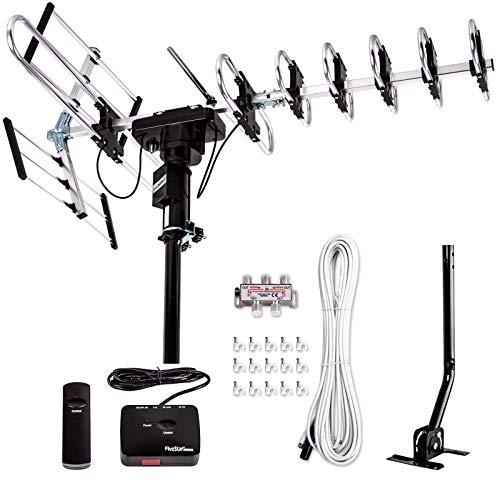
For a setup with as many as five televisions, Five Star Amplified Outdoor Antenna is the only option here whose package specifically supports that many sets. It is an amplified outdoor antenna with 360-degree rotation, FM support, and a mounting pole and installation kit. The manufacturer claims a range of up to 200 miles, but that figure is not a guarantee of reception; terrain, buildings, and transmitter location affect the signal. The dimensions are 17 inches long, 8 inches wide, and 7 inches high. Choose another model if a long coax cable or a four-TV splitter package is your priority.
Bottom line: Choose this if you need a package designed to support up to five TVs and want remote-direction rotation.
Five Star Yagi Antenna with J Pole
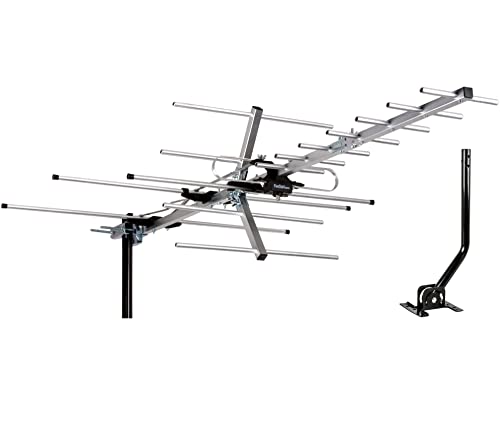
Unlike the amplified rotating model, Five Star Yagi Antenna with J Pole is a Yagi-style antenna intended for attic or roof mounting and includes a J pole. Its maker identifies VHF and UHF reception and FM compatibility, while its range of up to 200 miles is conditional on distance from towers and intervening obstructions. The package name does not identify a supported television count, so confirm the needed distribution setup before choosing it for several TVs. The dimensions are 17 inches long, 8 inches wide, and 6 inches high. This is a fit for buyers prioritizing a Yagi design and a mounting pole over a specified multi-TV kit.
Bottom line: Choose this for a Yagi antenna and included J pole when receiver count is not the deciding factor.
Five Star Yagi Antenna 4-TV Kit
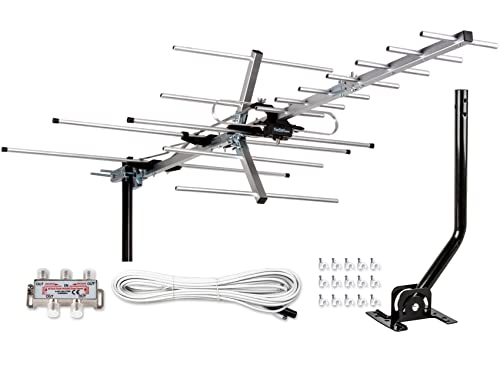
Five Star Yagi Antenna 4-TV Kit differs from the other Yagi option by explicitly pairing support for four TVs with an installation kit and mounting pole. It receives VHF and UHF signals, and the manufacturer claims up to 200 miles while noting that tower distance and obstructions affect reception. At 17 inches long, 8 inches wide, and 6 inches high, it shares the dimensions of the other Yagi kit, so package contents and receiver support are the useful distinctions.
Bottom line: Choose this when you want a Yagi package specifically set up for four TVs.
Five Star Outdoor HDTV Antenna, ATSC 3.0 Ready
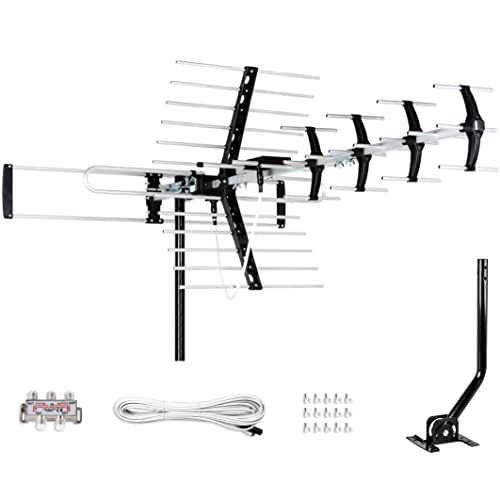
Five Star Outdoor HDTV Antenna, ATSC 3.0 Ready is the model in this group whose name specifically identifies ATSC 3.0 readiness; it also names support for four TVs and includes an installation kit and J mount. Its features describe multidirectional VHF and UHF reception. The manufacturer claims up to 200 miles, with reception affected by local towers, trees, and other obstacles. Stated dimensions are 17.5 inches long, 11.3 inches wide, and 6.3 inches high. ATSC 3.0 readiness alone does not ensure that a particular broadcast is available in your area, so check local station availability before choosing on that basis.
Bottom line: Choose this if ATSC 3.0 readiness and a four-TV package are priorities.
Five Star Amplified Antenna with Remote
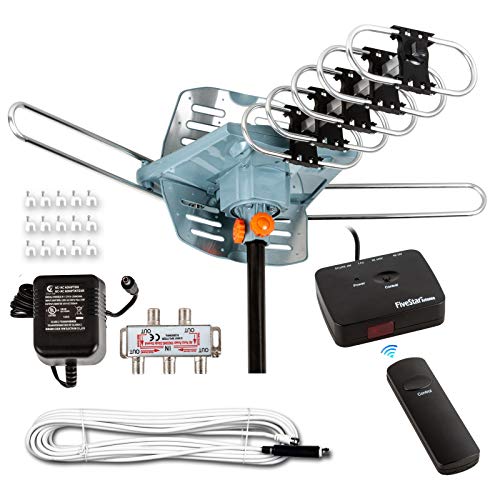
Five Star Amplified Antenna with Remote stands out for its included 40-foot RG6 coaxial cable, four-way splitter, and remote-controlled 360-degree rotation. The package also includes a control box and power supply; the mounting pole is not included, so plan for a separate mount if needed. Its product name claims 150 miles of range, but a range figure does not determine which stations a specific location can receive. The package says it supports five TVs, though the included splitter has four outputs, so confirm how you intend to connect all sets. Its antenna size is 24 by 29 by 10 inches.
Bottom line: Choose this if the included 40-foot cable and remote rotation matter more than having a mounting pole in the package.
How to choose a Five Star TV antenna
Start with the number of televisions, then compare package contents and how you will aim the antenna. A splitter divides one antenna feed among multiple sets; each split reduces signal strength, so long cable runs and several splits can make marginal reception less reliable. Amplifiers can help compensate for losses in a distribution system, but they cannot create a usable signal where terrain or distance blocks the broadcast. For free over-the-air reception in the United States, broadcast TV uses VHF and UHF bands; check local stations and their broadcast bands before selecting an antenna. Treat a maximum range as a claim rather than a promise. If you need five connections, compare the named TV support with the actual splitter output count.
Mounting and aiming an outdoor TV antenna
Roof placement often clears nearby walls and trees, while an attic can simplify installation but roofing materials and framing may weaken signals. Aim a directional antenna toward the broadcast transmitters you want to receive; stations in different directions may call for repositioning or a rotating antenna. Use a local TV signal map to identify the directions and bands of nearby stations before mounting. A motorized 360-degree antenna can change direction without physically turning the mount, while fixed designs require physical adjustment. Keep outdoor coax connections weatherproof and route cable with a drip loop so water does not follow it indoors. Installers should avoid power lines; maintain at least 10 feet of clearance from overhead electrical lines and never work near them.
Compare antenna package types
Package differences can matter as much as antenna shape: receiver support, cable length, splitter outputs, and included mounting hardware determine what else a setup may need. Use the table to compare the distinctions, not as a prediction of reception quality. Yagi models are directional designs, while a rotating antenna can be aimed toward different transmitter directions. An amplified model may suit a distribution setup with several TVs, but amplifier gain is not a substitute for a clear signal path. Verify the mount and cable route for the location before installation.
| Setup need | Package feature to prioritize | Trade-off to consider |
|---|---|---|
| Several televisions | Explicit TV support and splitter outputs | Splitting can reduce signal strength |
| Change antenna direction | 360-degree rotation | Power and control components are part of setup |
| Long indoor cable route | Included coax length | Cable length alone does not guarantee reception |
| Roof or attic installation | Included pole or mount | Attic materials and nearby obstructions can affect reception |
How to improve over-the-air reception
Begin by checking which local stations transmit from which directions and whether they use VHF or UHF; then position the antenna with the clearest practical path. Roof height can reduce obstruction from nearby buildings and trees, but a higher location is not automatically better if it creates a more difficult or unsafe installation. Scan for channels again after changing the antenna direction or position, since the tuner needs to refresh its available stations. Keep coaxial cable connections secure and outdoors connections protected from moisture. When multiple TVs share an antenna, minimize unnecessary splitters and cable length; weak stations are more likely to disappear after signal loss in the distribution path. Never mount or handle an antenna where it could contact overhead power lines.
Frequently Asked Questions
Does a 200-mile antenna receive stations 200 miles away?
A maximum range claim does not guarantee reception at that distance. Terrain, buildings, trees, transmitter power, and antenna placement all affect whether a station reaches the tuner.
Can one TV antenna feed several televisions?
Yes, a splitter can distribute one antenna signal to multiple TVs, but each split reduces signal strength. Match splitter outputs to the number of sets and keep cable runs as short as practical.
Should I put an outdoor antenna in the attic?
An attic can protect an antenna from weather, but roofing, foil-backed insulation, and framing can weaken broadcast signals. If reception is marginal indoors, a roof position with a clearer path may work better.
Do I need to point a Yagi antenna at a tower?
A Yagi is directional, so aim it toward the transmitter direction for the stations you want. If important stations are in different directions, you may need to reposition the antenna or use a rotating setup.
Does ATSC 3.0 readiness guarantee local channels?
No; ATSC 3.0 readiness describes compatibility, not local station availability. Check whether broadcasters near you transmit ATSC 3.0 before making that the deciding feature.