
Fleshing Knife for Hides: 4 Tools Compared by Blade

For most hide work, Wiebe 12-inch Dual Handle Knife is the versatile choice because its 12-inch stainless steel blade and dual handles are specified for both skinning and fleshing. Choose a shorter blade for closer control or a kit if you want two different scraping tools rather than one knife.
A fleshing knife is a two-handled tool pushed across a hide to remove fat and membrane; keep the edge angle shallow and work away from your supporting hand.
We earn a commission if you buy through links on this page. As an Amazon Associate I earn from qualifying purchases. Products are compared on manufacturer specifications, not hands-on testing.
- Best overall: Wiebe 12-inch Dual Handle Knife – Its 12-inch stainless steel blade is paired with dual handles and is described for skinning and fleshing.
- Best for shorter strokes: Standard 8-inch Fleshing Knife – The 8-inch blade and two handles suit buyers who prefer a shorter working edge.
| Product | Best for | Blade length | Handle style | Material | Shop |
|---|---|---|---|---|---|
| Wiebe 12-inch Dual Handle Knife | Versatile pelt work | 12 in | Dual, composite | Stainless steel | Check Price on Amazon |
| 13-inch Dual Handle Fleshing Knife | Longer scraping edge | 13 in | Dual; material unspecified | Stainless steel | Check Price on Amazon |
| 12-inch PP Handle Fleshing Knife | Non-slip grip | 12 in | Dual, non-slip PP | Stainless steel | Check Price on Amazon |
| Standard 8-inch Fleshing Knife | Shorter blade reach | 8 in | Two handles; material unspecified | — | Check Price on Amazon |
Fleshing Knives for Hides Compared
Compare blade lengths, grip styles, and whether each option is a single knife or a kit.
Wiebe 12-inch Dual Handle Knife
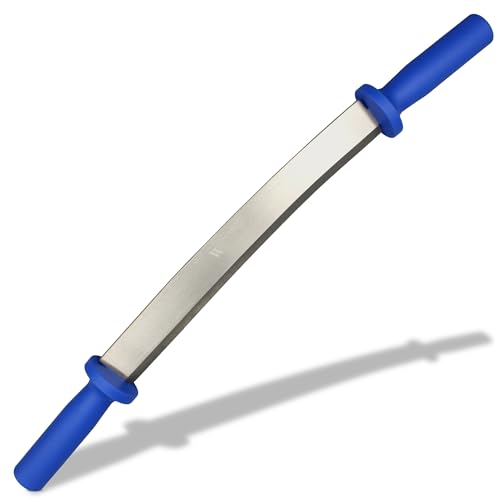
The 12-inch blade separates this knife from the 8-inch option and the 13-inch model, while its dual composite handles provide two-handed leverage. The maker describes it as suitable for both skinning and fleshing small to medium game, including raccoon, fox, muskrat, and coyote. Its stainless steel blade is beveled. The maker also claims edge retention and reduced hand fatigue, but blade bevel and handle materials do not establish a particular edge angle or grip fit. Choose another size if your work calls for a shorter blade or a longer scraping edge.
Bottom line: Choose this for a single 12-inch knife intended for both skinning and fleshing.
13-inch Dual Handle Fleshing Knife

The 13-inch blade is the longest single-knife edge among these options, giving it more working length than the two 12-inch knives and the 8-inch model. Its blade is 0.16 inch thick, and the overall length is about 22.6 inches. The maker describes one side as sharp and the opposite side as blunt for scraping fat and membrane. That combination may suit someone who wants cutting and scraping edges on one tool, but its longer blade is less suited to tight, detailed strokes than a shorter option.
Bottom line: Choose this when a 13-inch edge and dual-purpose blade matter more than close control.
12-inch PP Handle Fleshing Knife

The polypropylene handles distinguish this 12-inch knife from the 12-inch composite-handled alternative. Its maker describes a curved stainless steel blade with a sharp side and a moderately blunted scraping side for removing fat and membrane. The non-slip grip is intended to provide leverage during longer sessions, although the specifications do not give handle dimensions or a blade thickness to help confirm hand fit and stiffness. Buyers who want a curved, dual-edge design can favor this style; those who need a known blade thickness should compare the 13-inch option instead.
Bottom line: Choose this for a curved 12-inch blade with non-slip polypropylene handles.
Standard 8-inch Fleshing Knife

The 8-inch blade is shorter than every other single knife here, making it the clearest choice for buyers who prefer a compact working edge. That leaves fewer ways to judge stiffness or grip comfort before choosing it. A shorter edge can help with controlled, localized strokes, while broader hides may take more passes than with a 12- or 13-inch blade. Select this option when blade length is the priority.
Bottom line: Choose this if you specifically want an 8-inch, two-handled fleshing knife.
How to choose a fleshing knife for hides
Blade length and edge shape are the first choices: 8 inches favors a shorter working edge, while 12- to 13-inch blades cover more width per stroke. A rounded or curved edge can help keep contact across a hide, but a sharp edge is also easier to drive into the skin if held too steeply. Traditional fleshing knives often have a scraping edge and a cutting edge; use the scraping side for membrane and fat, and reserve cutting action for appropriate tasks. For a smaller pelt or detailed area, choose an 8- or 12-inch edge; for broader passes, consider 12 or 13 inches. Match the handle to two-handed control, not appearance alone.
Fleshing knife blade lengths and control
A shorter blade generally gives more control in small areas, while a longer edge can make broader passes with fewer strokes. Among the options here, lengths run from 8 to 13 inches, so the practical decision is whether close work or coverage matters more. This comparison can guide that choice independently of brand.
| Blade length | Best suited to | Tradeoff |
|---|---|---|
| 8 inches | Short, controlled strokes | More passes across broad areas |
| 12 inches | Middle-ground coverage and control | Less compact than 8 inches |
| 13 inches | Broader scraping strokes | Less suited to tight areas |
When working close to an edge or thin area of hide, use short, shallow strokes rather than forcing the full blade across it.
Safe fleshing technique and edge care
Keep the hide supported on a fleshing beam or another stable surface, and push the knife away from your body and hands. A sharp edge can cut skin as readily as unwanted tissue; gloves do not replace controlled strokes, and the supporting hand should stay out of the blade path. Use the blunt scraping side, when provided, for broad removal rather than prying with the sharp edge. Clean and dry a stainless steel blade after wet work to limit residue and corrosion risk. Store the knife with its edge covered or positioned where it cannot be contacted accidentally, and check for loose handles or damage before use.
Fleshing knives versus scraper kits
A dual-handle knife combines a long working edge and two-handed leverage, while a scraper kit supplies separate implements with different forms. A single knife is simpler when you want a known blade length, and a set can be useful when you prefer dedicated tools for distinct scraping jobs. Kit dimensions may describe the whole implement rather than the blade, so compare actual blade length when coverage is important. Handle material also affects feel: polypropylene, composite, and wood have different surfaces, and shape and grip matter more than material alone. If you cannot comfortably hold a tool in both hands, confirm the grip dimensions before ordering.
Frequently Asked Questions
What blade length works for fleshing a deer hide?
A 12- or 13-inch blade gives broader coverage than an 8-inch blade. Choose 8 inches when the area is small or close control matters more than fewer passes.
Should I use the sharp side or blunt side?
Use a blunt or moderately blunted edge for scraping fat and membrane, and keep any sharp edge out of the hide unless cutting is intended. A steep angle increases the chance of nicking the skin.
How do I keep a fleshing knife from cutting through a hide?
Keep the blade angle shallow and use short, controlled strokes with the hide supported on a stable beam. Work away from your body and supporting hand, especially around thin areas.
Can a fleshing knife also be used for skinning?
Some dual-edge models are described for both skinning and fleshing, but not every tool here specifies that purpose. A dedicated sharp edge is more appropriate for cutting than a blunt scraping edge.
How should I clean a stainless steel fleshing knife?
Rinse off hide residue and dry the blade after each wet session; stainless steel can still stain or corrode when residue and moisture remain. Store the edge covered to prevent accidental contact.