
Flocculant for Fish Ponds: 3 Options Compared

For most fish ponds, The Pond Guy RapidClear is the clearest fit because its dose is 1 fluid ounce per 500 gallons and it is made for koi ponds and water gardens. Choose MICROBE-LIFT Flocculant Plus instead if you prefer its lower listed dose of 1 ounce per 1,000 gallons and can keep aeration and filtration running; CrystalClear RapiClear is another liquid flocculant for outdoor ponds.
We earn a commission if you buy through links on this page. As an Amazon Associate I earn from qualifying purchases. Products are compared on manufacturer specifications, not hands-on testing.
- Best overall: The Pond Guy RapidClear – Its 1-fluid-ounce-per-500-gallon dose is tailored to cloudy koi pond water.
- Best for vacuum cleanup: CrystalClear RapiClear – Its clumped particles can be removed with filtration or a pond vacuum.
- Best for filtration: MICROBE-LIFT Flocculant Plus – Its directions call for ongoing aeration and filtration during clarification.
| Product | Best for | Dose | Claimed clearing time | Removal method | Shop |
|---|---|---|---|---|---|
| The Pond Guy RapidClear | Koi pond clarity | 1 fl oz / 500 gal | 2–4 hours | Clumped particles removed; method unstated | Check Price on Amazon |
| CrystalClear RapiClear | Vacuum cleanup | — | 1–3 hours | Filtration or pond vacuum | Check Price on Amazon |
| MICROBE-LIFT Flocculant Plus | Active filtration | 1 oz / 1,000 gal | 24–48 hours after haze | Filtration | Check Price on Amazon |
Flocculant for Fish Ponds Compared
Compare the application rate and how each treatment expects clumped particles to leave the water.
The Pond Guy RapidClear

The Pond Guy RapidClear is the only option here with a dose specifically framed for cloudy water: 1 fluid ounce per 500 gallons. The maker says the liquid clumps floating organic and inorganic particles and that results may appear in 2–4 hours. Its intended settings include koi ponds, water gardens, fountains, and aquariums, and it has no water-temperature restriction. The limitation is that the fields do not explain how to remove the resulting clumps; a buyer should ensure the pond’s filtration or vacuum setup can collect them rather than assuming the treatment removes debris by itself.
Bottom line: Choose it when the 500-gallon dose fits your pond volume.
CrystalClear RapiClear

CrystalClear RapiClear stands out for its explicit cleanup options: the maker says its clumped suspended particles can be removed by filtration or a pond vacuum. It is a liquid intended for outdoor water gardens, fountains, koi ponds, water features, and pondless waterfalls, with no temperature-use restriction. The maker claims clearing in 1–3 hours, but the fields do not supply a volume-based dose, so it is harder to compare the amount needed for a particular pond. Its pet-safe claim should not replace following the container’s directions around aquatic life.
Bottom line: Pick it if you plan to collect clumps with a filter or pond vacuum.
MICROBE-LIFT Flocculant Plus
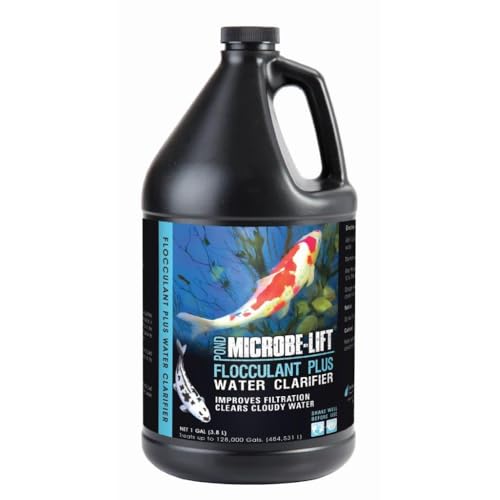
MICROBE-LIFT Flocculant Plus is differentiated by a lower stated dose per water volume and explicit operating guidance: add 1 ounce per 1,000 gallons, then maintain aeration and filtration. The maker says particles are attracted to improve filtration and that clearing should follow the milky-haze period within 24–48 hours; the dose may be repeated as necessary. It is intended for cloudy pond water and is described as suitable around aquatic life and plants. The longer stated clearing window matters if you need rapid visual clarity, and its directions require functioning aeration and filtration.
Bottom line: Choose it when you can keep aeration and filtration running.
How pond flocculant clears suspended particles
Flocculant binds fine suspended particles into larger clumps that filtration or vacuuming can capture. It does not remove the clumps on its own, so clear water depends on a working mechanical filter or a way to vacuum settled material. Keep aeration running while treating a stocked pond; suspended material and treatment can add load to the water, and fish need dissolved oxygen. Apply liquid in moving water so it disperses through the pond rather than concentrating in one spot. Use the product’s own volume-based dose, not a dose borrowed from another formulation, because the three products here give different or incomplete dosing instructions.
Choose a dose based on pond volume
Calculate pond volume before dosing: for a rectangular pond, multiply length × width × average depth in feet, then multiply by 7.5 for approximate gallons. For an irregular pond, estimate sections separately and add them. A dose of 1 fluid ounce per 500 gallons is twice the concentration of 1 ounce per 1,000 gallons, so those rates are not interchangeable. Only two options here give a numeric dose per volume; for CrystalClear RapiClear, confirm the dose on its container before applying it. Avoid rounding a small pond’s volume sharply upward, since that can lead to overapplication.
Use this comparison to match the treatment with your cleanup plan.
| Need | Product fit | Why |
|---|---|---|
| Volume-based dose at 1 oz per 500 gal | The Pond Guy RapidClear | Its maker gives that dose for cloudy water |
| Vacuum or filter collection | CrystalClear RapiClear | Both removal routes are described |
| Aeration and filtration guidance | MICROBE-LIFT Flocculant Plus | Its directions specify both during treatment |
Plan for filtration and fish safety
Keep the filter and aeration running during treatment when the label permits; MICROBE-LIFT Flocculant Plus specifically calls for both to maximize clarification. Fish rely on dissolved oxygen, and warm water holds less oxygen than cool water, so avoid turning off aeration to let particles settle in a stocked pond. A flocculant is for suspended particles, not a substitute for removing decaying leaves, excess waste, or the cause of recurring cloudiness. If fish gasp at the surface or congregate near a return, increase aeration and stop adding treatment while you address oxygen stress. Confirm dosing and fish-safety directions on the chosen product’s container before use.
Set expectations for clearing time
Clearing time differs by formula: maker claims in this comparison range from 1 hour to a 24–48-hour window after a milky haze period. Circulation, particle load, and the ability to capture clumps affect visible results, so a faster claim is not a guarantee for every pond. Do not immediately repeat a dose because the water remains cloudy; follow that product’s repeat guidance and remove accumulated material. Persistent cloudiness may come from algae growth or an ongoing source of debris rather than particles that a flocculant can gather.
Frequently Asked Questions
How does pond flocculant work in fish water?
Pond flocculant attracts or binds fine suspended particles into larger clumps that can be caught by filtration or removed by vacuum. It clarifies particulates rather than eliminating their source.
Can I use flocculant with fish in the pond?
The products here are presented for use around aquatic life, but that does not remove the need to follow their specific fish-safety directions. Keep aeration running in a stocked pond because fish need dissolved oxygen, especially in warm water.
How do I calculate gallons in my fish pond?
For a rectangular pond, multiply length, width, and average depth in feet, then multiply by 7.5 to estimate gallons. Irregular ponds are easier to estimate as separate sections and add together.
Should pond filter stay on after adding flocculant?
Keep filtration and aeration operating when the product’s directions call for it; MICROBE-LIFT Flocculant Plus specifically says to maintain both. A filter helps capture clumps, while aeration supports fish oxygen needs.