
Flying Manta Ray Tube: Towable Types Compared

A flying manta ray tube is best matched by its rider capacity and whether you want a standard towable or a large flying-fish design; GYUEM Flying Fish Towable, 2–6 Riders is the closest match here because it is a flying tube built for 2–6 riders. Choose a different style if you want a conventional seated towable or a single-rider spinner.
Flying-fish towables are large inflatable craft towed behind a boat, while a standard tube stays on the water rather than aiming to lift off.
We earn a commission if you buy through links on this page. As an Amazon Associate I earn from qualifying purchases. Products are compared on manufacturer specifications, not hands-on testing.
- Best overall: GYUEM Flying Fish Towable, 2–6 Riders – Its flying-tube design and 2–6 rider capacity are closest to a flying manta ray tube.
- Best for six riders: AIRMAT FACTORY Fly Fish Tube, 6 Person – The 13-by-10-foot PVC flying-fish tube is specified for up to six riders.
- Best for three riders: O’Brien Bat Wing, 3 Person – The 62-by-105-inch covered towable is sized for up to three riders.
| Product | Best for | Rider capacity | Dimensions | Material | Shop |
|---|---|---|---|---|---|
| GYUEM Flying Fish Towable, 2–6 Riders | Flying fish rides | 2–6 riders | 14.1 × 12.7 ft | — | Check Price on Amazon |
| AIRMAT FACTORY Fly Fish Tube, 6 Person | Six-person groups | Up to 6 riders | 13 × 10 ft | PVC | Check Price on Amazon |
| O’Brien Bat Wing, 3 Person | Three riders | Up to 3 riders | 62 × 105 in | 840D nylon cover | Check Price on Amazon |
| Airhead Gyro, 1 Rider | Solo spinning | 1 rider | 55 × 35 in deflated | PVC | Check Price on Amazon |
| GYUEM Rotating Towable, 5 Person | Group spinning | 5 riders | 10.5 ft | PVC | Check Price on Amazon |
Flying Manta Ray Tube Options
These towables range from large flying-fish inflatables to conventional tubes and a one-rider spinner.
GYUEM Flying Fish Towable, 2–6 Riders

Among these options, GYUEM Flying Fish Towable, 2–6 Riders is the closest match for a flying manta ray-style ride: it is a large flying-fish towable intended to lift from the water once towed fast enough. Its 14.1-by-12.7-foot footprint and three independent air chambers distinguish it from compact tubes. The maker describes six heavy-duty grab handles and says the other chambers retain buoyancy if one is damaged. This suits groups seeking the flying-fish format, but its size calls for a boat and towing setup appropriate to a large inflatable.
Bottom line: Choose this for a large flying-fish towable for a group.
AIRMAT FACTORY Fly Fish Tube, 6 Person
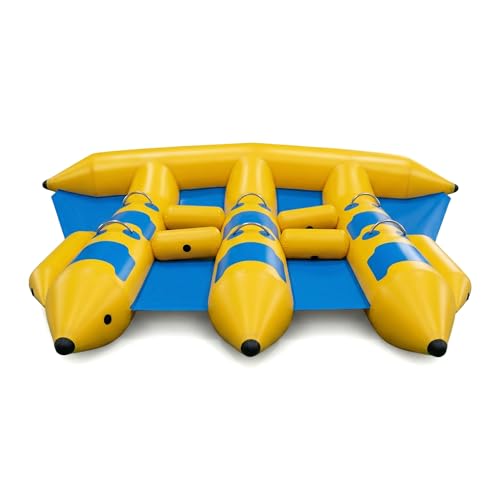
For a six-person flying-fish option with a material, AIRMAT FACTORY Fly Fish Tube, 6 Person uses PVC and measures 13 by 10 feet. The maker specifies six heavy-duty metal handles, three rear D-rings for towing, and an included electric pump. Its footprint is smaller than the 14.1-by-12.7-foot flying fish, so it may suit buyers comparing group capacity with overall size. The available features do not give a rider weight limit, so confirm the combined load capacity before choosing it for a full group.
Bottom line: Choose this if six-person capacity and PVC construction are priorities.
O’Brien Bat Wing, 3 Person

Unlike the flying-fish inflatables, O’Brien Bat Wing, 3 Person is a conventional three-person towable with a fully covered 840D nylon cover. Its 62-by-105-inch size is substantially more compact than the group flying-fish designs. Six EVA-wrapped handles, a quick-connect tow hook, and a lighting valve are included features. This is a fit for riders seeking a familiar towable tube rather than a craft designed to lift off the water; the capacity is three riders.
Bottom line: Choose this for a compact, conventional towable for up to three.
Airhead Gyro, 1 Rider

Airhead Gyro, 1 Rider is the only single-rider spinner here: its bullet-shaped transparent body and tumbling action set it apart from both flying-fish inflatables and multi-rider tubes. It measures 55 by 35 inches when deflated and is made from heavy-duty PVC with doubled-welded seams. The maker says its stainless-steel swivel tow system is designed for strength and resilience. The one-rider format is a poor fit for groups or for anyone specifically seeking a large flying manta ray-style inflatable.
Bottom line: Choose this for a solo ride with a spinning, tumbling format.
GYUEM Rotating Towable, 5 Person

For a group that prefers rotation over flying-fish shape, GYUEM Rotating Towable, 5 Person is a five-person spinning towable with a 10.5-foot diameter. The maker describes puncture-resistant, UV-protected PVC fabric, reinforced seams, a wide base, and a built-in towing connector; a pump is included in the product name. Those traits make it a different style from a manta ray or flying-fish towable. Choose it for its rotating format, and verify how the five-person limit applies to your riders before heading out.
Bottom line: Choose this for a five-person rotating towable rather than a flying-fish ride.
How to choose a flying manta ray tube
Start with the ride shape and the number of riders, then compare the tow points and handles. Flying-fish towables are large inflatables designed to skim or rise when towed; standard tubes are generally pulled along the surface, while a spinning towable adds rotation rather than lift. The flying-fish options measure 13 by 10 feet and 14.1 by 12.7 feet, so plan for a boat and launch area that can handle a wide inflatable.
Capacity is not the same as a safe combined load: rider size, seating arrangement, and the boat’s towing limits all matter. Before towing, use a properly rated towline and an observer in addition to the driver; keep riders clear of the propeller and stop if the tube becomes unstable.
Flying fish and standard towables compared
Choose a flying-fish design for its large, lift-oriented shape, or a standard towable when a surface ride and smaller footprint matter more. The sizes below help distinguish the formats, not establish a universal safe towing speed.
| Type | Typical form | Fit cue |
|---|---|---|
| Flying fish | Large inflatable, 13–14.1 ft long | Group ride designed to skim or rise |
| Conventional tube | Compact covered tube | Surface towing for a smaller crew |
| Spinning towable | Enclosed or wide rotating design | Rotation is the defining ride feature |
A wide flying-fish craft needs more open water than a compact tube, and its operator should not assume a particular speed makes flight safe. Choose open, uncrowded water and leave room to turn and stop.
Rider capacity and towing setup
Choose a tube whose rider count fits your group, but verify the combined weight limit before buying because a head count alone does not set a load rating. Towables commonly use a dedicated tow connector or reinforced D-rings; a proper towline should be rated for the tube and total load, not replaced with general-purpose rope. Keep the tow point aligned and inspect handles, seams, valves, and attachment points before every outing.
For flying-fish designs, a capable boat, an attentive driver, and a separate observer are essential. Everyone should wear a properly fitted U.S. Coast Guard-approved life jacket, and riders should hold handles rather than tow hardware. Stop towing before approaching swimmers, docks, or shallow water.
Flying manta ray tube safety and care
Water-towed inflatables can expose riders to falls, collisions, and sudden changes in direction, so use calm, open water and conservative turns. The driver should keep a clear view or rely on an observer, maintain separation from other boats and people, and cut power before retrieving a rider. Never tow an unoccupied tube or tow near the boat’s propeller.
Rinse PVC and nylon towables with fresh water after saltwater use, let them dry fully before storage, and keep them out of prolonged direct sun. Check seams, tow connectors, handles, and air chambers for leaks or damage; a multi-chamber design does not make a damaged tube safe to tow.
Frequently Asked Questions
Can a flying fish tube really leave the water?
Some flying-fish towables are designed to skim or rise under tow, but whether they lift depends on the design, loading, conditions, and boat operation. Do not treat a particular speed as a safe or guaranteed flight threshold.
How many riders fit on a flying fish tube?
The options here are specified for 2–6 riders or up to six riders, depending on the model. Check combined rider weight as well as head count because the two limits are not interchangeable.
What size boat do I need to tow one?
Boat suitability depends on the tube’s tow load and the boat’s own capacity, not the tube’s rider count alone. Confirm the towable’s load limit and use a tow point and line rated for the complete load.
Do riders need life jackets on a towable tube?
Yes, each rider should wear a properly fitted U.S. Coast Guard-approved life jacket suitable for their size. A tube’s handles or multiple air chambers do not replace personal flotation equipment.
How should I store an inflatable towable?
Rinse saltwater off and dry the tube fully before storage to reduce material and seam wear. Keep it out of prolonged direct sunlight and check handles, tow points, valves, and seams before the next use.