
Foam Tiles Under Pool: Hot Tub Mats Compared

For an inflatable pool or hot tub, ISXACFF 85-Inch Hot Tub Mat is the closest match because its interlocking EVA pieces form an 85-by-85-inch base with a separate pump mat. Choose 16-Pack 24-Inch Gym Floor Tiles instead if you need a modular gym-style layout rather than one large square pad; confirm the pool’s footprint fits the mat before ordering.
We earn a commission if you buy through links on this page. As an Amazon Associate I earn from qualifying purchases. Products are compared on manufacturer specifications, not hands-on testing.
- Best overall: ISXACFF 85-Inch Hot Tub Mat – Seventeen pieces make an 85-by-85-inch hot tub base and include a separate pump mat.
- Best for a simple square pad: 85-Inch Extra-Thick Hot Tub Mat – This 85-by-85-inch EVA mat offers 1/2-inch thickness for a hot tub or inflatable pool.
- Best for modular coverage: 16-Pack 24-Inch Gym Floor Tiles – Sixteen 24-inch puzzle tiles connect into a 64-square-foot floor area.
| Product | Best for | Coverage | Tile count | Shop |
|---|---|---|---|---|
| ISXACFF 85-Inch Hot Tub Mat | Hot tub foundation | 85 × 85 in | 17 pieces | Check Price on Amazon |
| 85-Inch Extra-Thick Hot Tub Mat | Square pool base | 85 × 85 in | — | Check Price on Amazon |
| 16-Pack 24-Inch Gym Floor Tiles | Flexible floor layout | 64 sq ft | 16 tiles | Check Price on Amazon |
Foam Tiles Under Pool Compared
Match the mat’s footprint and layout to the pool base, and keep the surface level before setup.
ISXACFF 85-Inch Hot Tub Mat
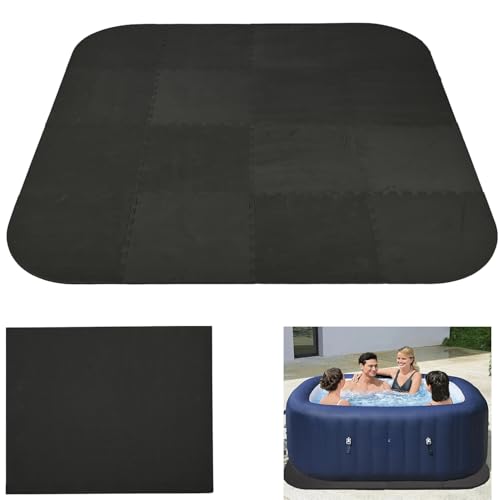
ISXACFF 85-Inch Hot Tub Mat is the only option here with a dedicated small mat for a pump alongside its larger interlocking floor pieces. The 17-piece set covers an 85-by-85-inch square and uses 1/2-inch EVA foam, with a waterproof, nonslip surface. It suits inflatable hot tubs or pools whose bases fit within that footprint and buyers who want a separate pump area. The square coverage is fixed by the set, so it is less adaptable than individual 24-inch tiles when the available space is an unusual shape.
Bottom line: Pick this set when your hot tub base fits an 85-inch square and you want a separate pump mat.
85-Inch Extra-Thick Hot Tub Mat

85-Inch Extra-Thick Hot Tub Mat offers the same 85-by-85-inch footprint and 1/2-inch thickness as ISXACFF 85-Inch Hot Tub Mat, but its maker does not describe a separate pump piece. Its high-density EVA foam is intended to cushion the base from ground friction and small sharp objects; the maker also claims noise reduction and heat insulation. This is a straightforward choice for an inflatable hot tub or pool with a matching square footprint. The fixed square layout matters if the setup area is narrow, irregular, or larger than 85 inches across.
Bottom line: Choose this square mat for an inflatable pool or tub with a base no wider than 85 inches.
16-Pack 24-Inch Gym Floor Tiles

Unlike the dedicated square hot-tub pads, 16-Pack 24-Inch Gym Floor Tiles uses 16 separate 24-by-24-inch puzzle tiles that connect into 64 square feet of coverage. The textured surface is designed for grip, and the EVA foam is intended for cushioning and floor protection in a workout area. Its modular shape can be arranged to suit a different room layout, which may help when a single 85-inch square will not fit. It is a gym floor set rather than a pool-specific mat, so choose it only if its dimensions and intended use suit your setup.
Bottom line: Pick these tiles when you need adaptable gym-style coverage, not a dedicated pool pad.
How to choose foam tiles under a pool
Start with the pool’s ground-contact footprint, then choose a mat that covers it without extending into an unstable or obstructed area. The two hot-tub mats here are 85 inches square and 1/2 inch thick; the gym set covers 64 square feet with 24-inch tiles. Measure the widest part of the base, including any protruding support feet, and compare it with the assembled mat. A pool base wider than 85 inches needs a larger covering than either square mat provides. EVA foam can cushion against ordinary ground friction, but it is not a substitute for clearing the site of stones, roots, or sharp debris before filling the pool.
Pool footprint and tile layout
For a circular pool, compare its diameter with the mat’s shortest overall dimension; for a rectangular pool, check both length and width. An 85-inch square spans 7 feet 1 inch on each side, while each gym tile is 2 feet by 2 feet. Sixteen such tiles can create a square approximately 8 feet by 8 feet when assembled in a four-by-four grid, totaling 64 square feet. Measure the assembled layout rather than assuming a smaller tile count will cover the same area. Puzzle edges can join tiles, but seams are still potential gaps, so align them flat and check the entire base area before placement.
Prepare the ground before setting a pool
A foam mat protects against abrasion, but it cannot level sloped soil or reliably shield a liner from every sharp object. Remove stones, sticks, and other hard debris, then check that the pool location is flat and stable before spreading the mat. Even a small slope can make water load unevenly; water weighs about 8.3 pounds per gallon, so a filled pool places substantial force on its base. Keep the whole pool bottom supported rather than letting an edge hang beyond the foam. Follow the pool maker’s ground-preparation rules as well, since some pool structures require a specific base material or installation method.
Foam mat limits and care
EVA foam is a cushioning layer, not a structural foundation or a repair for damaged ground. Keep interlocking seams connected and inspect for compression, splits, or loose edges before reuse; replace damaged pieces rather than covering a gap with extra foam. Water trapped between a mat and a surface can leave the area damp, so lift and dry the mat when the pool is removed and store pieces dry. Avoid dragging a filled pool across the foam, since the shifting load can pull seams apart or abrade the pool bottom. Check the pool maker’s guidance for compatibility with foam under the base.
Frequently Asked Questions
How much larger should a pool mat be than the pool?
The mat should support the entire pool base, including any feet or protrusions, but it does not need a large overhang. Measure the pool’s widest footprint and keep every supported edge on the mat; an 85-inch square cannot fully support a base wider than 85 inches.
Can interlocking gym tiles go under an inflatable pool?
They can provide cushioning if the connected tiles cover the entire pool footprint and the pool maker permits a foam underlay. A 24-inch tile is 2 feet square, so lay out enough tiles to support the full base and check the seams for gaps.
Should foam tiles go under a pool on uneven ground?
No; foam tiles do not level a sloped or uneven site. Clear debris and prepare a stable, level base first, because water weighs about 8.3 pounds per gallon and an uneven pool base can carry its load unevenly.
How do you keep foam pool mats from separating?
Assemble the puzzle edges fully on a flat surface and check the joints before positioning the pool. Avoid pulling or dragging a filled pool across the mat, since the shifting weight can disconnect seams.