
GardePro E5 Trail Cameras Compared by Video and Fit

GardePro E5 2.0 is the closest match for most people seeking a GardePro E5 trail camera, with 4K video, 64MP photos and a 0.1-second trigger. Choose an E5S instead if 1296P video and its 100-foot no-glow night vision better suit your setup.
Trail cameras use motion sensors to capture wildlife or activity without a live connection; the non-cellular E5 models require retrieving the SD card to view footage.
We earn a commission if you buy through links on this page. As an Amazon Associate I earn from qualifying purchases. Products are compared on manufacturer specifications, not hands-on testing.
- Best overall: GardePro E5 2.0 – Records 4K video and 64MP photos, with a 0.1-second trigger.
- Best for night coverage: GardePro E5S – Its no-glow night vision reaches 100 feet.
- Best for two locations: GardePro E5S 2-Pack – The pack includes two non-cellular E5S cameras.
| Product | Best for | Video | Shop |
|---|---|---|---|
| GardePro E5 2.0 | 4K video | 4K | Check Price on Amazon |
| GardePro E5S | Single camera | 1296P HD | Check Price on Amazon |
| GardePro E5S 2-Pack | Two locations | 1296P HD | Check Price on Amazon |
GardePro E5 Trail Cameras
Compare the E5 and E5S by capture resolution, pack size and the way you plan to review footage.
GardePro E5 2.0

For higher video resolution in the E5 range, this model captures 4K video while retaining 64MP still photos and a 0.1-second trigger. GardePro says it has a 120-degree detection view and can take bursts of up to five photos. Its non-cellular, non-Wi-Fi design suits locations where you can retrieve the SD card rather than check footage remotely. The trade-off is that the 4K specification does not include the E5S models’ listed 100-foot night-vision range, so prioritize the E5S if that figure is central to your placement decision.
Bottom line: Choose this model if 4K video is your main priority.
GardePro E5S

The single-camera E5S combines 64MP photos and 1296P HD video with a 100-foot no-glow night-vision range. GardePro specifies an IP66 rating and a 1/4-inch-20 mounting thread, useful when choosing a compatible mount for a tree, post or fence. It is non-cellular and non-Wi-Fi, so footage is retrieved from the SD card. Its video resolution is lower than the E5 2.0’s 4K; pick it when the E5S night-vision specification or single-camera format matters more than video resolution.
Bottom line: Choose this if you want one E5S camera with a 100-foot night-vision range.
GardePro E5S 2-Pack
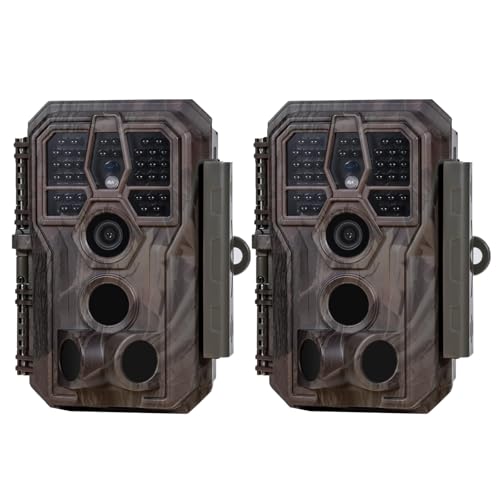
This option is a two-camera E5S pack, suited to monitoring separate trails or approaches with the same capture specifications: 64MP photos, 1296P HD video and a 0.1-second trigger. GardePro also lists 100-foot no-glow night vision, an IP66 rating and a 1/4-inch-20 mounting thread for this model. Both cameras are non-cellular and non-Wi-Fi, so plan to retrieve their SD cards to review footage. The pack’s limitation is that both units share the E5S’s 1296P video resolution rather than the E5 2.0’s 4K recording.
Bottom line: Choose this pack if you need E5S coverage at two locations.
How to choose a GardePro E5 trail camera
Choose by video resolution first: the E5 2.0 records 4K, while the E5S models record 1296P HD. All three options list 64MP still photos and a 0.1-second trigger, so those specifications do not distinguish them. A trail camera uses motion detection to capture activity, then stores footage for later review; these models are non-cellular and non-Wi-Fi, so plan to retrieve the SD card. For monitoring two separate routes, the two-camera pack suits that need; for one position, compare the single-camera models. Do not choose on photo megapixels alone: video resolution and camera placement affect whether moving footage shows the detail you want.
Where to place a trail camera
Mount a trail camera about 3 to 4 feet above ground for many wildlife trails, adjusting height for the animal and terrain. Aim across a trail rather than directly along it so an animal has time to enter the detection area; a practical starting distance is roughly 10 to 20 feet from the expected path. Face north or south when possible to reduce direct sun glare, and avoid moving branches that can trigger repeated captures. The E5S models have a 1/4-inch-20 mounting thread; use a compatible mount and secure the camera so wind does not shift its aim. Check the route during daylight before leaving the camera in place overnight.
How to compare trail camera night vision
Infrared night vision lets a trail camera record in darkness without a visible white flash; “no-glow” refers to the infrared illumination being less visible to people and animals. The E5S models list a 100-foot night-vision range, but usable detail at night also depends on subject distance, movement and the scene. Place the camera close enough to the trail for its field of view and illumination to cover the area you want. Avoid aiming across reflective foliage or a nearby wall, since close objects can dominate night footage. For property monitoring, angle the camera toward the approach rather than a public path, and respect local rules on recording people.
Trail camera setup and SD card habits
Test a trail camera at its intended height and angle before leaving it unattended; walk through the detection zone and check that the frame captures the path. Format a compatible SD card in the camera before its first use, and bring a spare card if retrieving footage requires a long trip. These E5 models do not provide cellular or Wi-Fi viewing, so card retrieval is part of the setup rather than an optional remote feature. Keep the camera’s seal and battery compartment clean and fully closed outdoors. Avoid opening the enclosure in heavy rain, and secure the mount to limit movement that can blur video or misdirect the sensor.
Frequently Asked Questions
Which GardePro E5 records 4K video?
The GardePro E5 2.0 records 4K video and 64MP still photos. The E5S models record 1296P HD video.
Do GardePro E5 trail cameras need cellular service?
No; the E5 and E5S options compared here are non-cellular. They also do not use Wi-Fi, so footage is reviewed by retrieving the SD card.
How high should a trail camera be mounted?
About 3 to 4 feet above ground is a useful starting height for many wildlife trails. Adjust the mount for the target animal and aim across, rather than straight down, the path.
How far from a trail should I place a camera?
Start around 10 to 20 feet from the route, then adjust based on the camera’s view and the scene. Closer placement can help keep a moving animal prominent in the frame.
What does no-glow night vision mean?
No-glow night vision uses infrared illumination designed to be less visible than a white flash. The E5S models list a 100-foot range, but distance and scene conditions affect the detail captured.