
Gary Brecka Hydrogen Bottle: 4 Models Compared

The Echo Go+ is the closest fit for someone seeking Gary Brecka’s hydrogen bottle, with a 10-ounce rechargeable design and SPE/PEM technology; choose another option if you need a larger capacity or a concentration figure.
Gary Brecka’s named bottle is not among these products, so compare these hydrogen-water generators by capacity, construction and the output claims provided for each.
We earn a commission if you buy through links on this page. As an Amazon Associate I earn from qualifying purchases. Products are compared on manufacturer specifications, not hands-on testing.
- Best overall: Echo Go+ 10 oz – The 10-ounce rechargeable Echo Go+ is the closest match to a portable hydrogen-water bottle.
- Best for larger capacity: ENERGILZ 16.2 oz – Its 16.2-ounce capacity is the largest among these options.
- Best for glass construction: Fakllod 460 ml Glass Bottle – The bottle uses high-borosilicate glass rather than polycarbonate plastic.
| Product | Best for | Capacity | Material | Hydrogen concentration | Shop |
|---|---|---|---|---|---|
| Echo Go+ 10 oz | Closest overall match | 10 oz | Polycarbonate plastic | — | Check Price on Amazon |
| ENERGILZ 16.2 oz | More water per fill | 16.2 oz | — | 6,000 ppb | Check Price on Amazon |
| Clcepore 6.0 Hydrogen Bottle | High output claim | — | — | Up to 6,500 ppb | Check Price on Amazon |
| Fakllod 460 ml Glass Bottle | Glass construction | 15.5 oz | Borosilicate glass | Up to 2,000 ppb | Check Price on Amazon |
Hydrogen Bottles Compared
Compare the bottle size, construction and maker-claimed output before choosing an alternative.
Echo Go+ 10 oz
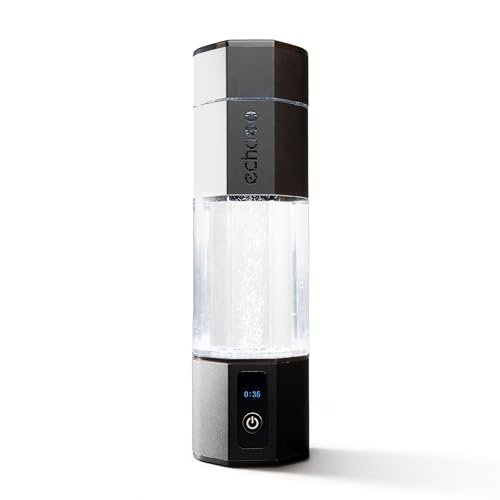
For the closest match to a compact rechargeable hydrogen bottle, the Echo Go+ pairs a 10-ounce capacity with SPE/PEM purification technology. The maker describes adjustable hydrogen levels and a sealed top for portability, while its food-grade polycarbonate body measures 8 inches tall and 2.5 inches wide. Its 0.75-pound weight is the lightest among these options.
Bottom line: Choose this if compact size and rechargeable portability matter more than an output concentration.
ENERGILZ 16.2 oz

The ENERGILZ bottle offers the largest capacity here, at 16.2 ounces, and a maker-claimed hydrogen concentration of 6,000 ppb. Its SPE/PEM technology is another point of overlap with the Echo Go+, but the 11.2-inch height and 3.7-inch width make it a larger object to carry. The product uses health-benefit language that should not be treated as a guaranteed result; the usable distinction is its capacity and concentration claim.
Bottom line: Pick this if a larger fill and a 6,000 ppb claim are priorities.
Clcepore 6.0 Hydrogen Bottle

The Clcepore 6.0 stands apart with the highest output claim in this group: up to 6,500 ppb. Its name references SPE/PEM technology, and its silver bottle measures 9.1 inches high and 2.7 inches wide. Those omissions matter if you need to match a daily water volume or avoid a particular construction. Treat the concentration as a maker claim rather than a guaranteed result in every use.
Bottom line: Choose this if its up-to-6,500 ppb claim is your deciding feature.
Fakllod 460 ml Glass Bottle

The Fakllod is the glass-construction option, using high-borosilicate glass and food-grade rubber, with a 460 ml capacity (about 15.5 ounces). Its maker claims up to 1,600–2,000 ppb and a three-minute electrolysis cycle. At 8.2 inches high and 2.75 inches wide, it is relatively compact, though its 1.23-pound weight is heavier than the Echo Go+.
Bottom line: Pick this if glass matters more to you than a higher stated concentration.
How to choose a hydrogen water bottle
Start with capacity and the concentration claim, then consider construction and portability. These choices span 10 to 16.2 ounces, while stated concentration claims range from up to 2,000 ppb to up to 6,500 ppb; those figures are manufacturer claims, not a guarantee of what every fill will contain. SPE/PEM refers to the electrolysis approach used by several options here, but a technology label alone does not establish output under every water or operating condition. If a particular ppb threshold matters to you, pick only a model with a figure and confirm how its maker defines the measurement. For carrying, compare dimensions and weight as well as volume: the shortest bottle is not necessarily the lightest.
Hydrogen bottle capacity and portability
Capacity is the clearest fit rule: choose a 10-ounce bottle when minimizing bulk matters, and consider a 15-ounce-or-larger choice when fewer refills are the priority. One US fluid ounce equals about 29.6 milliliters, so the 460 ml Fakllod holds about 15.5 ounces. Height and width matter for cup holders, bags and storage, but no universal bottle size fits every holder; measure a holder opening if a tight fit is essential. Weight also varies: among products with a figure, the Echo Go+ weighs 0.75 pound, while the ENERGILZ is 1.5 pounds. A larger fill can mean a less convenient carry, especially when the bottle is full.
Hydrogen generation claims and bottle materials
Hydrogen bottles use electrolysis to generate dissolved hydrogen in water; concentration claims should be compared as claims, not assumed outcomes. A ppb figure is a concentration unit, and the named values here are not directly comparable as independent test results because no common measurement method is provided. Materials also affect handling: the Echo Go+ uses polycarbonate plastic, while the Fakllod uses high-borosilicate glass with food-grade rubber. Glass can break if dropped, so use extra care around hard surfaces; plastic avoids that breakage risk but buyers with material preferences should check the construction. Do not treat health-effect language as proof that hydrogen water treats or prevents a condition.
Using and caring for a hydrogen water bottle
Follow the maker’s cleaning and charging directions, and do not submerge an electrical or rechargeable base unless its manual explicitly permits it. For an electrolysis bottle, use only water types the manufacturer allows; mineral content and additives can affect an electrolysis device, so avoid assuming that juice, flavored water or heavily mineralized water is suitable. Rinse the drinking surfaces after use and let removable parts dry fully to limit residue and odor. Glass bottles need careful handling around sinks and counters, while a sealed top can reduce spill risk during carrying but does not make a bottle leakproof under every condition. Before first use, confirm the cycle and cleaning method for the exact model.
Frequently Asked Questions
What does ppb mean on a hydrogen bottle?
PPB means parts per billion, a concentration unit used for dissolved hydrogen claims. A figure such as 6,000 ppb is a manufacturer claim, and comparisons are most useful when the measurement conditions match.
How much water does a 460 ml bottle hold?
A 460 ml bottle holds about 15.5 US fluid ounces. That is roughly 5.5 ounces more than a 10-ounce bottle, so capacity can help determine how often you need to refill.
Can I put juice in an electrolysis bottle?
Do not assume an electrolysis bottle is suitable for juice or flavored drinks. Use plain water unless the maker’s instructions explicitly allow another liquid, since additives may interfere with the device or leave residue.
Is a glass hydrogen bottle safer than plastic?
Neither material is universally safer; the better fit depends on handling and material preferences. Borosilicate glass can break when dropped, while the Echo Go+ uses food-grade polycarbonate plastic.
How often should I clean a hydrogen water bottle?
Rinse drinking surfaces after each use and clean the bottle on the schedule in its manual. Dry removable pieces fully after washing, and do not immerse a rechargeable base unless its instructions permit it.