
Gbnryg Professional Metal Detectors for Adults Compared

Gbnryg M55J Metal Detector is the Gbnryg professional metal detector for adults to consider first if lower carry weight matters: it weighs 2.8 pounds and has five search modes. Choose Gbnryg M55Z Metal Detector if its 12-inch coil and five modes fit your priorities; consider ULHUND Foldable Metal Detector instead if you want a foldable detector with an adjustable stem.
Metal detectors use a search coil to sense metal in the ground; discrimination settings can help filter some unwanted targets, but may also mask desirable ones.
We earn a commission if you buy through links on this page. As an Amazon Associate I earn from qualifying purchases. Products are compared on manufacturer specifications, not hands-on testing.
- Best overall: Gbnryg M55J Metal Detector – It combines five search modes and a 12-inch coil with a weight of 2.8 pounds.
- Best for listed features: Gbnryg M55Z Metal Detector – Its 12-inch IP68 coil and five modes suit buyers comparing the Gbnryg options.
- Best for portability: ULHUND Foldable Metal Detector – Its foldable design, included backpack and 2.4-pound weight suit buyers prioritizing carry convenience.
| Product | Best for | Coil size | Weight | Search modes | Shop |
|---|---|---|---|---|---|
| Gbnryg M55J Metal Detector | lighter carry | 12 in. | 2.8 lb | 5 | Check Price on Amazon |
| Gbnryg M55Z Metal Detector | 12-inch coil | 12 in. | 5.8 lb | 5 | Check Price on Amazon |
| ULHUND Foldable Metal Detector | foldable storage | 11 in. | 2.4 lb | — | Check Price on Amazon |
Gbnryg Professional Metal Detectors for Adults
Compare the two Gbnryg models with a foldable alternative by coil size, weight and search controls.
Gbnryg M55J Metal Detector
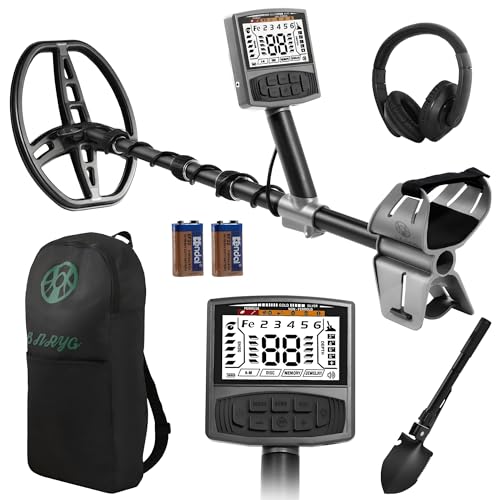
At a 2.8 pounds, this Gbnryg model is lighter than the other Gbnryg option here, while retaining a 12-inch IP68 coil and five search modes. Its controls include pinpoint positioning, junk-metal rejection, memory, jewelry and all-metal modes, plus a backlit LCD. The maker says its ground-balance system supports detection as deep as 12 inches; actual results depend on the target and ground. The maker cautions that jewelry mode works best with high-purity metals, so buyers searching for low-purity alloys should not rely on that mode alone.
Bottom line: Choose this option if you want the lighter Gbnryg model with pinpoint mode.
Gbnryg M55Z Metal Detector

This Gbnryg model shares a 12-inch coil and five search modes with Gbnryg M55J Metal Detector, but its weight is 5.8 pounds. Its coil is described as IP68 waterproof, a distinction for searches where the coil may encounter water. The maker claims quarter-sized metal items can be detected as deep as 12 inches and says the DSP chip improves accuracy. Treat that depth as a maker claim, not a guarantee across different targets or soil.
Bottom line: Pick this model if its coil and mode set matter more to you than lower carry weight.
ULHUND Foldable Metal Detector

The ULHUND is the foldable alternative: it has an 11-inch IP68 DD coil, an internal cable design and a weight of 2.4 pounds. Its stem adjusts from 22 to 60 inches, and the included backpack supports carrying and storage. The backlit LCD includes target ID, and the maker claims a 12.8-inch search depth. This is not a Gbnryg model, so it is a partial match for shoppers specifically seeking that brand. Choose it if compact storage and stem adjustment outweigh matching the Gbnryg models’ 12-inch coils.
Bottom line: Choose this alternative if foldable storage and an adjustable stem matter most.
How to choose a metal detector
Choose by the targets and conditions you expect, not by a maximum-depth claim alone. A larger coil can cover more ground per sweep, while smaller coils can be easier to maneuver around trash or tight spaces. Discrimination can reduce signals from selected metals, but gold and small jewelry can share low-conductivity characteristics with unwanted items, so heavy filtering risks missing good targets. Start with all-metal mode in an unfamiliar area, then compare signals with discrimination settings. A practical rule: if you expect small jewelry or gold, keep discrimination low and use pinpoint mode to narrow a promising signal before digging. Coil size, target size, soil mineralization and burial position all affect detection depth.
Coil size, waterproofing and ground conditions
Coil size is only one part of search performance: coil design and ground mineralization also affect how cleanly a detector reads targets. A DD coil uses two overlapping D-shaped windings and can be useful in mineralized ground; coil size alone does not establish that a unit is suitable for underwater use. IP68 is an ingress-protection rating, but the rating’s depth and duration conditions must be checked against the manufacturer’s specification before submerging equipment. For this comparison, the Gbnryg models have 12-inch coils and the ULHUND has an 11-inch DD coil. Confirm the permitted submersion conditions before taking any detector into water, especially since a waterproof coil does not establish that the control housing is waterproof.
Search modes and discrimination
Search modes change how a detector responds to targets; they do not make every target type equally easy to find. All-metal mode is useful for scanning broadly, while discrimination can suppress selected categories of metal. Pinpoint mode narrows the location of a detected object to make recovery more precise. Memory modes can retain a selected target response, but a saved preference can also overlook items with similar or weaker signals. Use this guide to match a mode to the task, then lower discrimination when small or mixed-metal targets matter.
| Need | Mode or feature to prioritize | Tradeoff |
|---|---|---|
| Broad initial scan | All-metal mode | More unwanted signals |
| Reduce selected junk signals | Discrimination | May mask desirable targets |
| Locate a signal before digging | Pinpoint mode | Requires a detected signal first |
Good detecting technique and responsible recovery
Keep the coil close to the ground and level through each sweep; lifting it at the ends changes the distance to targets and can make coverage uneven. Move at a steady pace and overlap passes so narrow gaps do not remain between sweeps. A detector’s depth claim is not a promise for every target: small pieces, mineralized soil and target orientation can change the signal. Before digging, check local rules and landowner permission; protected areas and private property may restrict detecting or recovery. Use a small plug, replace soil neatly and take recovered trash with you. These habits reduce disturbance and keep a search site usable for others.
Frequently Asked Questions
Does a 12-inch coil find targets deeper than an 11-inch coil?
Not necessarily: coil diameter is only one factor in depth, alongside target size, soil mineralization and coil design. A small target can be harder to detect at depth than a larger one.
Can I use a waterproof search coil underwater?
Only within the maker’s depth and duration limits. A waterproof coil does not mean the detector’s control housing or all connectors can be submerged.
Why can discrimination hide gold or small jewelry?
Discrimination suppresses selected signal ranges, and small gold or mixed-metal jewelry can produce signals that overlap unwanted targets. If those targets matter, use low discrimination and investigate repeatable signals.
How should I sweep a detector coil?
Keep the coil level and close to the ground, moving steadily with overlapping passes. Lifting the coil at each end increases its distance from targets and can leave uneven coverage.
What affects a detector’s actual search depth?
Target size, target orientation, soil mineralization, coil design and sweep technique all affect detection depth. A maker’s maximum-depth claim should not be treated as a guaranteed result for every target.