
GE Pro Crystal HD Amplified Antenna: 5 Options Compared

The GE Pro Crystal HD amplified antenna match is GE Indoor Amplified Antenna 48732, whose maker claims reception up to 50 miles and includes an amplifier. Choose another model if you need a specific mounting style, portability or outdoor placement.
Indoor TV antennas receive over-the-air VHF and UHF broadcasts through a coax connection; actual reception depends on the location of broadcast towers, terrain, buildings and antenna position.
We earn a commission if you buy through links on this page. As an Amazon Associate I earn from qualifying purchases. Products are compared on manufacturer specifications, not hands-on testing.
- Best overall: GE Indoor Amplified Antenna 48732 – Its included amplifier and maker-claimed range up to 50 miles make it the closest fit to the search.
- Best for top-of-TV mounting: GE Hover Amplified Antenna 37075 – The amplified antenna can sit on top of a television, mount on a wall or rest on a tabletop.
- Best for outdoor placement: GE Outdoor HD Antenna 29884 – Its weather-resistant design and included J mount support attic or outdoor installation.
| Product | Best for | Antenna type | Maker-claimed range | Amplification | Shop |
|---|---|---|---|---|---|
| GE Indoor Amplified Antenna 48732 | Closest match | Indoor | Up to 50 miles | Included | Check Price on Amazon |
| GE Flat Panel Indoor Antenna 33681 | Unpowered indoor | Indoor | Up to 40 miles | — | Check Price on Amazon |
| GE Outdoor HD Antenna 29884 | Attic or outdoor | Outdoor or attic | 70+ miles | — | Check Price on Amazon |
| GE Hover Amplified Antenna 37075 | Top-of-TV mount | Indoor | 55+ miles | Included | Check Price on Amazon |
| GE Portable Magnetic Antenna 81843 | Travel setup | Portable indoor | Up to 20 miles | — | Check Price on Amazon |
GE Pro Crystal HD Amplified Antenna Options
Compare the closest match with related GE antennas by their intended placement and signal features.
GE Indoor Amplified Antenna 48732

GE Indoor Amplified Antenna 48732 is the closest match for shoppers seeking an amplified GE indoor antenna. It has adjustable dipoles, an included coax cable and an AC adapter, so it needs a nearby outlet as well as a TV coax input. The maker says its PureAmp technology includes a 4G/5G LTE filter and claims reception up to 50 miles from broadcast sources. This can suit a room where a powered indoor antenna is practical. The range claim is not a guarantee: buildings, terrain and tower direction can limit reception even within that distance.
Bottom line: Choose this if you want a powered indoor antenna with adjustable dipoles.
GE Flat Panel Indoor Antenna 33681
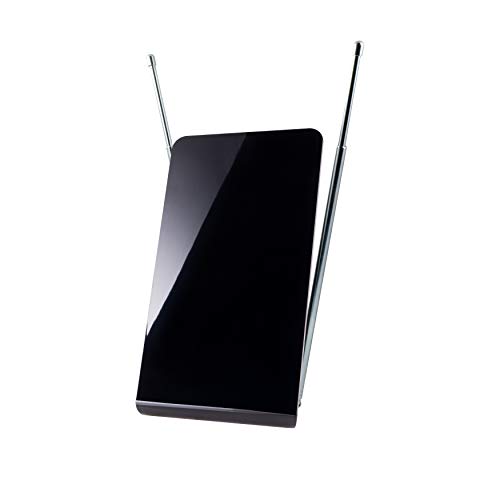
GE Flat Panel Indoor Antenna 33681 differs from the closest match by using a flat panel design with extendable rabbit-ear dipoles and an adjustable stand. It includes a 5-foot coax cable and is described as supporting VHF and UHF reception. The maker claims reception up to 40 miles and compatibility with NEXTGEN TV (ATSC 3.0) broadcasts where available. It suits buyers who prefer a tabletop indoor setup with adjustable elements. The features do not identify an amplifier, so this is not the closest choice for someone specifically seeking an amplified antenna; check the packaging for the exact included components.
Bottom line: Choose this for a flat panel indoor setup with adjustable dipoles.
GE Outdoor HD Antenna 29884

GE Outdoor HD Antenna 29884 is a different type from an indoor amplified antenna: it is designed for attic or outdoor placement and includes a J mount. Its weather-resistant construction supports installation where an indoor antenna may be obstructed by walls or nearby structures. The maker claims reception from more than 70 miles and says it supports VHF, UHF and ATSC 3.0 broadcasts where available. Consider it when an outdoor or attic position is the main requirement.
Bottom line: Choose this when attic or outdoor mounting is the priority.
GE Hover Amplified Antenna 37075

GE Hover Amplified Antenna 37075 is another amplified indoor option, but its defining feature is flexible placement: it can mount on top of a TV, attach to a wall or sit on a tabletop. The maker claims a range of 55 miles or more and says its PureAmp amplifier has a 4G/5G LTE filter. Horizontal swiveling can help with aiming toward broadcast sources. This model suits buyers who want an antenna positioned directly at the television rather than one placed elsewhere in the room. Its mounting approach may not suit a TV without a usable top surface or nearby wall space.
Bottom line: Choose this for amplified reception with flexible mounting.
GE Portable Magnetic Antenna 81843

GE Portable Magnetic Antenna 81843 is a compact travel antenna rather than a fixed-room amplified model. Its magnetic base can attach to many metal surfaces, and the maker claims 360-degree reception up to 20 miles. The features identify VHF and UHF reception and compatibility with ATSC 3.0 broadcasts where available. Its compact form suits an RV, campsite or temporary television setup where portability matters more than the longer range claims of the other models. The shorter claimed range makes it a weaker fit for distant broadcast sources; verify that the intended location has usable over-the-air signals.
Bottom line: Choose this for a compact travel or backup TV setup.
How to choose an amplified TV antenna
Choose an amplified antenna when its powered setup fits your room, not just because its range claim is larger. Over-the-air reception depends on signal strength at the antenna; walls, metal siding, hills and distance can weaken signals. Amplifiers can boost a received signal, but they cannot create a broadcast signal that does not reach the antenna, and strong nearby signals can also overload a system. If the TV is more than a few miles from the antenna by coax cable, cable loss becomes more relevant, especially with splitters. For a distant tower or obstructed indoor location, first compare a higher or outdoor mounting position rather than assuming amplification alone will solve reception.
Indoor antenna placement and aiming
Place an indoor antenna near a window and as high as practical, then scan channels after each meaningful position change. Broadcast signals commonly arrive from different directions, so turning the antenna toward the tower area can improve some channels while weakening others. Use a broadcast-reception map or local station coverage tool to identify tower directions before adjusting. A useful decision rule is to try another location if a channel breaks up repeatedly after a rescan; moving the antenna several feet or above nearby furniture can change the signal path. Keep the coax connection secure and avoid routing it tightly alongside power cables.
Indoor, outdoor and portable antenna types
Choose by installation location first: an indoor antenna needs a usable room position, an outdoor model needs a safe mounting point, and a portable model prioritizes easy relocation. VHF and UHF are separate broadcast bands, so an antenna intended to receive both is useful when local stations use different bands. ATSC 3.0 availability depends on local broadcasters and does not guarantee reception by itself. This table separates the options by their intended placement and the maker’s range claim.
| Need | Option | Claimed range |
|---|---|---|
| Powered indoor reception | GE Indoor Amplified Antenna 48732 | Up to 50 miles |
| Top-of-TV or tabletop placement | GE Hover Amplified Antenna 37075 | 55+ miles |
| Attic or outdoor mount | GE Outdoor HD Antenna 29884 | 70+ miles |
| Travel and temporary use | GE Portable Magnetic Antenna 81843 | Up to 20 miles |
Scanning channels and troubleshooting reception
Run the television’s channel scan after installing or relocating an antenna; the TV stores the channels it can receive during that scan. Rescan after aiming changes, since a saved channel list may not reflect the new position. If a channel is missing, check the coax connection, move the antenna away from obstructions and scan again. Picture breakup often points to a weak or fluctuating signal, while an overly strong signal can also cause reception problems with some setups. For any roof or exterior installation, use a stable mount and keep clear of overhead power lines; do not climb or mount equipment in unsafe conditions.
Frequently Asked Questions
Does an amplified TV antenna guarantee a longer range?
No, an amplifier cannot receive a signal that does not reach the antenna. Terrain, buildings, tower direction and coax length all affect reception, so antenna location matters as much as the range claim.
Where should I place an indoor TV antenna?
A high position near a window is a useful starting point. Move and rotate the antenna toward broadcast towers, then rescan channels after each substantial adjustment.
Do I need to scan channels after moving an antenna?
Yes, run the TV’s channel scan after repositioning the antenna so it can refresh the saved channel list. If a station is still missing, try another location or aiming direction and scan again.
What is the difference between VHF and UHF reception?
VHF and UHF are different over-the-air broadcast bands, and local stations may use either one. An antenna designed for both can receive stations across both bands when signal conditions permit.
Will an antenna receive ATSC 3.0 broadcasts?
An antenna can receive ATSC 3.0 over-the-air signals when local broadcasters provide them and the connected TV or tuner supports the format. Availability and reception vary by area.
Is an outdoor TV antenna safe to install myself?
Roof and exterior antenna work involves fall and electrical hazards; keep the antenna and mount well clear of overhead power lines. Use a stable mounting location and avoid climbing when conditions are wet or windy.