
Green Gobbler Main Line Opener: 4 Options Compared

For a Green Gobbler main-line clog, Green Gobbler Ultimate Main Drain Opener, 64 oz is the direct match: its 64-fluid-ounce, high-density formula is made for main lines as well as household drains. Choose Ultimate Main Drain Opener, 4-gallon case if you need the larger case and its reach of up to 50 feet; choose a different product type for tree roots or routine enzyme maintenance.
Main-line openers are chemical drain treatments intended for obstructions in a home’s larger drain pipe. If sewage backs up into multiple fixtures, stop using water and contact a plumber rather than adding more cleaner.
We earn a commission if you buy through links on this page. As an Amazon Associate I earn from qualifying purchases. Products are compared on manufacturer specifications, not hands-on testing.
- Best overall: Green Gobbler Ultimate Main Drain Opener, 64 oz – A 64-fluid-ounce main-line formula also covers sinks, tubs, toilets and showers.
- Best for extended reach: Ultimate Main Drain Opener, 4-gallon case – The maker says it can reach clogs up to 50 feet away.
- Best for routine maintenance: Green Gobbler Enzyme Drain Cleaner, 1 gal – An enzyme formula is intended for ongoing grease and food-waste buildup in septic systems and grease traps.
| Product | Best for | Package size | Formula | Intended use | Shop |
|---|---|---|---|---|---|
| Green Gobbler Ultimate Main Drain Opener, 64 oz | Main-line clogs | 64 fl oz | High-density liquid | Main lines and household drains | Check Price on Amazon |
| Ultimate Main Drain Opener, 4-gallon case | Longer reach | 4 gal | Bleach-free liquid | Main-line clogs up to 50 ft | Check Price on Amazon |
| Green Gobbler Drain Clog Dissolver, 2-pack | Household drain clogs | 2-count pack | Liquid | Sinks, tubs, showers, toilets | Check Price on Amazon |
| Green Gobbler Enzyme Drain Cleaner, 1 gal | Routine buildup | 1 gal | Enzyme-based | Septic tanks and grease traps | Check Price on Amazon |
Green Gobbler Main Line Opener Options
Compare the main-line formulas with related drain treatments by package size, formula and intended task.
Green Gobbler Ultimate Main Drain Opener, 64 oz

Green Gobbler Ultimate Main Drain Opener, 64 oz is the direct main-line option in a single 64-fluid-ounce bottle. Green Gobbler says its high-density formula sinks through standing water and dissolves grease, hair, oils, soap scum, wipes and paper products; the maker also says it is suitable for pipes and septic systems. Its uses include sinks, tubs, toilets, showers and kitchen sinks, so it suits households looking for one formula across several drain types. The package is smaller than the four-gallon case. For a clog beyond ordinary household drains, choose the larger case only if its reach claim fits your situation.
Bottom line: Pick this for a household main-line clog when a single 64-fluid-ounce bottle suits the job.
Ultimate Main Drain Opener, 4-gallon case
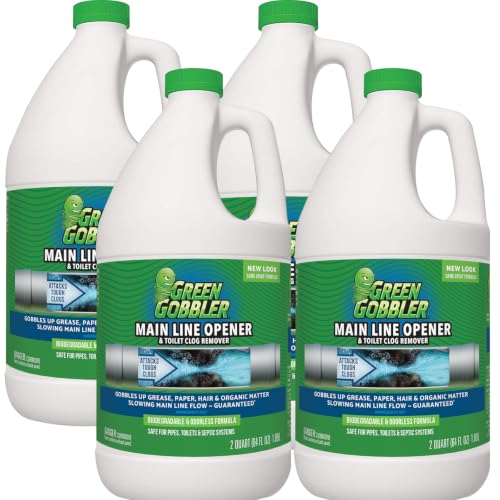
Ultimate Main Drain Opener, 4-gallon case stands apart by specifying a reach of up to 50 feet and a 4-gallon case. Green Gobbler says the bleach-free formula breaks down hair, sludge, wipes and other organic material, and is suitable for copper and PVC pipes, septic systems, sinks, tubs, toilets and garbage disposals. The maker directs users addressing a main-line clog to pour it into a first-floor toilet, flush, then leave the system unused for 10 to 12 hours. That waiting period makes this a poor fit when the drain must be back in service quickly; confirm that the product’s directions suit your plumbing setup.
Bottom line: Choose this when the reach and larger case match your main-line clog.
Green Gobbler Drain Clog Dissolver, 2-pack

Green Gobbler Drain Clog Dissolver, 2-pack is a household drain clog dissolver rather than a product specifically framed as a main-line opener. Green Gobbler says its liquid dissolves hair, soap scum, toilet paper, wipes and organic buildup, and is intended for sinks, tubs, showers, toilets and floor drains. The two-count pack suits a buyer dealing with slow household drains in more than one location. Its specified use does not include the main-line reach claim associated with Ultimate Main Drain Opener, 4-gallon case, so do not assume it will address a deep obstruction in a main sewer line. Choose a main-line formula for that job.
Bottom line: Choose this for ordinary household drain clogs, not a deep main-line blockage.
Green Gobbler Enzyme Drain Cleaner, 1 gal

Green Gobbler Enzyme Drain Cleaner, 1 gal differs from a fast clog opener by using enzymes for routine buildup in drains, septic tanks and grease traps. Green Gobbler says the formula digests grease, fats, oils, paper and food waste, works within hours, and provides up to eight treatments; it also describes the product as non-corrosive and suitable for pipes and septic systems. The gallon bottle is aimed at maintenance rather than clearing a sudden main-line blockage. Buyers facing a backed-up main drain should choose a product specifically intended for that clog instead of relying on enzyme maintenance treatment.
Bottom line: Pick this for routine grease and food-waste maintenance, not an acute main-line clog.
How to Choose a Main Line Opener
Match the treatment to the obstruction and the drain’s location: organic material such as hair, grease, paper and wipes is the target described for the main-line liquids here, while tree roots call for a different approach. A main drain carries wastewater from multiple fixtures toward the sewer or septic system, so a backup affecting more than one fixture can signal a line problem rather than a local sink clog. If sewage appears in a tub or floor drain, stop running water and call a plumber; adding chemicals can complicate service. Never combine drain cleaners or mix them with bleach, ammonia or other household chemicals, because reactions can release dangerous heat or fumes. Use gloves and eye protection, and keep people and pets away from the drain during treatment.
Main Line Clues and When to Call a Plumber
Several slow fixtures or a backup at a low drain are stronger clues to a main-line issue than one slow sink. A single clogged fixture is more likely to have a localized obstruction, while gurgling in other drains during flushing can point to a shared pipe or vent problem. Chemical openers are not a substitute for diagnosing a sewer backup, broken pipe or root intrusion; repeated treatments can delay the repair and expose a technician to leftover cleaner. Stop using water if wastewater is backing up, and tell the plumber what products went into the drain. A toilet overflow or wastewater on floors also needs prompt cleanup with appropriate protective gear, not another dose of drain opener.
How Main-Line Drain Cleaners Differ
Main-line liquids, household drain openers and enzyme maintenance cleaners serve different jobs. A liquid opener is intended to break down a clog; enzyme products target gradual organic buildup and do not have the same deep-line reach. Root treatments address roots in pipes, not ordinary hair or grease clogs. This distinction helps prevent a common mistake: choosing a maintenance product when a drain is already backing up. Use the table as a task-first guide, and check the pipe material and septic-system compatibility before treating a drain.
| Need | Product type | Choose when |
|---|---|---|
| Organic main-line clog | Main-line liquid opener | The blockage is in the home’s main drain |
| One slow household fixture | Household drain dissolver | The obstruction is local to a sink, tub or shower |
| Recurring grease buildup | Enzyme maintenance cleaner | The goal is routine system upkeep |
| Roots inside sewer pipes | Root treatment | Root intrusion is the suspected cause |
Safe Use and Common Drain-Cleaner Mistakes
Never pour a second chemical cleaner into a drain that already contains another product; incompatible cleaners can generate heat, splatter or toxic gas. Follow the product’s own dose and contact-time directions, ventilate the area, and avoid plunging immediately after chemical treatment because liquid can splash back onto skin or eyes. Keep the container closed and out of children’s reach. Avoid assuming that a product safe for one pipe material is safe for every plumbing component, especially older or specialty installations; verify material compatibility when the plumbing is unknown. A repeated clog after treatment usually needs mechanical diagnosis rather than repeated chemical applications.
Frequently Asked Questions
How can I tell whether a clog is in the main line?
A main-line problem often slows or backs up more than one fixture, while a single slow sink usually points to a local drain. Gurgling in other fixtures during a flush is another warning sign; stop water use if sewage backs up.
Can drain opener be used in a septic system?
Some formulas are specifically described as septic-safe, but that does not make every drain cleaner suitable for every system. Use only a product whose directions identify septic compatibility, and never combine cleaners.
How long should a main-line opener sit?
Contact time depends on the product directions. For the four-gallon Green Gobbler formula, the maker directs users to leave the system unused for 10 to 12 hours after treatment.
What should I do if two drains back up at once?
Stop running water and treat simultaneous backups as a possible shared drain or sewer-line issue. Do not add another chemical dose; wastewater backup can require prompt professional diagnosis.
Are enzyme drain cleaners the same as clog openers?
No. Enzyme cleaners are generally used for gradual organic buildup such as fats and food waste, while a clog opener is intended to address an existing obstruction. A backed-up main drain should not be treated as routine enzyme maintenance.