
Hand Held Portable Welders: 5 Models Compared

For one machine that covers both flux-core MIG and stick welding, choose 2-in-1 MIG and Stick Welder; its two processes and support for 0.032- and 0.040-inch wire set it apart. Choose a stick-only model instead if you want a simpler rod-welding setup or need a defined 20–120A range.
Handheld welders put the electrode holder or wire-feed equipment in a compact form, but they still require protective gear, a suitable power circuit and safe work practices.
We earn a commission if you buy through links on this page. As an Amazon Associate I earn from qualifying purchases. Products are compared on manufacturer specifications, not hands-on testing.
- Best overall: 2-in-1 MIG and Stick Welder – Combines flux-core MIG and MMA stick modes, with two wire diameters and 3/32- to 1/8-inch rods.
- Best for five-step control: 110V Handheld Stick Welder, 20–120A – Offers five current settings across a 20–120A output range in a handheld stick-welding design.
- Best for rod-size range: Protmex Portable Welder, 20–120A – Supports 3/32- to 1/8-inch rods and includes 20 welding rods.
| Product | Best for | Welding process | Current output | Consumable fit | Shop |
|---|---|---|---|---|---|
| 2-in-1 MIG and Stick Welder | Two-process work | Flux-core MIG, MMA | 250A | 0.032/0.040-in wire; 3/32–1/8-in rods | Check Price on Amazon |
| 110V Handheld Stick Welder, 20–120A | Five-setting control | MMA stick | 20–120A | — | Check Price on Amazon |
| Saker Portable Welder, 20–120A | 3/32-inch rods | ARC stick | 20–120A | 3/32-in rods | Check Price on Amazon |
| Protmex Portable Welder, 20–120A | Rod-size flexibility | ARC stick | 20–120A | 3/32–1/8-in rods | Check Price on Amazon |
| 110V Handheld Arc Welder, 20–120A | Hot-start features | Arc stick | 20–120A | 3/32–1/8-in rods | Check Price on Amazon |
Hand Held Portable Welders Compared
Compare each machine’s welding process and consumable compatibility before choosing for a repair or project.
2-in-1 MIG and Stick Welder

The two-process design separates this welder from the stick-only options: it supports gasless flux-core MIG as well as MMA stick welding. The product name specifies 110V and 250A, and the features identify compatibility with 0.032- and 0.040-inch wire plus 3/32- to 1/8-inch rods. The maker says it is intended for carbon steel, stainless steel and cast iron, but not aluminum. This is the clearest match for someone who wants to switch between wire-feed and rod welding; choose a stick-only machine if MIG is unnecessary and you prefer a dedicated electrode setup.
Bottom line: Choose this for projects where switching between flux-core wire and stick rods is useful.
110V Handheld Stick Welder, 20–120A

Five selectable current settings distinguish this 110V MMA stick welder from the other rod-only choices, which describe their adjustment differently. Its output range is 20–120A, and its gun-style body integrates the inverter and electrode holder; a ground clamp, welding mask and five rods are included. The maker recommends matching the setting to the electrode and its recommended operating range. This suits a buyer who wants a handheld stick machine with a compact set of included accessories. The product name does not define a rod diameter, so confirm the electrode size you plan to use before ordering.
Bottom line: Pick this for five current settings and a compact stick-welding layout.
Saker Portable Welder, 20–120A
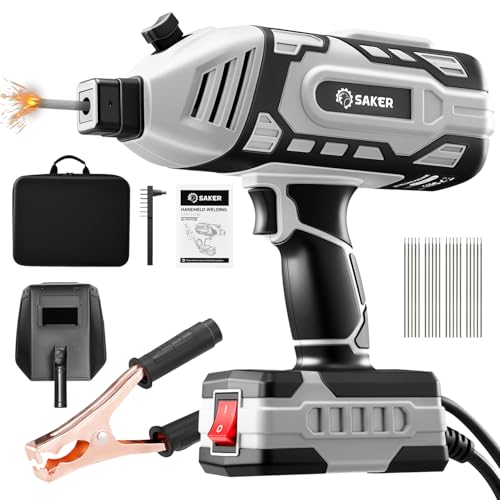
The Saker is a 110V handheld ARC welder with a five-variable-current adjustment and compatibility with 3/32-inch rods, making its consumable fit more specific than the options without a defined rod diameter. Its features identify an IGBT inverter and describe the maker’s claims of arc stability and easier starts; treat those as manufacturer claims rather than a guarantee for every setup. Carbon steel and iron are named among its intended materials. This model suits repair tasks planned around 3/32-inch rods. A buyer needing 1/8-inch electrodes should choose a machine whose compatibility includes that diameter.
Bottom line: Choose this when 3/32-inch rods match the work you have planned.
Protmex Portable Welder, 20–120A

The Protmex accepts both 3/32- and 1/8-inch rods, a wider stated electrode-size span than the Saker’s 3/32-inch fit. This 110V ARC machine has five adjustable current settings from 20–120A and includes 20 welding rods. The maker says its inverter provides arc stability and automatic current compensation during voltage fluctuations; results still depend on the electrode, joint and power supply. The broader rod range suits buyers who already work with both sizes. Its 120A maximum is the limit to consider if your planned electrode or material calls for more current.
Bottom line: Pick this if you need the compatibility with both 3/32- and 1/8-inch rods.
110V Handheld Arc Welder, 20–120A

Hot start and anti-stick are the distinguishing named features on this 110V handheld arc welder, alongside a 20–120A output range and support for 3/32- to 1/8-inch rods. The maker claims its IGBT inverter provides arc stability, and the product name specifies a 2.7-pound weight. The broad rod-size compatibility suits a buyer who wants those two named arc-starting and sticking aids in a portable stick unit. The maker does not establish its duty cycle, so confirm that rating if you expect to weld continuously for extended stretches.
Bottom line: Choose this for the hot-start and anti-stick features with two rod sizes.
How to choose a hand held portable welder
Choose by welding process first, then match the machine’s output and consumables to your work. Stick welding uses a flux-coated electrode held against the work; flux-core wire feeds continuously and can avoid a separate shielding-gas bottle. A 110V input does not tell you the machine’s duty cycle or the current available at the outlet, so check the circuit requirements and duty-cycle rating before planning long welds. For these options, 2-in-1 MIG and Stick Welder supports two processes, while the rest are stick or arc welders. If your work needs both wire and rods, choose a dual-process unit; if it is all rod work, compare rod diameter and adjustment range instead. Aluminum requires a suitable process and setup, not just a machine marketed for steel.
Match electrode size to current and joint
Match the electrode diameter to the machine’s output range and the electrode maker’s current recommendation; a larger rod generally needs more current. A practical decision rule is to rule out any model whose rod range excludes your planned electrode, such as choosing a 3/32-inch-only option only when that size fits the task. Rod selection also depends on base-metal type, thickness, joint position and whether the work is clean; the largest compatible rod is not automatically the right one. Use the electrode package’s polarity and amperage guidance rather than assuming every rod uses the same settings. Remove paint, rust and oil from the weld area where appropriate, because contamination can interfere with arc behavior and weld quality.
Protect yourself and the work area
Arc welding creates intense ultraviolet and infrared radiation, hot spatter and fumes, so use a correctly shaded welding helmet, safety glasses, gloves and flame-resistant clothing that covers skin. Keep flammable materials away from sparks and check the opposite side of a wall or workpiece for fire hazards; never weld a sealed container that may hold flammable residue. Welding fumes require effective ventilation, and coated or unknown metals need particular caution. A handheld body does not make an arc welder safe to hold like an ordinary power tool: keep the electrode and live welding circuit clear of skin and damp surfaces. Set up on a dry, stable surface and disconnect power before changing consumables or inspecting the equipment.
Frequently Asked Questions
Can a 110V handheld welder weld thick steel?
A 110V rating alone cannot establish the steel thickness a machine can weld reliably. Compare the welder’s output and duty cycle with the electrode maker’s current range and the joint design; multiple passes may be needed for thicker sections.
What is the difference between stick and flux-core welding?
Stick welding uses a flux-coated rod that melts as the electrode, while flux-core welding feeds a continuous tubular wire. Flux inside the wire helps shield the weld, and many flux-core setups can operate without a shielding-gas cylinder.
Do I need gas for flux-core welding?
Self-shielded flux-core wire is designed to weld without an external shielding-gas cylinder. Check the wire type before setup, because gas-shielded flux-core wire requires a different arrangement.
How long can a portable welder run continuously?
Duty cycle determines the welding time within a 10-minute period, commonly expressed as a percentage at a specified current. For example, a 20% duty cycle permits 2 minutes of welding followed by 8 minutes of cooling at that rated output; check the machine’s duty-cycle rating before extended work.
Can handheld stick welders weld aluminum?
A basic stick welder is not automatically suitable for aluminum; the machine, electrode and process must all be compatible. Check the machine’s supported materials and use an aluminum-specific process and consumable rather than assuming a steel electrode will work.