
Harbor Breeze Ceiling Fans: 4 Models Compared

For a flexible indoor/outdoor option, Harbor Breeze Merrimack II 52-in is the leading pick because its title identifies both settings and its included light kit has LED bulbs. Choose Harbor Breeze Armitage 52-in for its coverage of rooms up to 400 square feet, or Harbor Breeze Sail Stream 52-in if you want a flush-mount model with a remote.
Ceiling fans move air to improve comfort, but they do not lower room temperature; select size and mounting style for the space, then confirm the fan’s outdoor rating for the intended location.
We earn a commission if you buy through links on this page. As an Amazon Associate I earn from qualifying purchases. Products are compared on manufacturer specifications, not hands-on testing.
- Best overall: Harbor Breeze Merrimack II 52-in – Its title specifies indoor/outdoor use, and its light kit includes LED bulbs.
- Best for large rooms: Harbor Breeze Armitage 52-in – The product features identify coverage for rooms up to 400 square feet.
- Best for low ceilings: Harbor Breeze Sail Stream 52-in – The flush-mount design keeps the fan close to the ceiling.
| Product | Best for | Mount | Blades | Room fit or airflow | Shop |
|---|---|---|---|---|---|
| Harbor Breeze Merrimack II 52-in | Indoor-outdoor spaces | — | 5 | — | Check Price on Amazon |
| Harbor Breeze Armitage 52-in | Large indoor rooms | Flush mount | 5 | Up to 400 sq ft | Check Price on Amazon |
| Harbor Breeze Sail Stream 52-in | Remote operation | Flush mount | 3 | Large rooms | Check Price on Amazon |
| Harbor Breeze Waveport 52-in | Stated airflow | Downrod mount | 5 | 4,576 CFM; up to 400 sq ft | Check Price on Amazon |
Harbor Breeze Ceiling Fans
Compare the included Harbor Breeze models by mounting style, blade count and stated room coverage.
Harbor Breeze Merrimack II 52-in
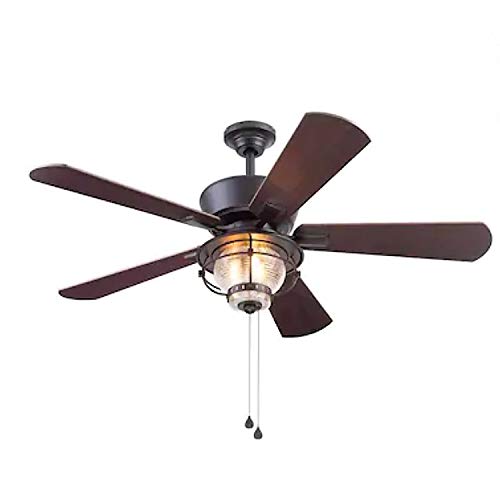
Harbor Breeze Merrimack II 52-in is the only model here whose title identifies both indoor and outdoor use. Its 52-inch, five-blade design has reversible brown or bronze blade faces, a seeded-glass shade and an LED fixture with bulbs included. The reversible finish offers two looks without replacing the blades. This is a useful match for someone choosing one style across a covered outdoor area and an adjoining room.
Bottom line: Choose this for its indoor/outdoor designation and reversible blade finish.
Harbor Breeze Armitage 52-in
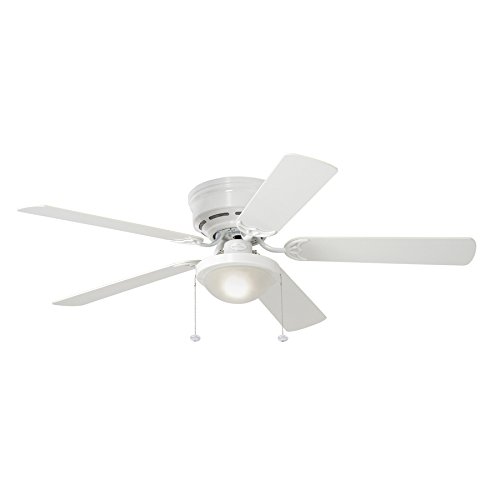
Harbor Breeze Armitage 52-in gives a clear room-size target: the product features say its 52-inch fan provides airflow for spaces up to 400 square feet. Its five reversible white/washed-oak blades let the room’s finish guide the look, while the alabaster glass light kit includes one 6.5-watt LED bulb. Flush mounting makes this the option to consider when a downrod would hang too low. The coverage is a maximum, not a guarantee of identical airflow in every room; open layouts and obstructions can change how air circulates.
Bottom line: Choose this for a large indoor room and a flush-mount installation.
Harbor Breeze Sail Stream 52-in

Harbor Breeze Sail Stream 52-in stands apart with three gray blades rather than the five-blade designs in this group, and its title includes a remote. The brushed-nickel finish and frosted-glass light kit suit buyers looking for a compact-looking flush-mount style; the fan is identified for large rooms. That makes it harder to compare on measured output than Harbor Breeze Waveport 52-in, which has a CFM figure. Consider this model when remote operation and a three-blade appearance matter most.
Bottom line: Choose this for a three-blade flush-mount design with a remote.
Harbor Breeze Waveport 52-in

Harbor Breeze Waveport 52-in is the only model in this group with an airflow figure: up to 4,576 CFM, alongside coverage up to 400 square feet. Its five tropical-style brown blades, weathered-bronze finish and downrod mount set it apart visually and mechanically from the flush-mount choices. The frosted-glass light kit includes two 60-watt bulbs, and the kit can be installed with or without the light. A downrod needs adequate ceiling height and blade clearance, so this is less suitable when a low ceiling makes a close-to-ceiling installation necessary.
Bottom line: Choose this when a downrod mount and stated airflow figure suit the room.
Choosing a ceiling fan by room size
A 52-inch fan is commonly used for rooms around 225 to 400 square feet, while a 42-inch fan is more typical for spaces around 144 to 225 square feet. These are planning ranges, not fixed performance guarantees: long rooms, high ceilings and partitions can call for more than one fan. A simple decision rule is to use one 52-inch fan for a fairly open room up to about 400 square feet, then reconsider if the space is divided or unusually long. Compare a model’s coverage with the room’s usable area, not just its overall dimensions. Harbor Breeze Armitage 52-in and Harbor Breeze Waveport 52-in give a maximum of 400 square feet; the other models do not supply a numerical coverage figure.
For the 52-inch options, blade clearance and mount style are as important as room area.
Flush mount or downrod installation
Flush-mount fans sit close to the ceiling and are generally the practical choice when ceiling height is limited; downrod fans hang lower and suit higher ceilings. Keep fan blades at least 7 feet above the floor and about 18 inches from walls or tall obstructions for safe clearance and useful airflow. A fan needs a box specifically rated to support a ceiling fan; an ordinary light-fixture box is not an adequate substitute. Harbor Breeze Armitage 52-in and Harbor Breeze Sail Stream 52-in specify flush mounting, while Harbor Breeze Waveport 52-in specifies a downrod mount.
Comparing blade count, lights and airflow
Blade count alone does not tell you how much air a fan moves; blade pitch, motor design and speed also affect airflow. CFM (cubic feet per minute) measures air volume, so compare CFM figures at the same speed when available. Only Harbor Breeze Waveport 52-in supplies a CFM figure, so the other models cannot be ranked by measured output from these specifications. A light kit is a separate decision: check whether its bulbs are included and whether the fixture can be removed if overhead illumination is not needed. Harbor Breeze Waveport 52-in says its light kit can be installed with or without the light; Harbor Breeze Merrimack II 52-in includes LED bulbs. Avoid treating an unspecified control or light feature as interchangeable across models.
Outdoor placement and seasonal direction
Outdoor suitability depends on the location’s exposure, not just a fan’s finish. Damp-rated fans are intended for covered, protected areas, while wet-rated models are designed for direct exposure to rain; verify the rating for the installation spot before choosing an outdoor fan. For seasonal comfort, a fan commonly runs counterclockwise in summer to push air downward, and clockwise at low speed in winter to circulate warmer air near the ceiling. Switch direction only when the fan is stopped, using its reversing control or switch as applicable.
Frequently Asked Questions
What room size suits a 52-inch ceiling fan?
A 52-inch fan commonly suits an open room around 225 to 400 square feet. Long, divided or high-ceiling spaces may need a different layout or more than one fan.
How high should ceiling fan blades be?
Keep blades at least 7 feet above the floor and about 18 inches from walls or tall obstructions. A flush mount can help in a low-ceiling room, but safe clearance still takes priority.
Can a ceiling fan use a regular light box?
No; a ceiling fan needs an electrical box rated to support a fan’s weight and motion. Have the box checked before installation if its rating is uncertain.
Which way should a ceiling fan turn in summer?
A ceiling fan commonly runs counterclockwise in summer to push air downward and create a cooling breeze. Stop the fan before changing its direction.
Can an indoor-outdoor fan get rained on?
Only a wet-rated fan is intended for direct rain exposure; damp-rated fans are for covered, protected locations. Confirm the rating for the specific installation spot before buying.