
Hay Chopper for Horses: 5 Models Compared by Feed Prep

For horse feed prep, the VEVOR suits buyers who want separate feed paths and a maker-claimed maximum output of 1,719 lb/h. Choose a different machine if you need a 110V motor option, an automatic conveyor, or a compact multi-purpose grinder.
A hay chopper cuts forage into shorter pieces for easier handling; the right choice depends on your feedstock, electrical supply, and desired cut length.
We earn a commission if you buy through links on this page. As an Amazon Associate I earn from qualifying purchases. Products are compared on manufacturer specifications, not hands-on testing.
- Best overall: VEVOR Dual-Port Hay Chopper – Separate forage and dicing inlets support different feed tasks, with a claimed maximum output of 1,719 lb/h.
- Best for 110V supply: Bonxrdun 110V 3 kW Hay Cutter – The configuration uses 110V and has six manganese-steel blades.
- Best for conveyor feeding: BEILOCKERY 4-Blade Conveyor Chopper – A chain conveyor feeds material automatically, and two cutting lengths are offered.
| Product | Best for | Motor | Feed setup | Maximum output | Shop |
|---|---|---|---|---|---|
| VEVOR Dual-Port Hay Chopper | Dual-task feed prep | 2.2 kW, 220V | Dual feed ports | 1,719 lb/h claimed | Check Price on Amazon |
| Bonxrdun 110V 3 kW Hay Cutter | 110V power option | 3 kW, 110V listed | Six-blade frame | 2,000–4,000 lb/h cutting claimed | Check Price on Amazon |
| EQCOTWEA 2.2 kW Forage Grinder | Multi-material grinding | 2.2 kW, 220V | Double feed port | 1,100 lb/h claimed | Check Price on Amazon |
| BEILOCKERY 4-Blade Conveyor Chopper | Automatic feeding | 2.2 kW, 220V | Chain conveyor | 880–1,760 lb/h claimed | Check Price on Amazon |
| HayWHNKN 3 kW Conveyor Chaff Cutter | Conveyor-fed cutting | 3 kW, 220V | Conveyor, four blades | — | Check Price on Amazon |
Hay Choppers for Horses Compared
Compare power, feeding arrangement, and output against the forage you plan to prepare.
VEVOR Dual-Port Hay Chopper
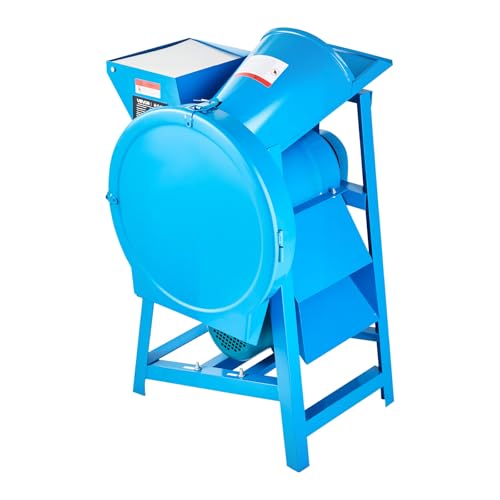
Separate feed paths are the key distinction here: the machine has one forage inlet and one dicing inlet, with maker-claimed capacities of up to 727 lb/h and 992 lb/h, respectively. A 2.2 kW motor runs on 220V, and the maximum combined processing capacity is 1,719 lb/h. The machine is also intended for vegetables, fruits, potatoes, fresh grass, corn stalks, and straw, which may suit a farm preparing more than horse forage. The 220V requirement is a limitation for barns without that supply; confirm the electrical connection and intended feed material before setup.
Bottom line: Choose this if you need distinct forage and dicing inlets and have 220V power.
Bonxrdun 110V 3 kW Hay Cutter

A 110V configuration distinguishes this cutter from the 220V machines, and its maker says the motor can also be customized for 220V or 380V. The six-blade frame uses manganese steel, while a cyclone dust collector is intended to limit airborne dust during dry-grass processing. The maker claims about 1–2 tons/h for grass cutting and kneading and 150–200 kg/h for shredding, so the chosen task affects throughput substantially. This taller, longer machine may fit a small farm or ranch with room for its 68.9-inch length, but the advertised cutting rate should not be treated as its shredding rate.
Bottom line: Pick this when 110V compatibility and a dust collector matter for your setup.
EQCOTWEA 2.2 kW Forage Grinder

Material versatility sets this grinder apart: its maker says it handles dry or wet straw, corn cobs, grains, and several vegetables, with discharge adjustment for pellets, strips, or powder. The 2.2 kW motor runs at 2,800 rpm, and the maker claims a maximum capacity of 1,100 lb/h. At 145.5 lb, it is heavier than the 70.55 lb VEVOR, a consideration if the machine must be moved between work areas. The input’s voltage is 220V, so this is not the fit for a barn limited to 110V; confirm that the feedstock and desired output form are suitable before purchasing.
Bottom line: Choose this for varied feedstocks and adjustable discharge forms with 220V available.
BEILOCKERY 4-Blade Conveyor Chopper

A chain conveyor for automatic feeding is the defining feature, unlike machines that rely on a direct manual feed opening. The 2.2 kW, 220V cutter has four blade sets and two cutting-length settings, and its maker claims output from 880 to 1,760 lb/h. At 209.4 lb, it is a substantial machine; plan a stable work area rather than frequent moving. The conveyor can reduce repetitive hand-feeding, but it does not remove the need to keep hands and clothing clear of the cutting mechanism. Choose it only if you have the required electrical supply and space to operate the conveyor safely.
Bottom line: Pick this for conveyor-assisted feeding and a choice of two cut lengths.
HayWHNKN 3 kW Conveyor Chaff Cutter

This chaff cutter pairs a conveyor with four replaceable blades, making it distinct for buyers who value automatic feeding and blade replacement. The maker says the conveyor belt tension can be adjusted with a screw and that two cutting-length settings are available. Its 3 kW motor is specified for 220V, so electrical compatibility is the first constraint to resolve. The conveyor and blades still require guarded, careful operation around moving and cutting parts.
Bottom line: Choose this if conveyor feeding and replaceable blades matter more than a throughput figure.
How to Choose a Hay Chopper for Horses
Start with the feedstock and the cut you need, then match power and feed arrangement. Dry hay, fresh grass, and chopped straw do not behave identically: dry, light forage can create more airborne dust, while wet or fibrous material can burden a cutter. A machine with separate forage and dicing inlets is useful when those are different jobs; a conveyor is relevant when repeated feeding is the bottleneck. Match motor voltage to the barn circuit before comparing output figures, and treat maker-claimed capacity as a ceiling rather than a guaranteed rate for every material.
For horse feeding, target a consistent chop suited to the ration and the horse’s feeding situation; a machine’s adjustable cut settings matter only if they produce the length your feeding plan calls for. Avoid feeding material the maker does not identify as compatible.
Power and Feed Arrangement Compared
Voltage and feeding layout narrow the choices faster than headline capacity. The table compares the major configurations so you can identify a practical match before considering throughput claims.
| Need | Relevant setup | Decision rule |
|---|---|---|
| Use a 110V circuit | 110V configuration | Choose only a model configured for that supply |
| Separate forage and dicing | Dual feed ports | Match each inlet to the task |
| Reduce manual feeding | Conveyor | Allow safe space around moving parts |
| Process multiple material types | Multi-purpose grinder | Confirm the target material and output form |
Do not infer that a 220V motor can plug into a standard household outlet; verify the circuit and installation requirements with a qualified electrician. For an extension cord, use a size and length rated for the motor load rather than a light-duty cord.
Horse Feed Prep and Cut Length
Chop length affects how forage is handled, but shorter is not automatically better for every ration. Horses need long-stem forage as part of normal chewing behavior, so chopped feed should be used as an intentional ration component rather than assumed to replace all long forage. Ask an equine nutrition professional to assess a ration change, especially for horses with dental or swallowing concerns.
Keep the output consistent and discard spoiled or moldy forage rather than processing it. Separate clean feed from bedding and soil, and process only materials the machine is intended to handle. If the chopper offers two settings or adjustable discharge, confirm the resulting cut or form on a small amount before preparing a full batch.
Safe Operation and Routine Care
Rotating blades and conveyors can cause severe injury, so disconnect power before clearing jams, adjusting belts, or replacing blades. Keep hands, loose clothing, and tools away from feed openings while the machine runs, and use eye and hearing protection around powered cutting equipment. Dust collection can reduce airborne material but does not eliminate the need to control dust or keep ignition sources away from dry forage.
Before each work session, inspect blade condition, guards, fasteners, and conveyor tracking; dull or damaged blades can impair cutting and strain the machine. Follow the model’s maintenance schedule for lubrication and blade service, and keep the work area dry and clear. Never defeat a guard or reach into an inlet to push material through.
Frequently Asked Questions
How short should hay be chopped for horses?
There is no single chop length that fits every horse or ration. Keep long-stem forage in the feeding plan unless an equine professional has advised a different form, and verify the machine’s cut setting with a small batch.
Can a hay chopper run on a household outlet?
Only if the motor voltage and circuit match the machine’s requirements. A 220V machine cannot be assumed to work on a standard 120V household circuit, and motor loads may require a dedicated circuit sized by an electrician.
Does chopping hay make it safe for every horse to eat?
No; chopped forage is not automatically appropriate for every horse. Horses with dental, swallowing, or other feeding concerns need an individualized ration plan from an equine veterinarian or nutrition professional.
How do I reduce dust when chopping dry hay?
Use dust control and ventilation, and wear eye and respiratory protection when handling dusty forage. Dry plant dust can irritate the eyes and airways, and dust collection does not make a dusty work area risk-free.
How often should chopper blades be checked?
Inspect blades before each work session and replace or service them when damaged or no longer cutting cleanly. Disconnect and isolate power before touching blades or clearing a jam.