
Hayward Sand Filter Pressure Gauge Fit and Alternatives

For a replacement gauge on a compatible Hayward sand filter, choose Hayward ECX270861 Replacement Gauge because it names specific Hayward models, including the S160T, S200 and S244T. The other options are general pool-filter gauges with 1/4-inch NPT connections, so choose one only after confirming your filter’s connection and mounting clearance.
A filter pressure gauge measures pressure in the system; comparing its reading with the clean-filter baseline helps indicate when maintenance may be due.
We earn a commission if you buy through links on this page. As an Amazon Associate I earn from qualifying purchases. Products are compared on manufacturer specifications, not hands-on testing.
- Best overall: Hayward ECX270861 Replacement Gauge – Names compatible Hayward sand filter models, including S160T, S200 and S244T.
- Best for vibration: SENCTRL Glycerin-Filled 0–60 PSI Gauge – Glycerin fill is intended to reduce pointer flutter, and the gauge has a 2.5-inch dial.
- Best for clean-filter marking: AetralYB 60 PSI Pool Filter Gauge – Has a movable indicator marked “Start” and “Clean Filter” on a 2-inch dial.
| Product | Best for | Fit or range | Dial size | Connection | Shop |
|---|---|---|---|---|---|
| Hayward ECX270861 Replacement Gauge | Hayward model fit | Select Hayward models | — | — | Check Price on Amazon |
| SENCTRL Glycerin-Filled 0–60 PSI Gauge | Vibration damping | 0–60 PSI | 2.5 in | 1/4 in NPT lower | Check Price on Amazon |
| AetralYB 60 PSI Pool Filter Gauge | Visible dial | 0–60 PSI | 2 in | 1/4 in NPT bottom | Check Price on Amazon |
| SENCTRL PRV-Tex 0–60 PSI Gauge | Clean-filter marker | 0–60 PSI | 2 in | 1/4 in NPT lower | Check Price on Amazon |
| UHARBOUR 60 PSI Pool Gauge | ASME accuracy spec | 0–60 PSI | 2 in | 1/4 in NPT bottom | Check Price on Amazon |
Hayward Sand Filter Pressure Gauges
Match the replacement to your filter model or verify the port and mount before choosing a general-purpose gauge.
Hayward ECX270861 Replacement Gauge
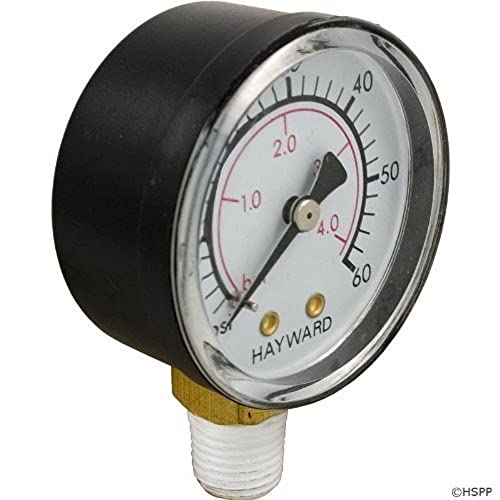
Unlike the general-purpose gauges here, this replacement names a specific set of compatible Hayward sand and D.E. filter models. Its fit list includes sand filter models EC30, EC40, S160T, S200, S240, S245T and multiple Pro Series models such as S210T and S244T. The boxed replacement suits owners matching a gauge to one of those named filters. Its limitation is model specificity: the compatibility does not cover every Hayward filter, so verify your exact model before selecting it.
Bottom line: Choose this when your Hayward filter model appears in its compatibility list.
SENCTRL Glycerin-Filled 0–60 PSI Gauge

Among the general-purpose options, this gauge has the largest dial at 2.5 inches and is glycerin-filled to inhibit pointer flutter from vibration or pulsation. Its 0–60 PSI dual scale, stainless-steel case and 1/4-inch NPT lower-mount connection suit compatible pool sand filters as well as other pressure checks. It is a partial match rather than a named Hayward replacement: buyers need to confirm the filter’s port accepts this connection and that the larger dial clears nearby equipment.
Bottom line: Choose this if a larger dial and vibration-damping fill matter.
AetralYB 60 PSI Pool Filter Gauge

The AetralYB pairs a 2-inch dial with a stated ±2% FS accuracy and an indicator line intended to help track a clean-filter reading. Its stainless-steel case, brass bottom mount and IP67 waterproof rating are aimed at pool, spa and aquarium filter settings. It is not identified as a Hayward-specific part, so compatibility depends on the port and available clearance.
Bottom line: Choose this for a compact dial with an accuracy figure.
SENCTRL PRV-Tex 0–60 PSI Gauge

The SENCTRL PRV-Tex has a rotatable baffle marked “Start” and “Clean Filter,” distinguishing it from options that only provide a dial or indicator line. Its 2-inch dial, 304 stainless-steel case, brass and stainless wetted parts, and IP67 waterproofing suit compatible pool and spa pressure checks. This is a general-purpose gauge, not a model-specific Hayward replacement. Verify that the lower-mount 1/4-inch NPT connection matches your filter, since a matching scale alone does not establish fit.
Bottom line: Choose this if you want a movable clean-filter reference marker.
UHARBOUR 60 PSI Pool Gauge

The UHARBOUR is the only option here that names ASME B40.100 compliance, and it gives an accuracy of ±2.5%. Its 2-inch dial has dual scales, a brass wetted part, and a twist-adjustable front marker for setting start and clean-filter references; the range is 60 PSI/4 bar. Pool, spa and aquarium filters are among its intended uses. It remains a general-purpose replacement, so confirm the center-bottom 1/4-inch NPT connection fits your Hayward filter before ordering.
Bottom line: Choose this if the ASME compliance and adjustable marker suit your needs.
How to Choose a Hayward Sand Filter Pressure Gauge
Start with the filter model and gauge-port connection, not the dial appearance. A model-specific replacement is the simplest route when your exact Hayward model is named; a universal gauge is viable only when its thread and mount match the filter. Several general-purpose gauges here use a 1/4-inch NPT connection, but mounting direction and dial clearance still matter. Pool filter gauges commonly use a 0–60 PSI scale, which gives room to read normal operating changes without using a narrowly scaled instrument. For maintenance, record the pressure after cleaning or backwashing; many pool owners use a rise of about 8–10 PSI above that clean baseline as a cue to clean again, subject to the filter maker’s guidance.
Gauge Fit and Connection Checks
Confirm the filter model, port thread and mount orientation before replacing a gauge. The named Hayward replacement lists compatibility with specific model families, while the alternatives specify lower or bottom 1/4-inch NPT connections; those terms describe the fitting direction, not a guarantee that every Hayward port matches. Measure the available room as well: a 2.5-inch dial needs more face clearance than a 2-inch dial, and the case or fitting may extend beyond the dial face. If your filter model or port is uncertain, verify the fit before ordering. Never force a threaded gauge into a port that resists; mismatched threads can damage the connection and lead to leaks.
Reading Filter Pressure and Cleaning Timing
A pressure reading is most useful against the same filter’s clean baseline, because pump, plumbing and filter conditions affect the displayed pressure. Record the gauge reading after cleaning or backwashing with the system running normally; many owners clean again when pressure rises roughly 8–10 PSI above that starting point. This is a common rule of thumb, not a universal threshold for every filter. A clean-filter marker can preserve the reference on the dial, while a handwritten note also works. Shut off the pump and release trapped system pressure before loosening or removing any gauge; never remove a gauge while the filter is pressurized.
Pressure Gauge Types Compared
A model-specific replacement and a universal gauge solve different fit problems. The comparison below focuses on the types and the connection information that can narrow a choice. General-purpose pool gauges commonly add features such as a marker, water-resistant case or damping fill, but those features do not establish compatibility with a particular filter. A Hayward model match is the stronger decision point when replacing an original gauge; for a universal option, matching the port and mount is essential.
| Type | What it offers | Decision rule |
|---|---|---|
| Model-specific replacement | Names compatible Hayward filter models | Use when your exact model is included |
| General-purpose 1/4-inch NPT gauge | Often offers a 0–60 PSI scale and varied dial features | Use only after confirming port and mount fit |
Frequently Asked Questions
When should I clean a sand filter based on pressure?
Many pool owners clean or backwash when pressure is about 8–10 PSI above the clean-filter baseline. Record that baseline after cleaning, since normal pressure differs with the pump and plumbing.
How do I find the clean pressure for my filter?
Run the filter under normal conditions after cleaning and note its pressure reading as the baseline. Use the same gauge and operating setup for later comparisons because pump speed and plumbing changes can shift readings.
Can any 1/4-inch gauge fit a Hayward filter?
No; matching a 1/4-inch NPT thread alone does not confirm mount orientation, clearance or compatibility with the filter port. Compare the filter model and port before choosing a general-purpose gauge.
What does a glycerin-filled pressure gauge do?
Glycerin fill can damp pointer flutter from vibration and pulsation, which may make a reading easier to follow. It does not by itself confirm that the gauge connects to a particular filter.
Is it safe to remove a pool filter gauge while running?
No; shut off the pump and release trapped pressure before removing the gauge. A pressurized filter can discharge water forcefully when a fitting is loosened.